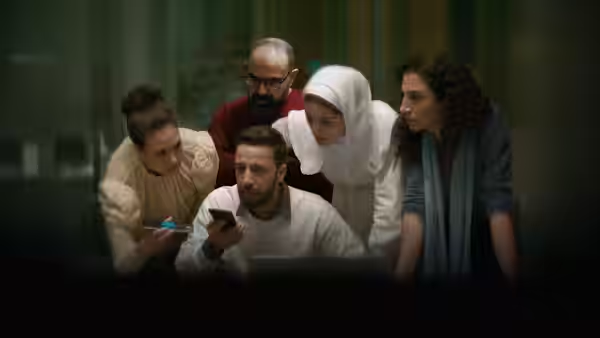
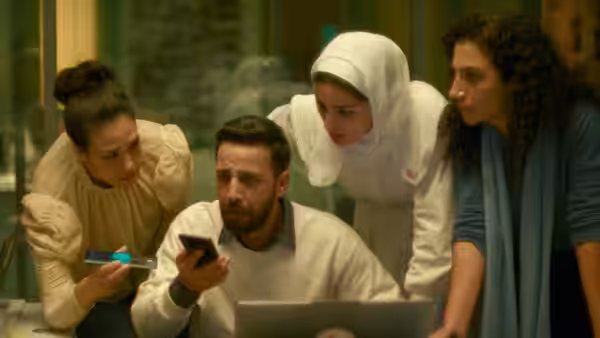
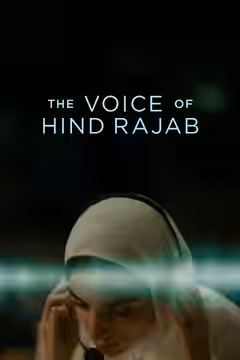
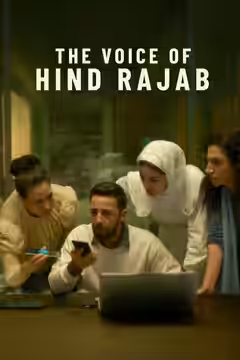
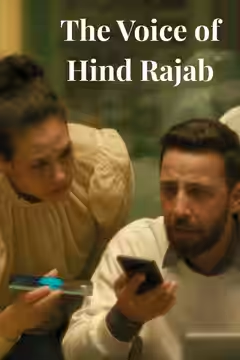
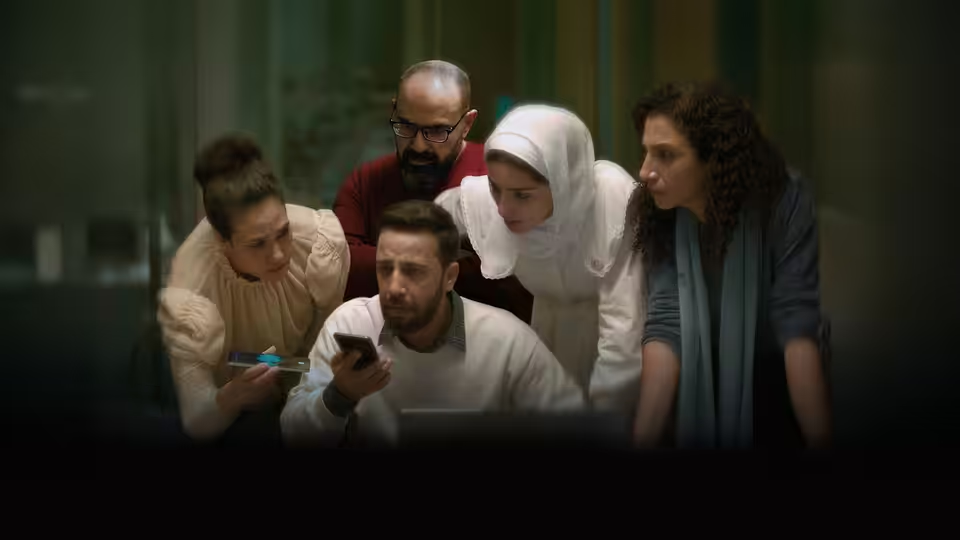
Five colleagues gather closely around a smartphone in an office
Film review

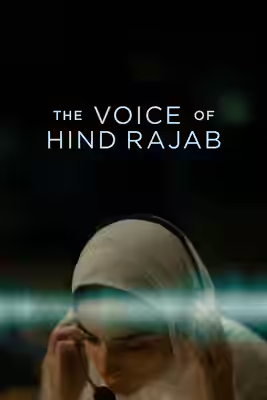
The Voice of Hind Rajab

2025 · Directed by Kaouther Ben Hania · 1h 29m · MiC 10+

In a sentenceEveryone on screen is acting except the child, who is only a voice, and she is the one we believe

Gaza. A call reaches the Red Crescent’s dispatch office: a young girl is alone and alive in a car that has been fired on. Kaouther Ben Hania’s film stays with the people who take that call. Rana (Saja Kilani) keeps the child talking. Omar (Motaz Malhees) wants an ambulance sent now. Mahdi (Amer Hlehel), who runs the office, has to get clearance for one to move, and Nisreen (Clara Khoury) tries to hold the others together. The girl on the line is not played by an actor. Her voice is the real recording of Hind Rajab, and the scenes are built around it. The film runs 89 minutes and carries a 15 certificate.

Plays from YouTube when you press play; nothing loads from them until then.

Fi1m review

The real voice of a child trapped in a car in Gaza runs through Kaouther Ben Hania’s drama. See it, though its first half hour is as hard to watch as anything we have seen, and the actors are less sure than she is.

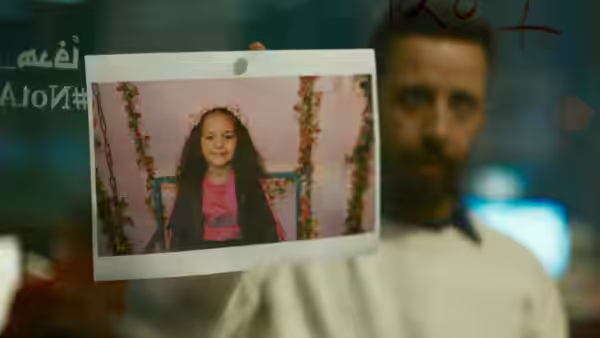
A Red Crescent dispatch office in Gaza took a call from a car. A young girl called Hind Rajab was alive inside it. The operators kept her on the line while they tried to get an ambulance to her, and the calls were recorded. Kaouther Ben Hania’s film plays those recordings into a reconstruction of that office, with actors as the people who spoke to her. The girl’s voice is real. The office is a set.

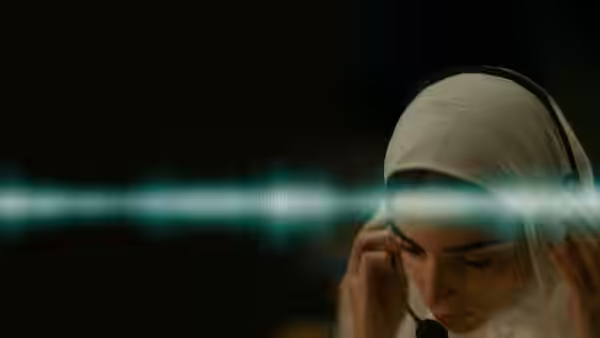
The first half hour is the film. Phones ring, operators pick up, and a small voice asks whether anyone is coming. Rana (Saja Kilani) is given the job of keeping her talking, and Kilani plays it as work: keep your own voice level, ask about the car, ask about school, do not let the silence grow. We were horrified, and nothing on screen did it. It was the sound of the child breathing between sentences while grown adults looked at a map and waited. Juan Sarmiento G. keeps the camera inside the office, close on faces and handsets, and never cuts to Gaza. The car is only a voice and a point on a screen.

Around Rana the film builds a small argument about what can be done. Omar (Motaz Malhees) wants the ambulance sent whatever the risk. Mahdi (Amer Hlehel), the man in charge, has to secure clearance for it to travel through a war zone and spends most of the film on hold. Nisreen (Clara Khoury) looks after the colleagues who are coming apart. Bessem Marzouk’s production design gives them an ordinary open-plan office of desks and screens, and the ordinariness is the point: this is a workplace, and the work today is a dying child. Malhees is the strongest of the four because he is allowed to be angry and Ben Hania lets the anger stand without comment.

What does not work is the thriller. Ben Hania, editing with Maxime Mathis and Qutaiba Barhamji, cuts the middle stretch like a countdown, with raised voices and Amine Bouhafa’s strings coming in under the confrontations. The recording does not need any of it. Every time the music rose under the actors we felt the film reaching for something the telephone had already given us, and there is at least one shouting match across the office that plays like a hospital serial. Most critics have forgiven this. We nearly do. The alternative, 89 minutes of a child’s voice over an empty office, would be unwatchable, and Ben Hania has to give us somewhere to put our eyes.

There is also the question of whether the voice should be in a drama at all. A dead child is the soundtrack to scenes in which actors weep, and several critics have asked where witness ends and spectacle begins. We think the charge is fair and that the film survives it. Ben Hania hides nothing about what she is doing; the tagline says the voices on the phone are real, and the last minutes leave the fiction behind in a way we will not describe. She wants this recording heard by people who would otherwise never hear it. That is a defensible reason.

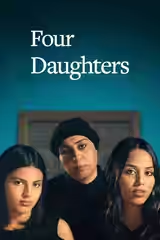
Ben Hania has worked this ground before. Four Daughters (2023) put real women alongside actors playing their missing relatives, and Beauty and the Dogs (2017) followed a young woman through one night of being passed from desk to desk. This is her plainest film and her most confined, and she is better at the confinement than at the drama. The shots that hold on Kilani’s face while the line goes quiet are worth more than any scene in which the script tells us what everyone feels.

It is a 15 certificate and 89 minutes long, and it feels longer, which for once is a compliment. Watch it without a phone in reach. You will not want to hear one ring for a while.

Critical consensus AI synthesised

83
Positive
10
Mixed
1
Negative
0
Time Out
15 December 2025 · ★★★★★ · Whelan Barzey
100

This is a stunning, heartbreaking document of the Palestinian plight and an act of intervention. It singles out the daring use of the real distress-call recordings as the spine of the film, expanded with authentic performances from the Palestinian cast.

Read the full review →
Empire
16 January 2026 · John Nugent
95*

The film is a devastatingly real docudrama blending actual audio with dramatisation of the Red Crescent's failed rescue attempt. It singles out the minimalist focus on the call centre operators and the real voice of Hind as making it one of the most powerful films possible.

Read the full review →
Radio Times
★★★★ · James Mottram
80

This is a harrowing and often difficult-to-watch true-life docudrama that pulls together an urgent anti-war work. It singles out Ben Hania's sensitive handling of the real audio and the material right to the end, even when showing footage of the actual car.

Read the full review →
The New York Times
17 December 2025 · Ben Kenigsberg
80*

The film is both powerfully direct and purposefully removed in its dramatization of the rescue efforts for the trapped girl. It evokes the events through the call center workers' frantic coordination without visualizing the horror from the child's perspective.

Read the full review →
Los Angeles Times
18 December 2025 · Robert Abele
75*

The docudrama is a powerfully blunt instrument of empathy that prioritizes the sound of an innocent victim amid roiling pain. It fuses docudrama tools with the real audio recording but sometimes favors close-up melodramatics over deeper analysis.

Read the full review →
Variety
3 September 2025 · festival review · Guy Lodge
60*

The hybrid film is unavoidably devastating due to the real audio but risks trivializing its documentary core with melodramatic and thriller elements. It confronts audiences with the girl's voice in a single-location dramatization of the call center but raises questions about ethics and execution.

Read the full review →

Straight answers AI written, from our review

Is The Voice of Hind Rajab worth watching?
The Voice of Hind Rajab is worth watching, and we scored it 81. Kaouther Ben Hania plays the real recorded calls of a child trapped in a car in Gaza into a reconstructed Red Crescent dispatch office, and the first half hour is as hard to sit through as anything we have seen. The actors and the thriller cutting around the recording are less sure than the voice itself.
How long is The Voice of Hind Rajab, and what is it rated?
The Voice of Hind Rajab runs 1h 29m and is rated 10+ by the MiC in Italy. It is a drama and history film.
Where can I watch The Voice of Hind Rajab in Italy?
The Voice of Hind Rajab is available to buy from Amazon Prime Video from €13.99. Availability is checked daily; the links above go straight to each service.
How violent or frightening is The Voice of Hind Rajab, and is it suitable for children?
The Voice of Hind Rajab carries a UK 15 certificate and is not suitable for children. There is almost no violence on screen; the camera never leaves the office, and the horror is entirely in the sound of a real child breathing between sentences while adults wait on a map. It is distressing rather than frightening, and the squeamish should know the girl is not an actor.
How does The Voice of Hind Rajab compare to Locke?
The Voice of Hind Rajab and Locke both confine themselves to people holding a crisis together by telephone, but the resemblance ends there. Locke is a fiction with Tom Hardy alone in a car, tense and occasionally too neatly arranged; Ben Hania's film is built around a real recording, and the real voice matters more than any performance. Locke is the better-made drama, and this is the one that stays with you.
What should I watch after The Voice of Hind Rajab?
After The Voice of Hind Rajab, try Locke (2013, Fi1m 82): Tom Hardy alone in a car on the motorway, holding his life together by phone. Then United 93 (2006, Fi1m 88): Real events rebuilt in near real time, mostly from control rooms full of people who cannot help.

Cast

Awards

Academy Awards, 2026

Nominated
Best International Feature Film

Grand Jury Prize of the Venice Film Festival, 2025

Won
Grand Jury Prize of the Venice Film Festival

If you liked this, try…

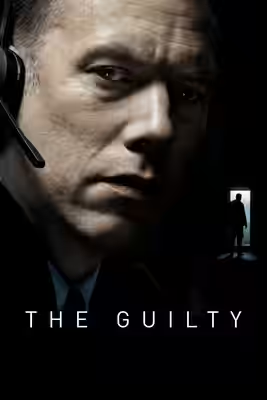
  1. The Guilty (2018) · not reviewed yetA Danish emergency dispatcher, one room, one night, and a caller he cannot reach.

  2. Locke (2013, Fi1m 82)Tom Hardy alone in a car on the motorway, holding his life together by phone.

  3. United 93 (2006, Fi1m 88)Real events rebuilt in near real time, mostly from control rooms full of people who cannot help.

  4. 5 Broken Cameras (2011) · not reviewed yetA Palestinian farmer films his village over five years; each camera is destroyed in turn.

  5. Four Daughters (2023) · not reviewed yetBen Hania’s earlier mix of real women and actors, looser and stranger than this one.

Free account

Know what to watch tonight

Two lists that know where things are streaming, collections you can share, your own score beside ours, and Discover that remembers what you have seen.

  • Want to see, sorted by what is streaming now
  • Seen, with your score out of ten
  • No adverts, ever