Balram (Adarsh Gourav) sits cross-legged on a bench in a neon-lit market
Film review

The White Tiger

2021 · Directed by Ramin Bahrani · 2h 05m

In a sentenceThe rich would like some gratitude for being so approachable

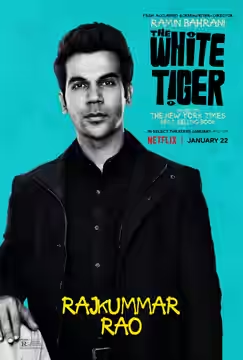
In contemporary India, Balram Halwai (Adarsh Gourav) wants to escape poverty and the obedience expected of him. His story draws in Ashok (Rajkummar Rao) and Pinky Madam (Priyanka Chopra Jonas), with wealthy employers offering kindness that does not make their servant an equal. Caste, money and the habits of servitude limit his choices. Obedience has become difficult to question, even when it works against him. As Balram tries to improve his position, he must reckon with people who consider the difference between their lives and his entirely reasonable.

Plays from YouTube when you press play; nothing loads from them until then.

Fi1m review

Ramin Bahrani’s class satire is sharp, darkly funny and carried by Adarsh Gourav’s absorbing performance. The middle takes too long to make its points, but the humiliations of service give its anger weight.

Ramin Bahrani’s The White Tiger, adapted from Aravind Adiga’s novel, is a good, bitterly funny account of ambition that pays close attention to the effort of obeying other people. Balram Halwai wants to escape poverty, and the film understands how much obedience can survive in someone determined to get away. Its anger grows from differences in power that the people benefiting from them scarcely notice. The telling is less disciplined, with a crowded middle and narration that sometimes does the actors’ work for them.

Adarsh Gourav is the reason to stay with it. As Balram Halwai, he makes eagerness, resentment and calculation seem possible at the same moment, without asking us to decide which is the real man. We winced at the employers’ condescending kindness. His performance makes receiving it seem like hard work, because gratitude has to be convincing to the person who expects it. That effort makes the film’s account of servitude uncomfortable to watch.

Rajkummar Rao’s Ashok and Priyanka Chopra Jonas’s Pinky Madam are important to that discomfort. Their performances allow the privileged people around Balram to believe in their own decency, which is more convincing than having everyone announce their wickedness. The film notices how easily concern for a servant can coexist with an assumption that he will remain a servant. This gives the lead something difficult to respond to, and the supporting performances leave space for his uncertainty.

Paolo Carnera’s cinematography supplies some of the restlessness that the narration labours to describe. The sharp framing keeps differences in status legible, while the increasingly grim treatment stops ambition from looking comfortably heroic. Chad Keith’s production design contributes to that clarity: the unequal circumstances register without needing a speech to explain them. The images are persuasive enough that the script’s insistence on explaining their significance becomes a recurring irritation.

Tim Streeto and Ramin Bahrani’s editing gives the earlier stretches an encouraging briskness, carrying a considerable amount of explanation without immediately making it feel burdensome. The music by Saunder Jurriaans and Danny Bensi helps sustain that unease. The rap-heavy soundtrack also gives the pursuit of wealth a useful swagger, making its attraction easier to understand. These choices keep the film lively even when the writing begins to repeat itself, although they cannot entirely disguise the middle’s loss of momentum.

The narration is the main difficulty. Its wit belongs to the film, and losing it altogether would take away some of the pleasure of spending time with this particular storyteller. But it too often tells us how to understand behaviour that the performances have already made clear. Once the psychological demands of service are established, further explanation adds length without much discovery. Across 125 minutes, that repetition matters, especially when the crowded storytelling makes the central struggle harder to follow than it needs to be.

As a crime drama about getting ahead, the film is unusually interested in the obedience that ambition must overcome. It does not require us to find its central character admirable before taking his predicament seriously. That willingness keeps the satire uncomfortable even when the storytelling becomes cumbersome. Give it an evening for Adarsh Gourav, with some patience for explanations his performance does not need.


Critical consensus AI synthesised

73
Positive
16
Mixed
5
Negative
0

Most critics find The White Tiger an absorbing, angry satire of class and inequality, with 16 positive reviews and five mixed responses. Praise centres on Adarsh Gourav, whose performance gives Balram charm, calculation and moral complexity without making him easy to like. The reviews also value the film’s depiction of enforced obedience and the psychological hold of servitude. Cinematography, music and the energy of the storytelling draw praise, though agreement on the pace is less secure.

Reservations cluster around a meandering middle, explanatory narration and closing passages that some find rushed or less forceful. The spread runs from enthusiastic approval to disappointment, with no wholly negative verdicts. The AV Club finds the adaptation too dutiful and emotionally distant, despite its sharp observations of condescending employers. Paste is the least persuaded, finding both satire and drama muddled, while still crediting the camerawork and the soundtrack’s expression of Balram’s ambition.

The i Paper
21 January 2021 · Francesca Steele
90*

The critic finds the adaptation vibrant, propulsive and morally complex, praising its sharp examination of inequality and corrupt politics. Adarsh Gourav’s kinetic, darkly comic performance is singled out as the film’s standout.

Read the full review →
Evening Standard
20 January 2021 · ★★★★ · Charlotte O'Sullivan
80

O’Sullivan finds the film angry, smart and dark, and says Bahrani is back on form. She praises Gourav’s nuanced lead performance and the poetic cinematography, though the middle section is overly knotty.

Read the full review →
Radio Times
★★★★ · Stephen Applebaum
80

The critic finds the film an incendiary, provocative satire that burns with anger. They praise Adarsh Gourav’s intriguing, multifaceted performance at the center of its rags-to-riches story.

Read the full review →
Time Out
20 January 2021 · ★★★★ · Dave Calhoun
80

The review presents the film as an energetic portrait of modern India that stands apart from ‘Slumdog’ comparisons. It praises the film’s rich, vivid tapestry of contemporary India.

Read the full review →
Vulture
22 January 2021 · Bilge Ebiri
80*

Ebiri finds the adaptation increasingly powerful, with a style that shifts from energetic to grim as Balram’s story darkens. He especially praises Adarsh Gourav’s performance, which makes Balram both cherubic and deadly.

Read the full review →
Empire
18 January 2021 · Hanna Flint
78*

Flint finds the film a timely, kinetic and textured satire of caste and inequality, anchored by an immensely watchable lead performance. She particularly praises its sharp framing, music and pace for bringing its world vividly to life.

Read the full review →

Straight answers AI written, from our review

Is The White Tiger worth watching?
The White Tiger is worth watching for its bitter class satire and Adarsh Gourav’s absorbing performance; we score it 78 out of 100. We wince at the employers’ condescending kindness, which makes the humiliations of service painfully clear, though the crowded middle and over-explanatory narration require patience.
How long is The White Tiger, and what is it rated?
The White Tiger runs 2h 05m. It is a drama and crime film.
Where can I watch The White Tiger in the Philippines?
The White Tiger is streaming on Netflix in the Philippines. Availability is checked daily; the links above go straight to each service.
How violent or frightening is The White Tiger, and is it suitable for children?
The White Tiger has a UK 15 certificate, so it is not suitable for children under 15. We find its treatment of servitude and condescending employers uncomfortable, with an increasingly grim tone; the certificate warrants caution for younger viewers, but does not by itself establish how graphic or frequent any violence is.
How does The White Tiger compare to Parasite?
The White Tiger shares Parasite’s discomfort with politeness between employers and servants, but we recommend Parasite more strongly for its gripping plotting. Gourav’s performance gives The White Tiger a compelling focus on the effort of obedience, though its narration explains too much; choose it for character-led satire rather than thriller momentum.
Is The White Tiger based on a true story or a book?
The White Tiger is adapted from Aravind Adiga’s novel, rather than presented as a true story. No prior knowledge of the book is needed: the film makes Balram’s struggle with poverty, caste and obedience clear, and we find that its narration sometimes explains more than the performances need.
What should I watch after The White Tiger?
After The White Tiger, try Parasite (2019, Fi1m 91): Another class satire that makes politeness between employers and servants deeply uncomfortable. Then The Servant (1963, Fi1m 89): A closer, nastier study of dependence inside a wealthy household; and Sorry to Bother You (2018, Fi1m 81): For a more unruly attack on work, ambition and selling yourself.

Cast

If you liked this, try…

  1. Parasite (2019, Fi1m 91)Another class satire that makes politeness between employers and servants deeply uncomfortable.

  2. The Servant (1963, Fi1m 89)A closer, nastier study of dependence inside a wealthy household.

  3. Sorry to Bother You (2018, Fi1m 81)For a more unruly attack on work, ambition and selling yourself.

  4. La Cérémonie (1995) · not reviewed yetDomestic service and class resentment, observed with patience and little reassurance.

  5. Bicycle Thieves (1948, Fi1m 93)A plainer account of poverty narrowing the choices available to a working man.