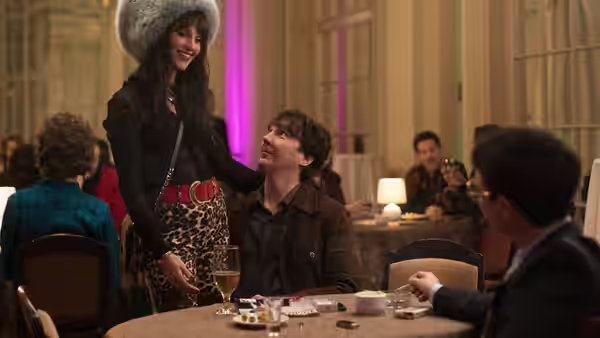
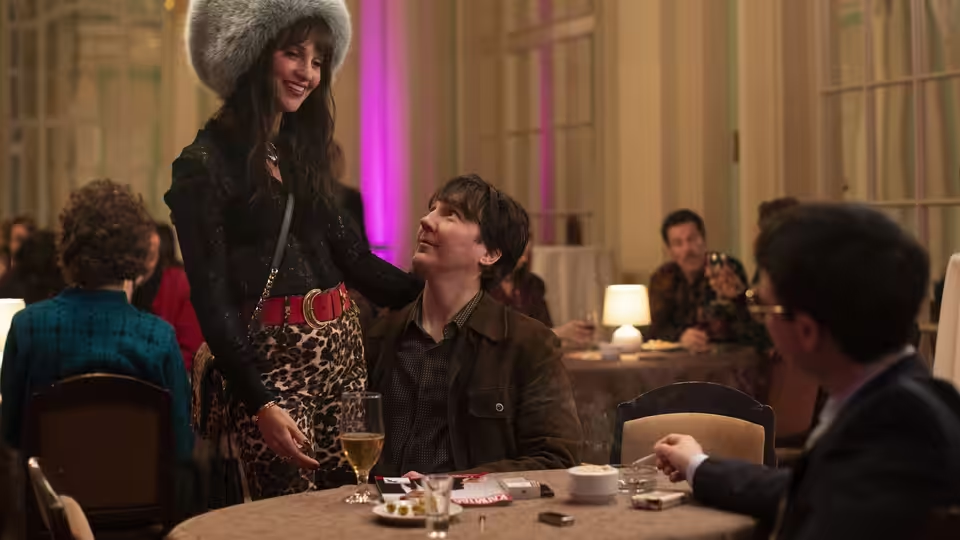
A woman in a fur hat stands beside a seated man at a restaurant table
Film review

The Wizard of the Kremlin

2026 · Directed by Olivier Assayas · 2h 16m

In a sentenceJude Law says almost nothing and wins the film; Paul Dano says everything and loses it

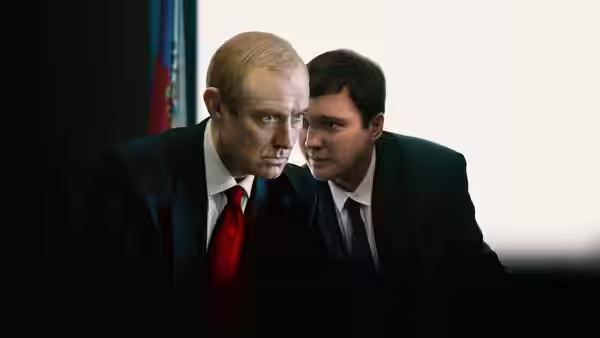
Moscow, in the years after the Soviet Union. Vadim Baranov (Paul Dano), a television producer with a taste for staging things, tells his story to Rowland (Jeffrey Wright), an American writer who has come to his country house to hear it. In the 1990s the oligarch Boris Berezovsky (Will Keen) hires Baranov to shape what Russians see on their screens, and as Boris Yeltsin (George Sogis) fails, Berezovsky and his circle go looking for a successor they can control. Baranov is sent to size up a quiet official from the security services, Vladimir Putin (Jude Law). Ksenia (Alicia Vikander), the woman he loves, is less sure the job is worth what it will cost. Baranov takes it anyway, and starts writing the show.

Plays from YouTube when you press play; nothing loads from them until then.

Fi1m review

Olivier Assayas turns Giuliano da Empoli’s novel into a 136-minute lecture on how Russia was managed, with Jude Law’s Putin the one thing in it that does not need explaining. Fascinating in patches, inert for long stretches, and never as sharp as its subject.

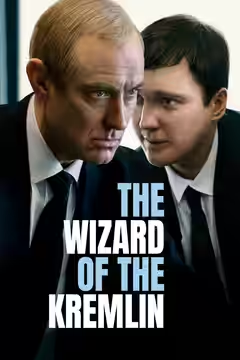
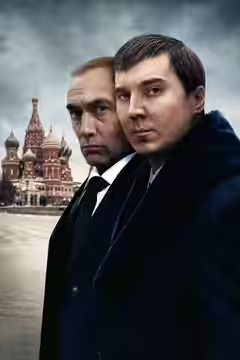
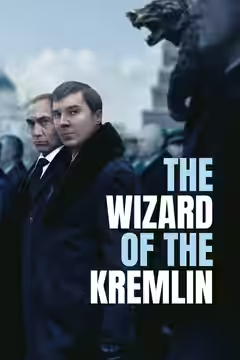
Vadim Baranov (Paul Dano) is the man who ran the show, and The Wizard of the Kremlin is his account of it. Olivier Assayas and Emmanuel Carrère have adapted Giuliano da Empoli’s novel into a film built almost entirely from Baranov’s voice: he sits in his country house, pours a drink for a visiting American writer, Rowland (Jeffrey Wright), and talks for 136 minutes about how he took a grey official from the security services and made him president. The idea underneath is a good one. Russian politics after Yeltsin was produced like television, and Baranov was the producer. The film says this in its first quarter of an hour and then keeps saying it, with dates.

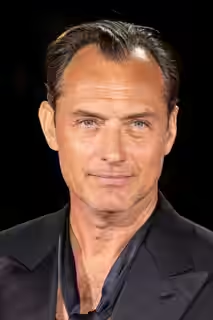
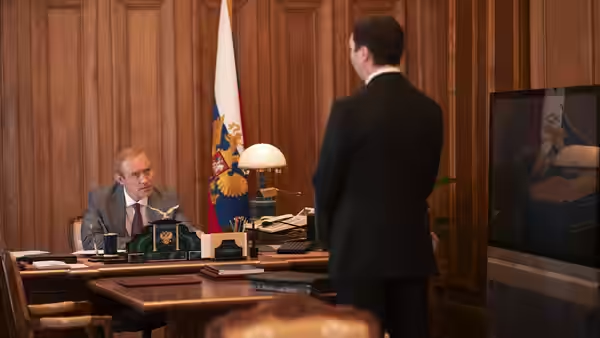
Jude Law is the reason to go. His Putin does not do the walk or the voice; he does the not-listening. When Baranov is brought in to meet him for the first time, in a plain office with nothing on the desk, Law does not look up for what feels like half a minute, and when he does he has already decided that the man in front of him is a tool. We felt the office go cold, and we felt it again every time he came back. It is a performance built on stillness and a small, contemptuous patience, and it is the one thing in the film that does not need a voiceover to explain it.

Dano is the harder case. He plays Baranov with a soft, level murmur and a smile that sits slightly to one side of his face, and for twenty minutes it is an interesting choice: a clever man who has trained himself never to raise his voice. By the end it is the only note he has, and because he narrates nearly everything, the whole film speaks in it. Rowland is there to listen and nod, and Wright, who can do a great deal with an eyebrow, is asked to do almost nothing else. Nobody in the house ever says to Baranov: that is not how it happened. So the film takes his word for it, and his word is kind to him.

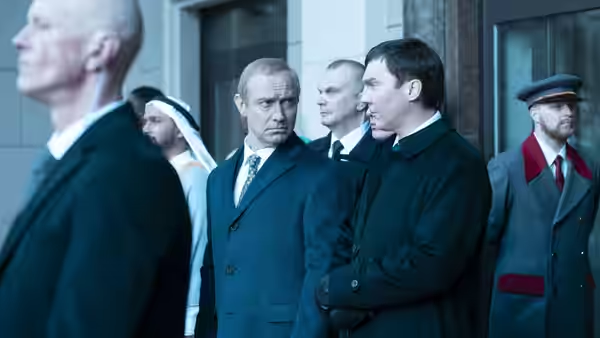
The craft is careful and rarely a pleasure. Yorick Le Saux shoots Moscow in flat grey daylight and the interiors in brown lamplight, which suits a story about men in rooms and becomes wearing across two and a quarter hours. François-Renaud Labarthe gives those rooms real weight, a Kremlin of marble and long carpets, Berezovsky’s private club, Baranov’s dacha with its books and its silence, and Jürgen Doering puts Law in suits a size too correct. Marion Monnier cuts archive news footage between the scenes, and it is the archive that carries the sense of a country coming apart. The drama around it moves from one dated episode to the next, each ending as the last did, with Baranov explaining what we have just watched.

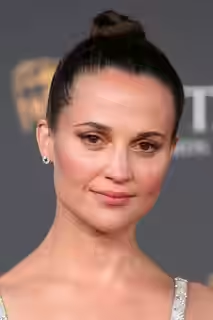
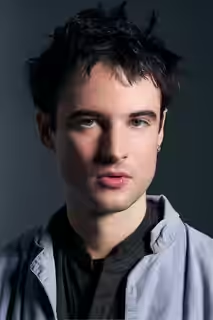
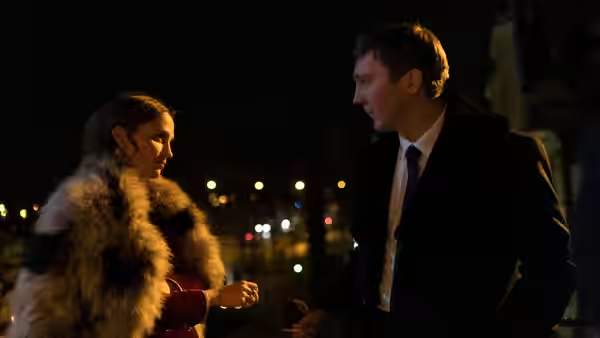
Will Keen is the best of the rest. His Berezovsky is all appetite and quick temper, a man who thinks he has bought the future and cannot understand why it will not stay bought, and his scenes with Baranov have a nasty comedy the film could have used more of. Alicia Vikander’s Ksenia is Baranov’s lover and then the measure of what he has given up, which is a thankless job, and she does it with grace. Tom Sturridge’s Dmitri Sidorov gets a few scenes of expensive unhappiness. Yevgeny Prigozhin (Andris Keišs), the biker Alexander Zaldostanov (Kaspars Kambala) and the writer Eduard Limonov (Magne-Håvard Brekke) come through like exhibits in a museum of the period, each labelled and then wheeled off. Everybody speaks English in whatever accent they arrived with, and the film has decided not to mind, which we found easier to accept than some critics have.

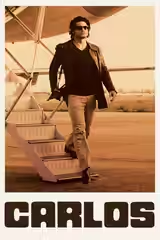
Assayas has done this kind of thing before and better. Carlos, from 2010, followed a man across two decades and several countries and never once stopped to explain him, because he was always doing something. Baranov is always describing something. That is the difference between a film that moves and a film that briefs, and this one briefs. We were interested for an hour, then we noticed we were waiting for Law to come back, then we noticed how long the waits were.

The second half covers events the news has already covered, and adds less to them than you would hope. See it for Law and Keen, and if you can, see it at home in two sittings, where the lecture is easier to follow and the gaps between the good scenes easier to fill.
Critical consensus AI synthesised

49
Positive
6
Mixed
6
Negative
11

Most critics come away from The Wizard of the Kremlin admiring one thing: Jude Law’s Putin. Review after review calls it chilling, steely or commanding, and several note that Law avoids impersonation, building the man from dismissiveness and stillness. Beyond that, the reviews lean negative. Nearly half find the film a failure, and even the warmer notices call it dense and uneven, praising its grasp of how a propaganda state manufactures confusion more than its drama.

The complaints cluster on structure and script: an episodic, overlong chronicle that lectures rather than dramatises, with a droning voiceover often blamed. Paul Dano’s Baranov splits the critics; Deadline and The Wrap think his quiet performance holds the film together, while The Guardian and The Observer find it mannered and one-note. The spread is wide. Vulture calls the film great and enormously entertaining; The New Yorker finds it politically passive and faults it for taking its narrator’s account at face value.

Vulture
3 September 2025 · festival review · Bilge Ebiri
95*

Ebiri calls the film great, finding its sweep through Russian history both revealing and enormously entertaining. He particularly praises Jude Law’s chilling portrayal of Putin through a riveting dismissiveness rather than an imitation of his mannerisms.

Read the full review →
Radio Times
17 April 2026 · James Mottram
70*

The headline presents the film as a fascinating portrait. It singles out Jude Law’s portrayal of Vladimir Putin.

Read the full review →
Screen Daily
31 August 2025 · festival review · Jonathan Romney
70*

The headline indicates a positive verdict, singling out Jude Law’s performance as Vladimir Putin. The film is described as a dense Venice competition title.

Read the full review →
Sight and Sound
16 April 2026 · festival review · BFI
70*

The critic finds the film flawed but essential viewing for understanding the workings of a totalitarian propaganda state. They praise its grasp of those mechanisms, while faulting the English accents and unevenly explanatory screenplay.

Read the full review →
RogerEbert.com
64*

The page is blocked by a browser check, so the critic’s verdict cannot be determined. No praise or complaint can be verified from the available page.

Read the full review →
IndieWire
31 August 2025 · C+ · Ryan Lattanzio
63

The critic finds the political drama subdued and respectable but too low-key to convey its intended urgency. Archival footage effectively evokes the turmoil beyond the Kremlin, though the film could use more venom and dramatic intensity.

Read the full review →

Straight answers AI written, from our review

Is The Wizard of the Kremlin worth watching?
The Wizard of the Kremlin is worth watching only for Jude Law's Putin and Will Keen's Berezovsky, and we scored it 50. Olivier Assayas turns Giuliano da Empoli's novel into 136 minutes of Paul Dano explaining Russian politics to a visiting writer, and the explaining wears thin after an hour. Watch it at home in two sittings if you watch it at all.
How long is The Wizard of the Kremlin, and what is it rated?
The Wizard of the Kremlin runs 2h 16m. It is a drama film.
Where can I watch The Wizard of the Kremlin in Japan?
The Wizard of the Kremlin is not on any streaming or rental service in Japan at the moment. It is available in 24 other countries; change your country at the top of the page to see where. Availability is checked daily.
How violent or frightening is The Wizard of the Kremlin, and is it suitable for children?
The Wizard of the Kremlin carries a UK 15 certificate and a US R, and it is not for children. It is a talky political drama about men in rooms rather than a violent one, so the squeamish have little to fear; what earns the certificate is adult subject matter and language rather than anything frightening on screen. Younger teenagers will simply be bored by it.
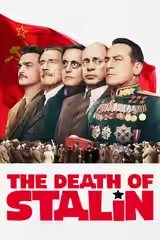
How does The Wizard of the Kremlin compare to The Death of Stalin?
The Wizard of the Kremlin is the sober, plodding cousin of The Death of Stalin, and the Iannucci film is the better of the two. Both are about the Kremlin choosing a leader, but Iannucci plays it as farce with real menace underneath, while Assayas plays it as a lecture and keeps reaching for a venom he never finds. Choose Iannucci unless you want two hours of Jude Law's stillness.
Is The Wizard of the Kremlin based on a true story or a book?
The Wizard of the Kremlin is based on Giuliano da Empoli's novel of the same name, adapted by Olivier Assayas and Emmanuel Carrère, which itself fictionalises real Russian politics after Yeltsin. Putin, Berezovsky and Prigozhin appear under their own names, but Paul Dano's Vadim Baranov is the novel's invention, and the film takes his self-serving account at face value. You do not need to have read the book.
What should I watch after The Wizard of the Kremlin?
After The Wizard of the Kremlin, try The Death of Stalin (2017, Fi1m 83): The Kremlin as farce, with the venom this film keeps reaching for and missing. Then Z (1969, Fi1m 84): Costa-Gavras shows how to make a state’s stage management move like a thriller.

Cast

If you liked this, try…

  1. Carlos (2010) · not on Fi1m yetAssayas doing the decades-spanning political life properly, with a man who never sits still.

  2. Leviathan (2014) · not on Fi1m yetZvyagintsev on what the machine Baranov built does to one man in a small town.

  3. The Death of Stalin (2017, Fi1m 83)The Kremlin as farce, with the venom this film keeps reaching for and missing.

  4. Citizen K (2019) · not on Fi1m yetAlex Gibney’s documentary on Khodorkovsky, the oligarch who lost the game Berezovsky started.

  5. Z (1969, Fi1m 84)Costa-Gavras shows how to make a state’s stage management move like a thriller.