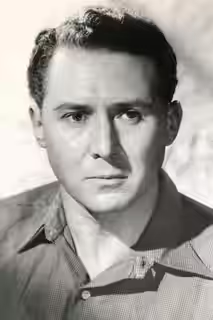
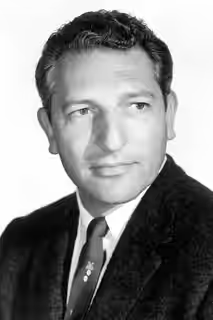
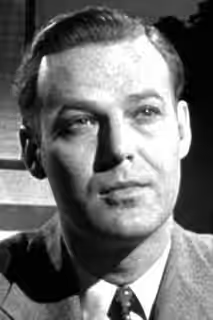
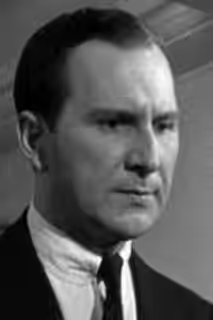
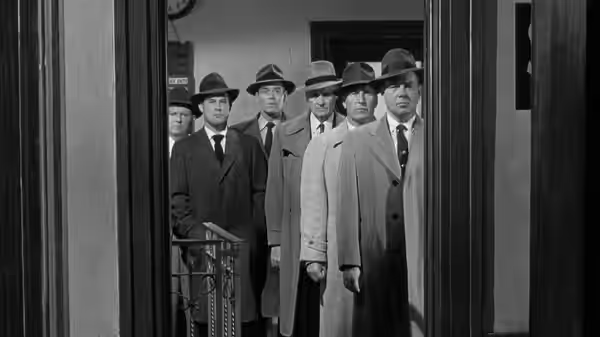
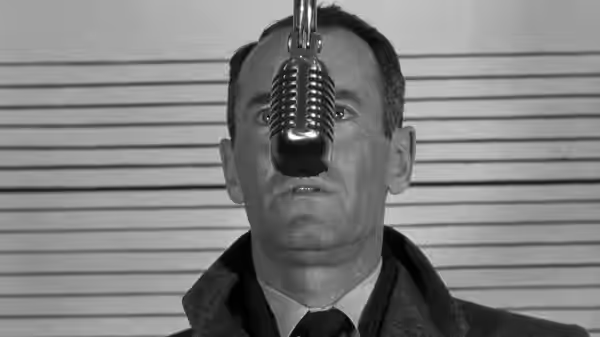
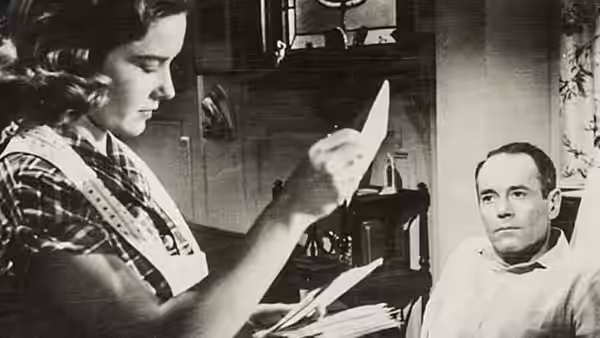
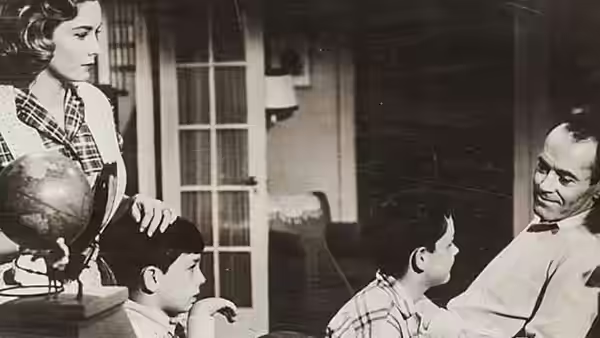
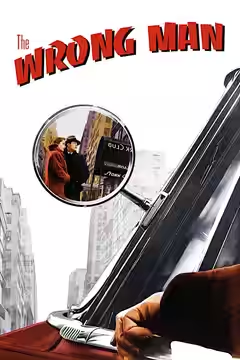
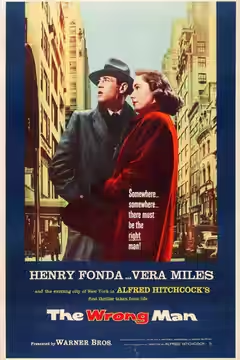
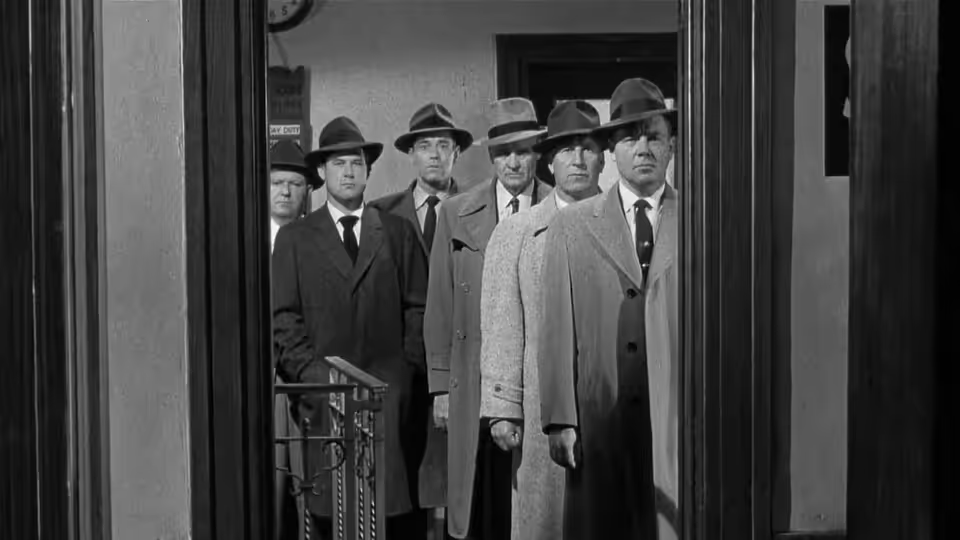
Five men in hats and suits stand in a row behind a partition
Film review

The Wrong Man

1956 · Directed by Alfred Hitchcock · 1h 45m

In a sentenceIf Henry Fonda cannot get the benefit of the doubt, the rest of us should worry

In New York, family man Manny Balestrero (Henry Fonda) is wrongly identified as a robber. He wants the mistake corrected, but being innocent does not make him any less helpless once he is treated as the accused. His predicament puts family life under pressure, with Rose Balestrero (Vera Miles) and Frank D. O’Connor (Anthony Quayle) among the people caught up in his ordeal. Based on a true story, the film follows events from Manny’s side: the bewilderment of being taken for someone else, the difficulty of making himself believed and the fear that innocence may not be enough.

Plays from YouTube when you press play; nothing loads from them until then.

Fi1m review

Alfred Hitchcock makes mistaken identity frightening by staying close to the man who cannot correct it. Henry Fonda gives this severe, humane thriller its force, though the unrelenting helplessness can make it a punishing watch.

The Wrong Man is a fine thriller that offers remarkably little pleasure in being right. Alfred Hitchcock takes a true story of mistaken identity and refuses to make innocence feel reassuring. Manny Balestrero, played by Henry Fonda, is a family man wrongly identified as a robber; knowing he is innocent gives us no comfortable advantage. Hitchcock wants us to understand how little that knowledge helps the person accused, and he succeeds almost too well.

Fonda’s casting is crucial because he makes Manny’s innocence seem ordinary, something the man himself has never needed to consider. We found the mistaken identification frightening because his bewilderment is so persuasive: he cannot understand how other people can be certain of something he knows is wrong. The performance does not ask us to admire a heroic victim. Fonda makes us worry about a person who seems poorly equipped for the attention he is getting.

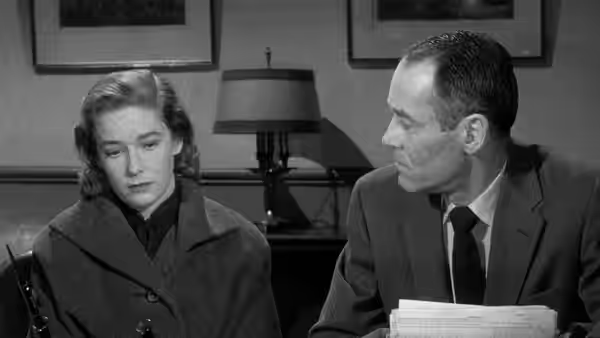
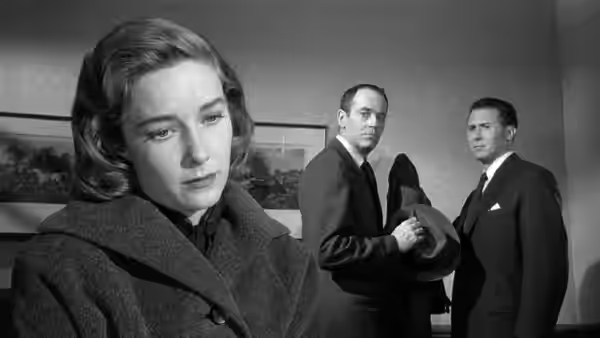
The concern for family life makes the experience harder to shrug off. Vera Miles plays Rose Balestrero, and her contribution gives the psychological cost a seriousness that a more narrowly procedural film might have avoided. The suffering around Manny matters in its own right, rather than merely adding to the list of things he must endure. Hitchcock allows that suffering to trouble our expectations of what putting a mistake right could accomplish.

Robert Burks’s photography gives the New York locations a useful ordinariness. The city feels insufficiently interested in Manny’s trouble, which makes it more disturbing than an obviously threatening backdrop would be. We can believe that other lives are continuing nearby, untouched by what has happened to him. The locations support the true-story approach without making the film feel like an illustrated account of a case.

George Tomasini’s editing serves the decision to stay close to the helpless accused. The suspense depends on sharing Manny’s uncertainty, and the cutting makes that restricted perspective uncomfortable without rendering it confusing. Bernard Herrmann’s music contributes to the pressure, although Fonda’s performance is what makes the anxiety difficult to put aside. These contributions work together particularly well because they keep our attention on what the ordeal feels like to the person undergoing it.

The reservation is the persistence of that pressure. Maxwell Anderson and Angus MacPhail’s screenplay gives the ordeal moral seriousness, but its concentration on helplessness can become wearing. We wanted more variation in the emotional demands being made on us. That is not a request for jokes or reassurance; a little more breathing space would make the changes in intensity easier to feel. The severity occasionally makes the film seem more uniform than its performances are.

Within the crime thriller, being wrongly accused can provide the excuse for an entertaining adventure. Hitchcock takes the accusation seriously enough to make that expectation seem uncomfortable here. We recommend it for Fonda, for its concern with the damage done to ordinary people, and for suspense that does not require us to doubt the accused. Choose it when being thoroughly unsettled sounds like a worthwhile use of an evening.
Critical consensus AI synthesised

78
Positive
4
Mixed
2
Negative
0

The available reviews lean positive on The Wrong Man, with praise centred on Hitchcock’s suspense and the psychological cost of mistaken identity. Critics respond to the frightening realism of the accused man’s ordeal and the attention paid to his helplessness. Slant Magazine singles out Fonda’s casting and the film’s moral responsibility, while The New Yorker finds its true-story basis and New York locations especially revealing of Hitchcock’s artistry.

The clearest reservation comes from Empire, which notes the controversial ending but still considers the film undeservedly overlooked. The recorded scores range from mixed to strongly enthusiastic, with none negative, though that spread needs a qualification: two of the six reviews lack accessible verdicts, so their specific objections cannot be established. Among the four readable assessments, differences concern the degree of enthusiasm rather than any shared substantial complaint.

Slant Magazine
8 September 2004 · ★★★★/4 · Eric Henderson
100

Henderson calls the film an underrated, harrowing study of mistaken identity and its psychological cost. He praises Fonda’s casting and the film’s urgent sense of moral responsibility.

Read the full review →
Variety
31 December 1957 · Variety Staff
90*

Variety praises the film as gripping realism that builds to a powerful climax. It singles out Hitchcock’s suspenseful treatment of the frightening mistaken-identity ordeal.

Read the full review →
The New Yorker
24 October 2012 · Richard Brody
80*

Brody regards the film as a particularly revealing expression of Hitchcock’s artistry and moral vision. He singles out its meticulous true-story basis and New York locations for giving it a sincere, curious quality.

Read the full review →
Empire
1 January 2000 · David Parkinson
70*

Parkinson regards the film as an undeservedly overlooked Hitchcock work, despite its controversial ending. He praises the suspense created by telling the story from the helpless accused man’s perspective.

Read the full review →
The New York Times
24 December 1956
65*

The URL identifies a New York Times review of the 1956 film. The page is inaccessible, so its verdict and specific praise or criticism cannot be verified.

Read the full review →
Time Out
· RM
64*

The page is labeled as a film review, but its verdict is unavailable in the accessible text. The metadata notes Hitchcock’s interest in a newspaper account of a family man wrongly identified as a robber, without revealing what the critic praises or criticizes.

Read the full review →

Straight answers AI written, from our review

Is The Wrong Man worth watching?
The Wrong Man is worth watching for Henry Fonda’s persuasive performance and its humane, unsettling suspense; we score it 83 out of 100. We recommend it to anyone drawn to serious crime dramas about ordinary people under pressure, though its sustained helplessness makes it a punishing choice for a relaxing evening.
How long is The Wrong Man, and what is it rated?
The Wrong Man runs 1h 45m. It is a crime and drama film.
Where can I watch The Wrong Man in India?
The Wrong Man is not on any streaming or rental service in India at the moment. It is available in 12 other countries; change your country at the top of the page to see where. Availability is checked daily.
How violent or frightening is The Wrong Man, and is it suitable for children?
The Wrong Man has a UK PG certificate, but its frightening mistaken accusation and sustained psychological pressure make it better suited to older children and teenagers than younger viewers. We find Manny’s bewilderment and the strain on his family deeply unsettling; the certificate should not be mistaken for a promise of light entertainment.
How does The Wrong Man compare to The Ox-Bow Incident?
The Wrong Man is our choice over The Ox-Bow Incident for sustained personal anxiety, while the shorter western better suits an evening focused on the frightening behaviour of a crowd. Both feature Henry Fonda and show certainty replacing evidence, but Hitchcock stays close to one innocent man’s helplessness; William A. Wellman examines a lynch mob whose members sound disturbingly reasonable.
What should I watch after The Wrong Man?
After The Wrong Man, try The Ox-Bow Incident (1943, Fi1m 84): Henry Fonda again confronts the frightening speed with which certainty replaces evidence. Then The Hunt (2012, Fi1m 82): An accusation spreads through a community that mistakes conviction for knowledge.

Cast

If you liked this, try…

  1. The Ox-Bow Incident (1943, Fi1m 84)Henry Fonda again confronts the frightening speed with which certainty replaces evidence.

  2. The Fallen Idol (1948) · not on Fi1m yetA child’s imperfect understanding makes adult suspicion more painful and suspenseful.

  3. The Lost Honour of Katharina Blum (1975) · not on Fi1m yetPolice suspicion and press intrusion turn an ordinary woman’s life into public property.

  4. I Just Didn't Do It (2007) · not on Fi1m yetA Japanese legal ordeal that takes the machinery of accusation seriously.

  5. The Hunt (2012, Fi1m 82)An accusation spreads through a community that mistakes conviction for knowledge.

The Wrong Man (1956) review: A fine thriller, but a punishing watch (India) | Fi1m