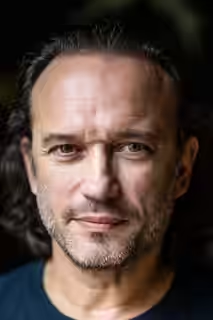
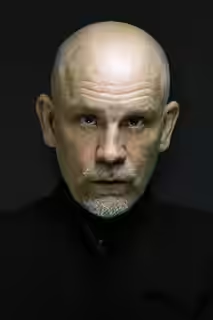
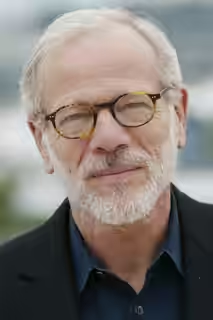
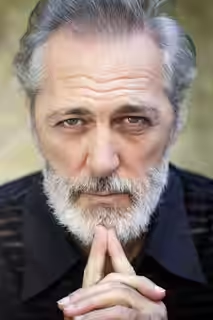
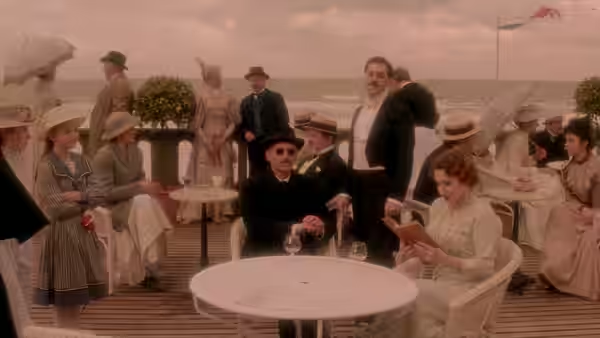
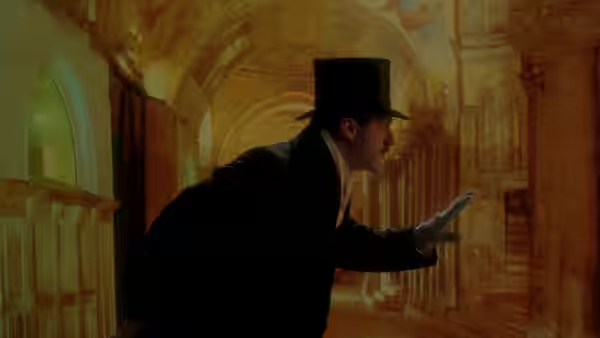
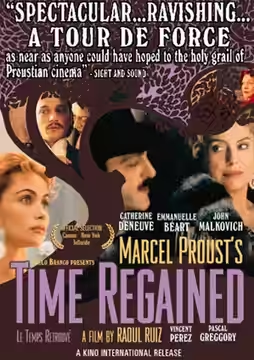
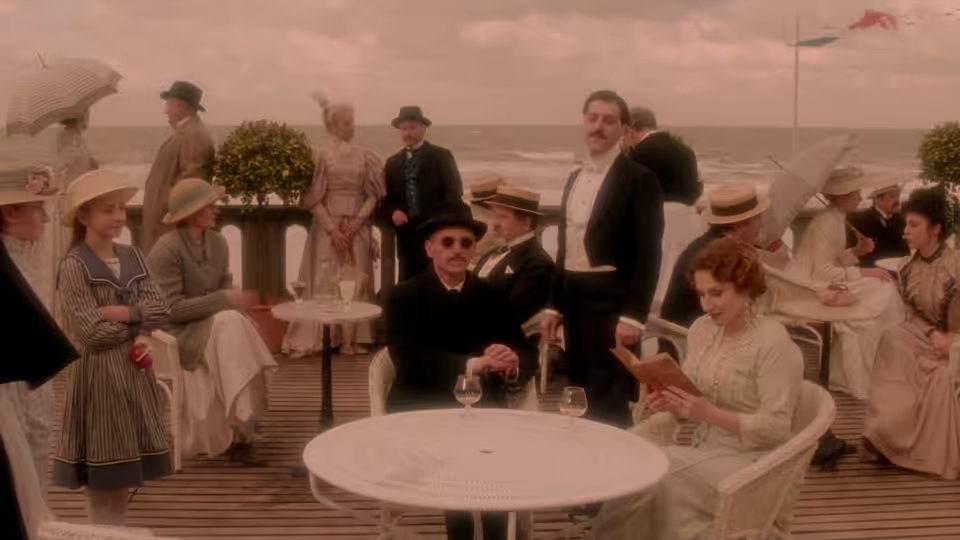
Baron de Charlus (John Malkovich) sits among guests at a seaside café
Film review

Time Regained

1999 · Directed by Raúl Ruiz · 2h 43m

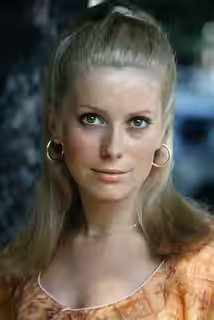
In a sentenceCatherine Deneuve is easier to recognise than the decade

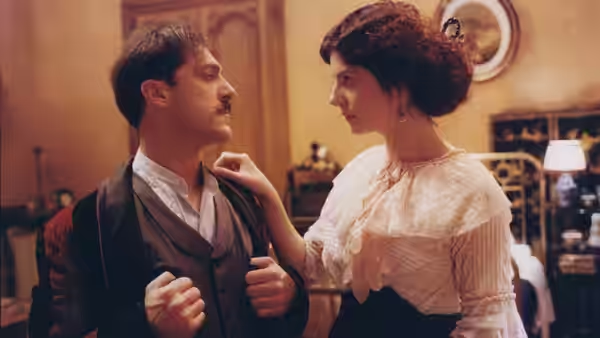
Marcel (Marcello Mazzarella) appears within the past he recalls, moving between the experiences of a participant and the perspective of a writer. His recollections bring together Odette (Catherine Deneuve), Gilberte (Emmanuelle Béart), Baron de Charlus (John Malkovich) and Saint-Loup (Pascal Greggory), with Albertine (Chiara Mastroianni) also part of this remembered world. People and periods do not arrive in chronological order, and memory overlaps with dream. Adapted from Marcel Proust’s novel, the film follows Marcel through a social world whose relationships emerge in fragments, rather than through a continuous account of events.

Plays from YouTube when you press play; nothing loads from them until then.

Fi1m review

Raúl Ruiz’s adaptation of Marcel Proust is rich, strange and often absorbing, with Marcello Mazzarella holding it together. The shifting relationships can be hard to follow, but the visual invention makes the effort worthwhile.

Time Regained is a rewarding, sometimes baffling adaptation that asks us to accept considerable uncertainty about who belongs where. Raúl Ruiz takes Marcel Proust’s final volume and lets memory determine how the film proceeds, without tidying its recollections into a convenient chronology. The shifts are often absorbing even when we have lost track of the relationships. We recommend it for the freedom of its filmmaking, with the warning that it offers less help with introductions than a newcomer might reasonably want.

Marcello Mazzarella gives Marcel enough presence to hold our attention through those changes. He observes his remembered world as a writer and also appears within it, unable to stand entirely apart from what he recalls. We were unexpectedly moved by that uncertain position, which makes remembering seem difficult rather than comfortably nostalgic. Marcello Mazzarella keeps this personal, giving us someone to care about while Raúl Ruiz experiments with the way a life can be put on screen.

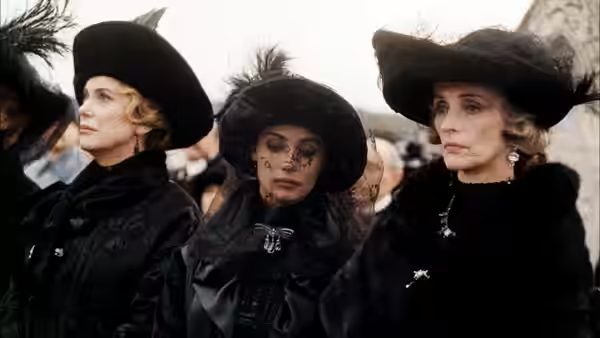
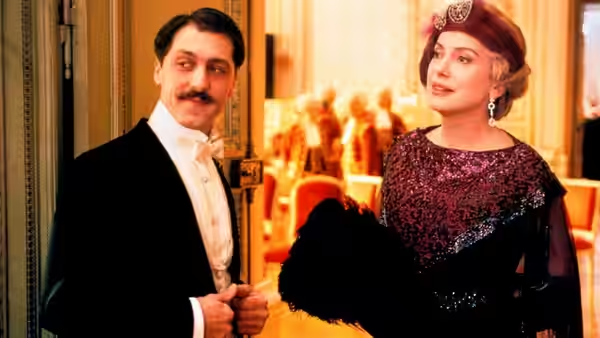
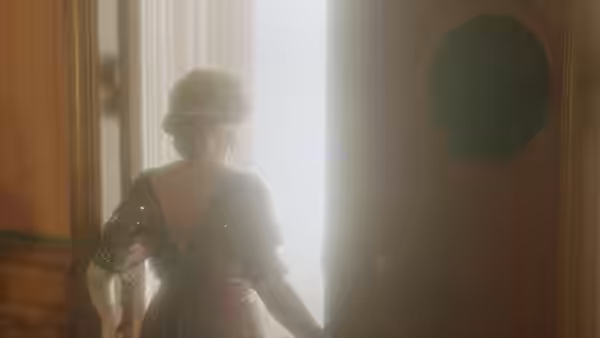
Ricardo Aronovich’s cinematography gives the period setting a richness worth attending to even when we have lost track of the people. Bruno Beaugé’s intricate production design makes the social world persuasive before we have sorted out its inhabitants. Raúl Ruiz then uses visual effects to unsettle that carefully recreated past, letting the shifts of time affect the way we look at it. The period detail gives us something to recognise as the film’s sense of time keeps changing.

Denise de Casabianca’s editing is crucial to keeping that approach watchable over 163 minutes. Individual passages have enough coherence to be absorbing, although the connections between them are often harder to establish. Jorge Arriagada’s music helps maintain continuity through these interruptions, encouraging us to stay with a passage before its place becomes clear. The film works particularly well when we can enjoy a scene without immediately demanding to know where it belongs in the larger story.

John Malkovich plays Baron de Charlus with restraint, giving us someone to watch closely amid the continual changes of focus. Catherine Deneuve’s Odette and Emmanuelle Béart’s Gilberte also draw attention, though having recognisable performers does not solve the problem of establishing their characters. Sometimes the film moves away from a person just as we begin to feel we know them. That is frustrating, particularly when the faces are easier to remember than the relationships between them.

The film belongs to the more adventurous end of literary adaptation, where a director does something beyond preserving dialogue and costumes. Raúl Ruiz’s treatment of memory justifies that freedom because the shifts in time change how we watch, making us question our understanding of what we have seen. This also saves the period recreation from becoming a procession of things to admire. There is considerable pleasure in watching such careful work put to use in a film willing to be peculiar.

We would not make reading the novel a condition of seeing the film, though familiarity plainly makes some of the introductions easier. Its individual scenes offer enough pleasure to keep it from becoming a test of literary preparation. Give it an unhurried evening, and allow a few people to remain strangers for a while. If losing track of a relationship makes it impossible to enjoy a film, choose something else.
Critical consensus AI synthesised

72
Positive
7
Mixed
4
Negative
0

Most critics respond warmly to Time Regained, with praise centred on Ruiz’s inventive visual treatment of Proust’s shifting memories and chronology. The cinematography, sets and period detail draw repeated admiration, while several reviews find the adaptation intellectually accomplished without sacrificing pleasure or emotion. Performances receive less consistent attention, though Variety singles out Marcello Mazzarella as Proust, and IndieWire praises John Malkovich’s restraint.

The main divide concerns how much familiarity with Proust the film demands, with responses ranging from enthusiastic to distinctly mixed rather than outright negative. Even favourable reviews acknowledge that its fragmented storytelling can be difficult to follow. IndieWire finds it confusing and rambling but absorbing when approached as a sequence of scenes. The AV Club offers the strongest reservation: it admires the cinematic handling of temporal shifts but finds too little emotional connection with the characters to carry viewers unfamiliar with the novel.

The Guardian
11 June 2000 · Philip French
90*

French praises the film as magnificent, describing it as a dazzling rendering of Proust’s final volume. He singles out its kaleidoscopic scope and its interplay between Proust as writer and participant.

Read the full review →
The New Yorker
8 December 2016 · Richard Brody
90*

Brody regards Ruiz’s adaptation as a triumph that brings the filmmaker’s artistry to exquisite new heights. He singles out its inventive visual effects and meticulous recreation of Proust’s era.

Read the full review →
Empire
1 January 2000 · William Thomas
85*

Thomas finds Ruiz’s adaptation an exquisite, sophisticated achievement, though its shifting focus can marginalize some of its stars. He especially praises the inventive visual techniques and the sumptuous cinematography and set design.

Read the full review →
Radio Times
★★★★ · David Parkinson
80

The critic calls the film a technically dazzling and intellectually accomplished literary adaptation. They praise Ruiz’s imaginative use of narrative, memory, emotion and dream to convey Proust’s complex novel.

Read the full review →
Slant Magazine
18 November 2018 · ★★★★ · Jake Cole
80

Cole praises Ruiz’s ambitious adaptation as visually and emotionally rich. He singles out the Blu-ray’s intricate art direction, cinematography, and sound mixing.

Read the full review →
Time Out
· TCh
70*

The available description suggests a positive verdict on Ruiz’s ambitious adaptation. It singles out the film’s unusual blend of avant-garde art film and lavish literary period drama.

Read the full review →

Straight answers AI written, from our review

Is Time Regained worth watching?
Time Regained is worth watching for its visual invention and absorbing treatment of memory; we score it 80. We recommend it to viewers comfortable with an adventurous literary adaptation, though its 163 minutes require patience with shifting periods and relationships that can remain unclear even when individual scenes hold our attention.
How long is Time Regained, and what is it rated?
Time Regained runs 2h 43m. It is a drama film.
Where can I watch Time Regained in Colombia?
Time Regained is not on any streaming or rental service in Colombia at the moment. It is available in 1 other country; change your country at the top of the page to see where. Availability is checked daily.
How does Time Regained compare to Wild Strawberries?
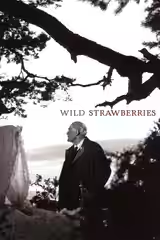
Time Regained is the more formally adventurous choice beside Wild Strawberries, while we recommend the latter for a more direct attachment to its central character. Both make memories into uncomfortable encounters, but Ruiz lets chronology and relationships become harder to follow. Victor Sjöström’s performance keeps Bergman’s drama human even when its symbolism becomes too insistent.
Is Time Regained based on a true story or a book?
Time Regained is adapted from the final volume of Marcel Proust’s novel, with Raúl Ruiz allowing memory rather than chronology to guide the film. We would not make reading the book a condition of watching, though familiarity helps with introductions; the adaptation’s freedom and visual invention matter more to our recommendation than literal fidelity.
What should I watch after Time Regained?
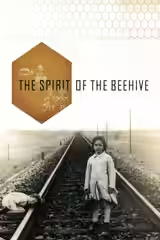
After Time Regained, try Wild Strawberries (1957, Fi1m 88): An ageing man’s memories become encounters he cannot comfortably keep at a distance. Then The Spirit of the Beehive (1973, Fi1m 87): A child’s uncertain understanding gives familiar places a quietly troubling sense of mystery.

Cast

If you liked this, try…

  1. Last Year in Marienbad (1961) · not on Fi1m yetAnother film that makes uncertain recollection part of the pleasure of watching.

  2. The Long Day Closes (1992) · not on Fi1m yetChildhood memories arranged through music and images, with little interest in conventional plotting.

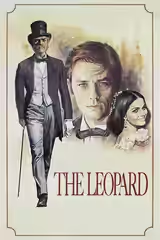
  3. The Leopard (1963) · not on Fi1m yetFor the period detail, complicated social hierarchies and awareness of passing time.

  4. Wild Strawberries (1957, Fi1m 88)An ageing man’s memories become encounters he cannot comfortably keep at a distance.

  5. The Spirit of the Beehive (1973, Fi1m 87)A child’s uncertain understanding gives familiar places a quietly troubling sense of mystery.