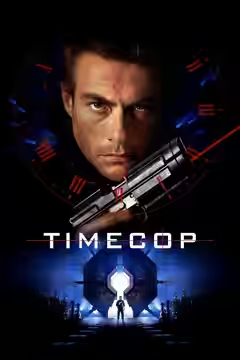
Peter Hyams’s time-travel thriller is darker and better built than anything else we have seen with Van Damme’s name above the title, and Ron Silver gives it a proper villain. The plotting falls apart if you look; the trick is not to look.
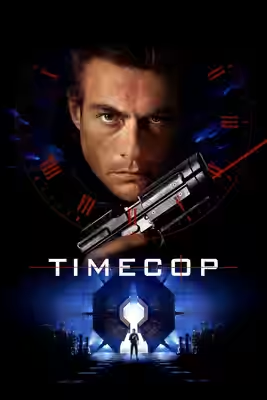
Peter Hyams’s film opens in 1863, with a rider robbing a Confederate gold shipment using a pair of machine pistols nobody will manufacture for a hundred years, and it has the decency to explain itself quickly. Time travel has been invented. You can go backwards but not forwards, because the future has not happened yet. Congress has set up the Time Enforcement Commission to stop people using the past to get rich, and Washington police officer Max Walker (Jean-Claude Van Damme) is recruited the same week his wife Melissa (Mia Sara) is killed in their house. Mark Verheiden’s screenplay, from a story he wrote with Mike Richardson, then jumps ten years and gets on with it.
It is a better film than its star usually gets, and we mean that as a compliment to the film rather than a dig at the star. Hyams is his own cinematographer here, and he shoots it dark: rain on the windows, blue light down corridors, faces lit from one side. Steven Kemper cuts those fights so you can see who hit whom, which was not a given in 1994 and is rarer now.
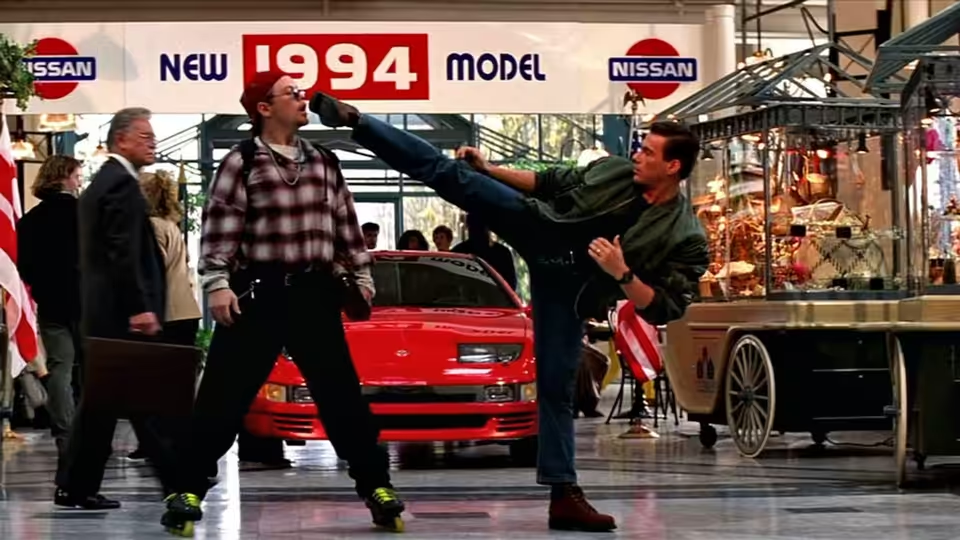
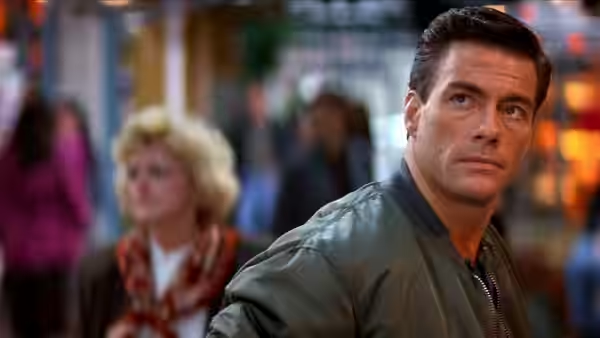
Van Damme plays Walker as a widower first and a kickboxer second, and he is more watchable for it. He does not do much with his face, but he does not do much wrong with it either, and Hyams keeps the dialogue short enough that the accent, which the film never accounts for in a Washington policeman, stops mattering after ten minutes. The action is where he lives. There is a fight in his own kitchen, in the dark, that ends with him doing the splits across the worktop to keep his feet out of a puddle somebody has just dropped a live wire into.
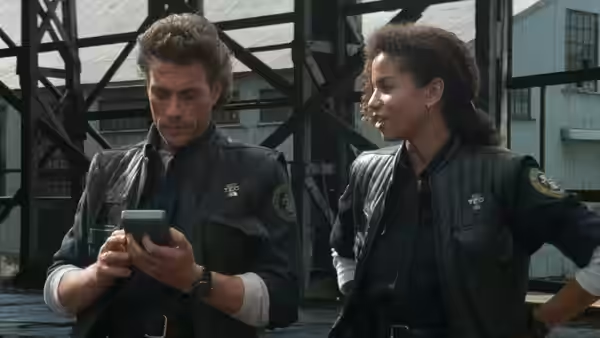
Ron Silver is the reason to stay. Senator Aaron McComb is running for president and funding the campaign by sending men into the past to play the markets with tomorrow’s newspaper. Silver plays him with open contempt for everyone he meets, including the people he is paying, and he delivers the film’s best lines as if bored by how easy it all is. Bruce McGill’s Commander Eugene Matuzak does the shouting boss with more warmth than the part asks for. Gloria Reuben, as Fielding, the internal affairs agent sent to ride along with Walker and report back, is good in a role the script loses interest in halfway through. Mia Sara is mostly in flashback and soft light, which is roughly what the part is.
The plotting is where it comes apart, and it comes apart in the usual places. The film states its rules in a briefing and then observes them when convenient. Walker comes home from one trip to find things in 2004 changed, and the film treats that as new furniture rather than something a man might lose sleep over. The middle stretch repeats itself: go back, fight, come home, be shouted at. And the 18 certificate is earned by three or four deaths staged with a relish the scenes around them do not share, so the tone lurches from Saturday matinee to something nastier and back inside a minute.
Against the time-travel films around it this is a middleweight. The Terminator (1984) made its one rule a knife and held it to the audience’s throat for the whole running time; Back to the Future (1985) made the paradox the joke and worked out every move in advance. Timecop uses time travel chiefly as a way to put Van Damme in a new costume every twenty minutes, and when it tries to be clever about the paradox it generally trips. The second half takes a turn we will not describe; we will say that it leans hard on a rule the film has only just made up.
For an evening with the lights down, it does what it is for. It is short, it is handsome, it has a villain worth hissing and a hero who looks as if he could do the stunts and mostly did. Do not ask about the physics. Ask Silver what he thinks of you, and enjoy the answer.