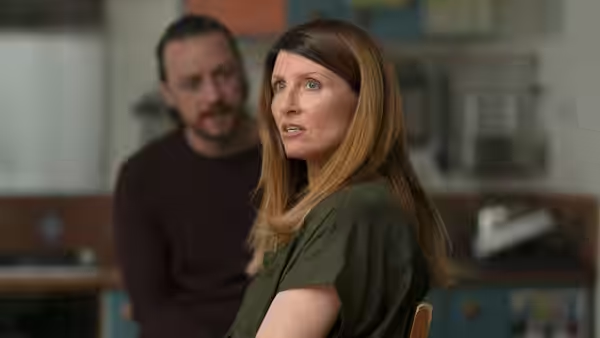
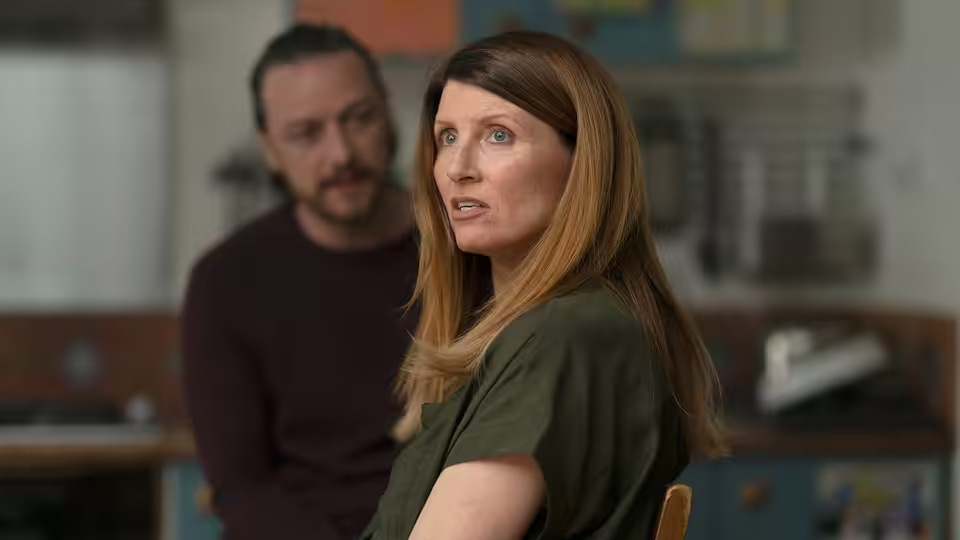
She (Sharon Horgan) turns toward someone while He (James McAvoy) stands behind her in a kitchen
Film review

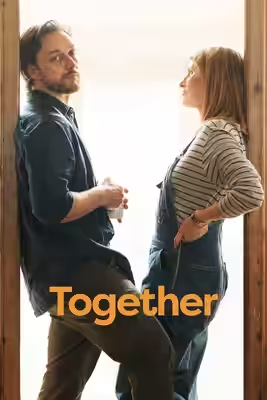
Together

2021 · Directed by Stephen Daldry · 1h 32m

In a sentenceNinety minutes in a kitchen with two people who would rather be anywhere else, and so, now and then, would we

A house in England in the first weeks of lockdown. He (James McAvoy) and She (Sharon Horgan) are not married, have not liked each other for years, and have stayed under the same roof for their son Artie (Samuel Logan), who is sent away whenever the adults want to be honest. With the front door shut on them, they turn to the camera and, taking turns and interrupting, explain exactly what is wrong with the other one: his politics, her work, the way each of them tells a story. She worries about her mother, who lives alone and whom she can no longer visit; he worries about his business. The shopping, the daily briefings and the rules arrive one at a time, and the two of them are left in the kitchen to work out whether they can bear it.

Plays from YouTube when you press play; nothing loads from them until then.

Fi1m review

A lockdown two-hander that gives James McAvoy and Sharon Horgan a kitchen and a camera to argue in front of. One speech of Horgan’s is as good as anything made about that year; the rest is a play that has not noticed it is being filmed.

Stephen Daldry and the writer Dennis Kelly made Together about the year most of us were trying to forget while it was still going on. A couple credited only as He (James McAvoy) and She (Sharon Horgan) are shut into their house for lockdown with their son Artie (Samuel Logan) and with each other, and they turn to the camera to tell us how much they mind. It runs 92 minutes, nearly all of them in one kitchen. The performances are big and alive, and one passage of Horgan’s got to us badly. The film around it is a play, and it stays a play.

Kelly’s device is direct address. The two of them talk to us, together and in turn, finishing each other’s insults and correcting each other’s version of events, and the writing is at its best when it is nastiest. McAvoy plays He as a man who has mistaken confidence for being right, loud, delighted by his own comparisons, and suddenly small when a point goes against him. Horgan gives She a dry patience that keeps giving way. For the first half hour we laughed a good deal, mostly at how exactly each of them knows what will hurt the other.

Iain Struthers keeps the camera where the actors can look at it, usually across the kitchen counter, and Úna Ní Dhonghaíle cuts seldom, so speeches run whole and a flinch is left on screen until it stops being funny. Karen Wakefield’s house is comfortable and cluttered and plainly lived in, and it does not change, which is true to the year and wears thin on screen. By the hour mark we knew every cupboard. Daldry made Billy Elliot (2000) and The Hours (2002), and knows how to put a camera somewhere that tells you something; here he has decided, with some honesty, that there is nowhere else to put it.

Then there is the speech. Somewhere in the middle Horgan has a long passage about her mother, said mostly straight into the lens, and we will not describe where it goes. We can say that it is the one stretch in which the film stops being about this couple and becomes about the country, and that we sat still through it and were back in that spring, with its rules and its phone calls and its waiting. Horgan does not raise her voice once. It is the best thing in the film.

The trouble is what surrounds it. Kelly has given each of them two or three grievances and they pass them back and forth for an hour and a half: they fight, they soften a little, they fight again about the same thing. The move towards each other is announced rather than shown; they tell us they have changed and the kitchen says they have not. Artie exists to be sent out of earshot so the adults can swear, and Samuel Logan is given almost nothing to do with him. By the last half hour we were tired, the particular tiredness of being stuck at a dinner party with a couple who have started, and the film seemed to take our tiredness for involvement.

There is also an anger in it that is real and well aimed. He and She are both, in their different ways, furious at how the country was run that year, and when the script lets them say so plainly the film has a pulse it otherwise lacks. It is a shame that the fury is spent in a few minutes and the bickering is given the rest.

See it for Horgan, for McAvoy at full stretch, and for ten minutes that are as good as anything made about that time. Watch it at home, where a film this stagebound loses nothing, and with someone you were shut in with; you will recognise more than you would like, and you may find yourselves arguing about which of you is He.

Critical consensus AI synthesised

58
Positive
3
Mixed
6
Negative
3

The reviews are split, and the critics’ score of 58 sits in the middle of a wide spread. What nearly everyone agrees on is the two performances. McAvoy and Horgan are called commanding, lively and nuanced even by critics who dislike the film, and several say their chemistry is what makes the couple believable. Horgan’s monologue about her character’s mother dying alone is the most praised passage, and the couple’s speech about deaths caused by the government’s handling of the pandemic is singled out as the point where the film’s anger lands.

The reservations cluster around the writing. Most critics find the two-hander better suited to the stage than the screen, and several say the constant bickering becomes exhausting. The British reviews from June are warmer than the American ones from August: The i Paper calls it remarkable and emotionally forceful, while The Wrap and The Hollywood Reporter find it tiring and unconvincing as a love story.

The i Paper
17 June 2021 · Sarah Carson
85*

Carson finds the film a remarkable, emotionally forceful account of lockdown that makes a powerful case for love. She especially praises Horgan’s shattering monologue about her character’s mother dying alone.

Read the full review →
Radio Times
17 June 2021 · Flora Carr
75*

The headline presents the film as both savagely funny and emotionally devastating. It singles out the sharp comedy and emotional impact of a couple’s lockdown arguments and soul-searching.

Read the full review →
RogerEbert.com
64*

The page could not be accessed, so the critic’s verdict is unavailable. No praise or complaint from the review could be verified.

Read the full review →
The New York Times
26 August 2021
64*

The article text is unavailable, so its verdict cannot be established. No specific praise or complaint can be reliably identified.

Read the full review →
Evening Standard
17 June 2021 · ★★★ · Katie Rosseinsky
60

Rosseinsky finds the lockdown drama compelling at times but better suited to the stage than the screen. She praises Horgan’s monologues, especially their poignant treatment of grief and disconnection.

Read the full review →
IndieWire
25 August 2021 · C · David Ehrlich
57

Ehrlich finds the film too stagey and its relationship-repairing arc unconvincing, though its anger gives the pandemic drama force. He singles out the couple’s speech about deaths caused by the UK’s bungled COVID response as its most powerful moment.

Read the full review →

Straight answers AI written, from our review

Is Together worth watching?
Together is worth watching for Sharon Horgan's long speech about her mother and for James McAvoy at full stretch, but the rest is a filmed play that repeats itself, and we scored it 61. It suits anyone who was shut in with someone that spring and can bear being reminded; it will tire anyone hoping for more than ninety minutes of a couple arguing in a kitchen.
How long is Together, and what is it rated?
Together runs 1h 32m. It is a drama and comedy film.
Where can I watch Together in Malaysia?
Together is not on any streaming or rental service in Malaysia at the moment. It is available in 43 other countries; change your country at the top of the page to see where. Availability is checked daily.
How violent or frightening is Together, and is it suitable for children?
Together has no violence and nothing frightening; it is 92 minutes of two adults arguing in a kitchen, with enough swearing to earn an R in the United States, and it carries no UK certificate. It is not for children, who would be bored long before they were shocked, and its subject, lockdown and a mother who cannot be visited, may be hard on anyone who had a bad year.
How does Together compare to Who's Afraid of Virginia Woolf??
Who's Afraid of Virginia Woolf? is the better film and Together the shorter one: both shut people who dislike each other in a house and let them aim, but Mike Nichols keeps Edward Albee's play almost whole and has Elizabeth Taylor, while Dennis Kelly's script runs out of grievances after an hour. Choose Together for lockdown and Horgan's speech; choose the earlier film if you have the stamina for 131 minutes.
What should I watch after Together?
After Together, try Who's Afraid of Virginia Woolf? (1966, Fi1m 86): One night, one house, two people who know exactly where to aim. Then 45 Years (2015, Fi1m 88): A long marriage cracks in a week, quietly, in a Norfolk kitchen.

Cast

If you liked this, try…

  1. Scenes from a Marriage (1973) · not reviewed yetBergman shuts a couple in rooms for six hours and nobody leaves unscathed.

  2. Who's Afraid of Virginia Woolf? (1966, Fi1m 86)One night, one house, two people who know exactly where to aim.

  3. Catastrophe (2015) · not reviewed yetHorgan writing and playing the same marriage with far better jokes.

  4. Staged (2020) · not reviewed yetThe other British lockdown two-hander, made on laptops and happier for it.

  5. 45 Years (2015, Fi1m 88)A long marriage cracks in a week, quietly, in a Norfolk kitchen.

Free account

Know what to watch tonight

Two lists that know where things are streaming, collections you can share, your own score beside ours, and Discover that remembers what you have seen.

  • Want to see, sorted by what is streaming now
  • Seen, with your score out of ten
  • No adverts, ever