Kon Ichikawa was hired to make a record of the 1964 Tokyo Games and made a film about faces, feet and waiting instead. It is long and it sags in the middle, but its best passages have not aged a day.
Kon Ichikawa had spent the previous decade making fiction films about soldiers, among them The Burmese Harp and Fires on the Plain, when he was handed the official film of the 1964 Tokyo Games. The brief was a record of who won what. What Ichikawa delivered runs 170 minutes and spends a surprising share of them on people who did not win, and on people who were not competing at all. It is a fine film and, in perhaps three long stretches, a great one. It also has an hour in the middle where it behaves like the record it was meant to be.
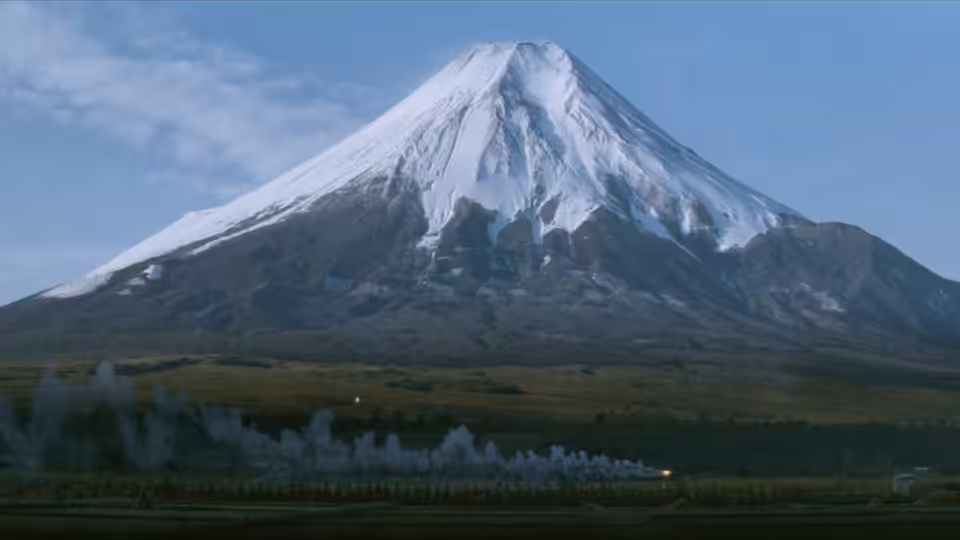
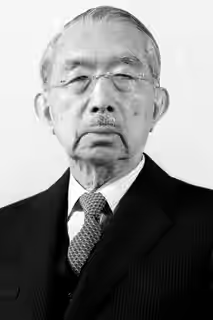
It opens with a red sun filling the frame, then a wrecking ball swinging into the side of an old Tokyo building. The city is being knocked down to make room. The torch comes across Japan by relay, Yoshinori Sakai carries it up the stadium steps to the cauldron, jets draw five rings in the sky and the doves go up in a clatter. Hirohito stands in his box and declares the Games open. Shuntarō Tanikawa’s narration says little about any of it, and what it does say is short.
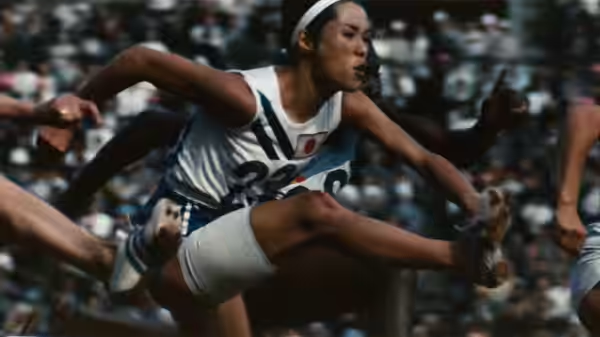
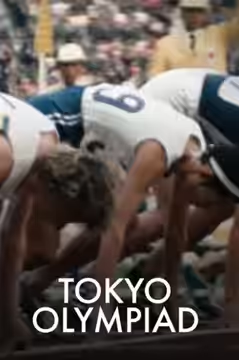
Five cinematographers are credited, among them Kazuo Miyagawa, who had shot Rashomon, and the house style is the long lens. Ichikawa’s cameras sit far back and pick out a face in the stands, an official’s hands on a starting pistol, a shot putter’s mouth as the throw goes. The men’s 100 metres final is given several minutes of athletes shaking out their legs and settling into the blocks before the race itself, which arrives in slow motion and lasts longer on screen than it did on the track. Tatsuji Nakashizu’s editing holds shots well past the point a newsreel would have cut. Toshirō Mayuzumi’s score comes and goes; for long stretches the only sound is feet on cinder and a crowd breathing in.
The sequence we will remember is not a final. Ahmed Issa runs the 800 metres for Chad, competing at a Games for the first time, and does not get past his heat. Ichikawa follows him afterwards into the athletes’ village and watches him eat, alone, at a long table, and walk back to his room. Nothing is said. It moved us more than anything in the medal events did, and it was the meal that did it: a young man a long way from home, finished with his Olympics by lunchtime, chewing. A committee film would not have known he was there.
The middle hour is where the committee gets its due. Swimming, gymnastics, weightlifting and the rest go past in order, competently shot and no more, and the narration starts telling us who is ahead. The 50-kilometre walk is treated as the comedy it looks like, which is a relief. We noticed the time around the ninety-minute mark and did not stop noticing it until the marathon started.
The marathon is the third great stretch. Abebe Bikila and the field leave the stadium for the streets, and Ichikawa films the road, the crowds on the pavements, the sponges and paper cups at the water stations, and above all feet, dozens of pairs of them, in close-up, for what feels like the entire distance. Where a broadcast would stay with the leader, the cameras keep drifting back down the field to the men who are struggling. What happens at the finish is a matter of record and we will leave it there. The closing ceremony follows, and we will not describe that either, except to say it is unlike any ceremony we have seen filmed.
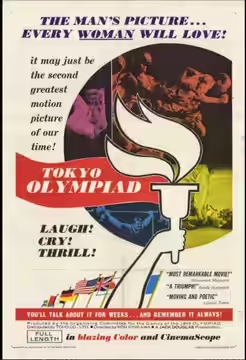
Leni Riefenstahl’s Olympia (1938) is the film this is always set against. Riefenstahl filmed athletes as statues; Ichikawa films them as tired people. Set against Ichikawa’s own fiction, the interest is the same one: what a body does when it has been asked for too much. It opened in Britain on 7 October 1965 under the tagline “The Man’s Picture… Every Woman Will Love”, which is hard to square with anything on screen. See it in one sitting if you can manage it, and on the biggest screen you have; the long lenses want room.