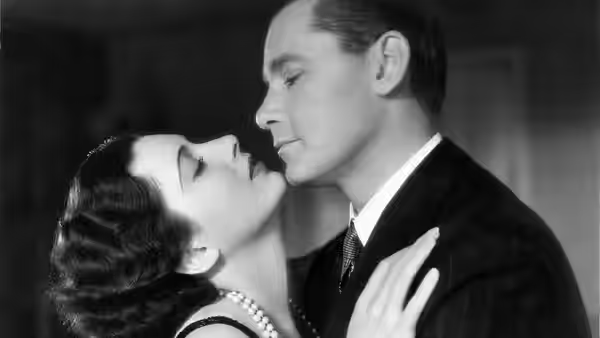
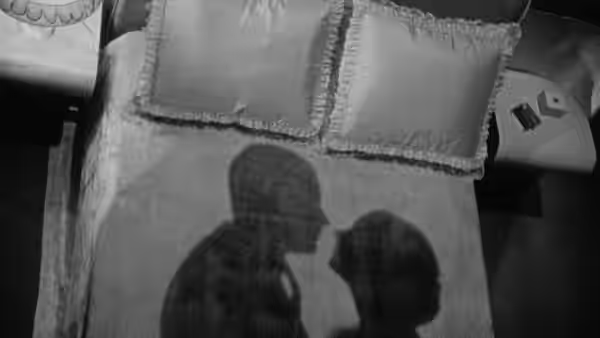
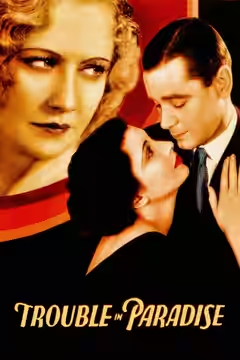
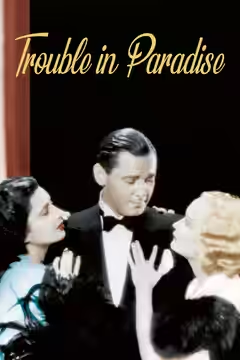
Gaston (Herbert Marshall) stands between Lily and Mariette as they reach toward him
Film review

Trouble in Paradise

1932 · Directed by Ernst Lubitsch · 1h 23m

In a sentenceEveryone has excellent manners, which is no reason to let them near your wallet

A gondolier sings amid a boatload of rubbish, introducing a romance involving con artists. Gaston (Herbert Marshall), Lily (Miriam Hopkins) and Mariette (Kay Francis) move through Art Deco surroundings where conversation is part of the business of getting what they want. Francois (Edward Everett Horton) and the Major (Charles Ruggles) are also among the company. Courtship and deception become difficult to separate, as polite behaviour offers little protection against people who know how to charm their way past suspicion. The exchanges concern attraction, dishonesty and the risks of trusting someone persuasive.

Fi1m review

Ernst Lubitsch’s romantic comedy is funny, deft and warmly recommended. The dialogue gives its charming cast plenty to enjoy, although their polished manners occasionally make the prospect of anyone getting hurt seem rather remote.

Ernst Lubitsch’s Trouble in Paradise understands the pleasure of being in questionable company. It is funny, brisk and worth your evening, with one reservation: the characters occasionally seem too practised at being charming. Samson Raphaelson’s screenplay makes dishonesty part of the attraction, giving the actors dialogue that rewards close attention without demanding hard work. The film runs for 83 minutes, and its confidence in leaving explanations to the audience helps make that running time feel generous rather than hurried.

The opening puts a gondolier’s song beside a boatload of rubbish. We laughed at the contrast between the song and the cargo. Lubitsch gets the joke across without treating romance as something foolish, and that generosity matters when we are asked to take pleasure in people who deceive one another. The same confidence carries into the dialogue, where the speed of an exchange never seems to prevent the actors from enjoying what they are saying, or giving us time to enjoy it too.

Herbert Marshall gives Gaston the calm that this kind of comedy needs; fussier playing would make the deception look like hard work. Miriam Hopkins’s Lily brings welcome impatience to that composure, and their exchanges are funniest when both performers seem certain they have got the measure of the other. Kay Francis gives Mariette enough warmth to make the possibility of someone’s feelings being hurt matter. None of the three needs to advertise a joke before delivering it, and their restraint leaves room for small differences in emphasis to register.

Victor Milner’s cinematography gives the performances room, while the Art Deco sets suit people who take appearances seriously. The rooms are pleasurable to look at, although their polish sometimes reinforces the feeling that everyone is a little too comfortable being observed. Travis Banton’s costumes help make the characters’ assurance convincing: looking so composed seems to be part of their preparation for dealing with other people. The visual care works because it does not distract from the faces or compete with the conversation.

The editing is particularly good at sustaining the exchanges without making the pace feel imposed on the actors. Lubitsch understands that a pause can be enjoyable when we are waiting to hear how someone will get out of a difficulty. W. Franke Harling’s music suits the lightness of the playing without making the romance feel too sweet. Within the romantic crime comedy, this is an exacting standard of timing: the talk remains clear, the attraction remains credible, and neither needs a lengthy explanation to keep us interested.

Our reservation is that such composure occasionally becomes airless. Marshall’s restraint is attractive, but Gaston can feel too well rehearsed, while the immaculate surroundings reinforce the sense that everyone has arrived ready to be admired. We wanted a little more awkwardness, particularly when the polished exchanges made the possibility of hurt seem distant. That is a modest complaint, but it matters in a romance, even one so agreeably unwilling to lecture its audience about good behaviour. We recommend it for an evening when respectable company would only spoil the fun.


Critical consensus AI synthesised

74
Positive
5
Mixed
2
Negative
1

Most critics respond warmly to Trouble in Paradise, with praise concentrated on Lubitsch’s comic timing, the ensemble and the dialogue. The favourable reviews describe a sophisticated comedy whose charm depends on precise construction, particularly the quick exchanges between its con artists and the rhythm of its editing. The Art Deco sets also draw admiration, while the opening image of a gondolier singing amid a boatload of rubbish attracts attention for its sharply observed humour.

The spread is wide rather than uniformly enthusiastic: five reviews are positive, two are scored as mixed and one is negative. Variety supplies the clear dissent, admiring the bright dialogue and stylish montage but objecting to the premise and finding that the film fails as a whole. The reasons behind the two mixed ratings cannot be verified from the available text, so they establish no shared reservation.

Empire
3 July 2006 · David Parkinson
95*

Parkinson regards the film as a timeless, highly sophisticated comedy with no false steps. He especially praises its finely tuned ensemble, exquisite Art Deco sets and screenplay.

Read the full review →
The AV Club
27 January 2003 · Scott Tobias
94*

Tobias finds the film breathlessly charming, sophisticated, and expertly constructed. He especially praises Lubitsch’s unexpected opening and the film’s elegant comic precision.

Read the full review →
Los Angeles Times
8 July 2010 · Betsy Sharkey
85*

Sharkey calls the film breathless fun and praises its sparkling comic energy. She singles out the lightning-fast, perfectly timed exchanges between its charming con artists.

Read the full review →
Slant Magazine
12 April 2026 · ★★★★ · Derek Smith
80

Smith praises the film as a sparkling Pre-Code masterpiece and calls the 4K upgrade long overdue. He singles out Lubitsch’s rhythmic editing and dialogue for heightening the film’s poetic, playful sensuality.

Read the full review →
Time Out
★★★★ · Tom Huddleston
80

The review presents the film as a sharply observant comedy. It singles out the opening image of a gondolier singing amid a boatload of garbage.

Read the full review →
RogerEbert.com
64*

The page is blocked, so its verdict cannot be verified. No praise or complaint can be reliably identified from the available text.

Read the full review →

Straight answers AI written, from our review

Is Trouble in Paradise worth watching?
Trouble in Paradise is warmly recommended for its witty dialogue, charming con artists and deft comic timing; we score it 84 out of 100. Its brisk 83 minutes suit an evening of romantic dishonesty, though we occasionally find the characters too polished for the risk of hurt feelings to seem convincing.
How long is Trouble in Paradise, and what is it rated?
Trouble in Paradise runs 1h 23m. It is a comedy and crime film.
Where can I watch Trouble in Paradise in Colombia?
Trouble in Paradise is not on any streaming or rental service in Colombia at the moment. It is available in 5 other countries; change your country at the top of the page to see where. Availability is checked daily.
How violent or frightening is Trouble in Paradise, and is it suitable for children?
Trouble in Paradise has a UK U certificate, indicating content generally suitable for children, though its appeal lies in romantic deception and conversation. We recommend it more readily for viewers who enjoy verbal comedy: the certificate suggests broad suitability, but the courtship and dishonesty may interest adults more than younger children.
How does Trouble in Paradise compare to The Lady Eve?
Trouble in Paradise is our choice for restrained verbal comedy, while The Lady Eve has the edge if we want vulnerability alongside the romantic confidence tricks. Both make courtship difficult to separate from deception, but Lubitsch’s polished exchanges can feel airless, whereas the reservation with Sturges’s romance is its occasionally insistent slapstick.
What should I watch after Trouble in Paradise?
After Trouble in Paradise, try The Lady Eve (1941, Fi1m 90): A confidence trick becomes courtship, with plenty of trouble telling them apart. Then The Sting (1973, Fi1m 85): For the pleasure of watching practised cheats work together and enjoy themselves; and The Handmaiden (2016, Fi1m 85): Desire and deception become more dangerous in this much darker, more explicit romance.

Cast

If you liked this, try…

  1. Design for Living (1933) · not on Fi1m yetAnother nimble arrangement of desire, with good manners offering little practical protection.

  2. The Lady Eve (1941, Fi1m 90)A confidence trick becomes courtship, with plenty of trouble telling them apart.

  3. The Earrings of Madame de... (1953) · not on Fi1m yetJewellery and flirtation acquire consequences that even excellent manners cannot politely dismiss.

  4. The Sting (1973, Fi1m 85)For the pleasure of watching practised cheats work together and enjoy themselves.

  5. The Handmaiden (2016, Fi1m 85)Desire and deception become more dangerous in this much darker, more explicit romance.