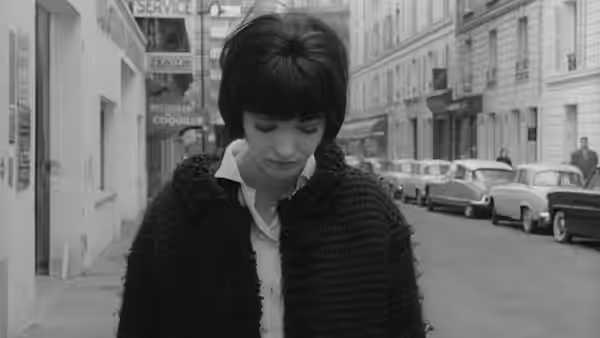
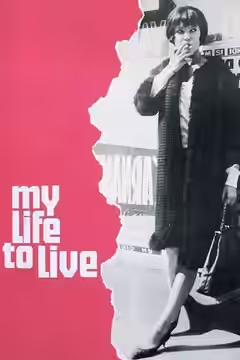
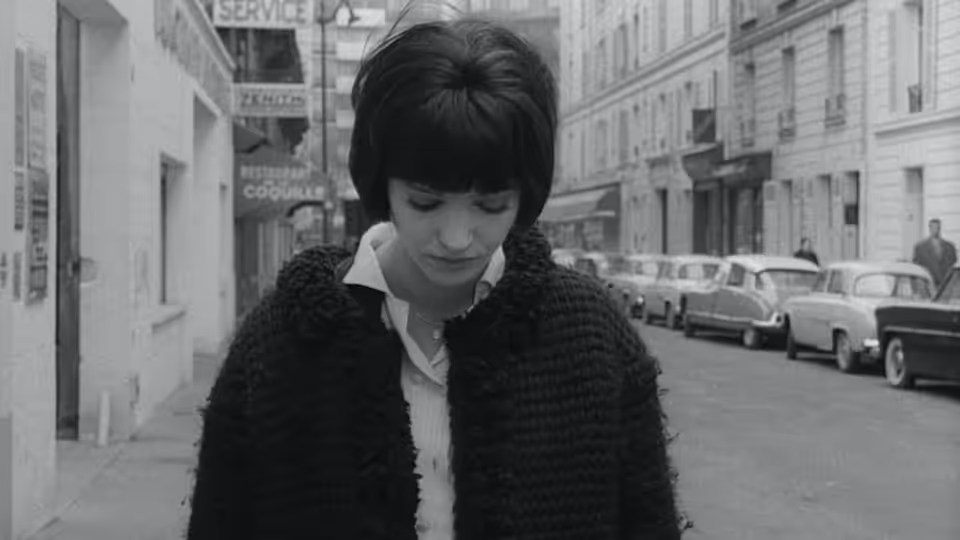
Nana Kleinfrankenheim (Anna Karina) looks down on a city street
Film review

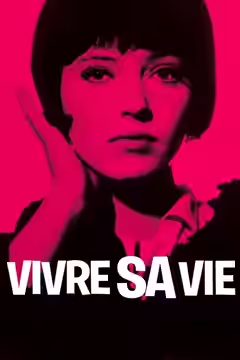
Vivre Sa Vie

1962 · Directed by Jean-Luc Godard · 1h 24m

In a sentenceTwelve chapters of a woman being looked at, by clients, by police, and most of all by her husband behind the camera

Paris, in the early sixties. Nana Kleinfrankenheim (Anna Karina) has left her husband Paul (André S. Labarthe) and their small child to try to act, and is getting nowhere. She sells records in a shop, is behind on the rent, and comes home one evening to find the landlady will not let her in. She sits alone in a cinema and cries at Dreyer’s La Passion de Jeanne d’Arc. A clumsy attempt to pocket a stranger’s 1,000 francs lands her in a police station. On the boulevards she starts taking men to hotels for the price of a bed for an hour and a little more, runs into her old friend Yvette (Guylaine Schlumberger), who already works the streets, and catches the eye of Raoul (Sady Rebbot), a pimp with a proposition. The film tells all this in twelve numbered chapters.

Plays from YouTube when you press play; nothing loads from them until then.

Fi1m review

Godard’s portrait of a Paris shopgirl who drifts into prostitution is told in twelve numbered chapters, coolly, and Anna Karina makes nearly every one of them ache. It is a cold film that keeps producing warmth. The last chapter is the only weak one.

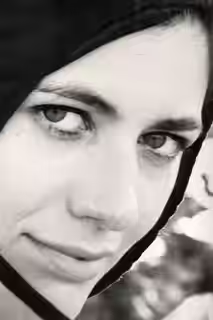
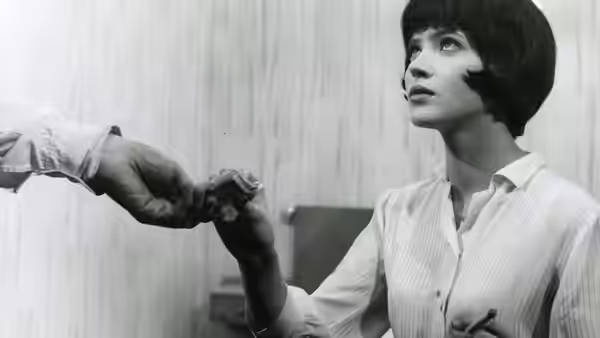
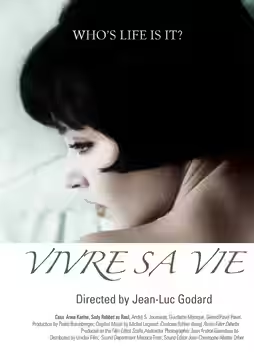
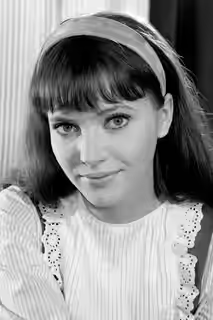
The credits of Vivre Sa Vie are three shots of Anna Karina’s head: left profile, right profile, then full face, lit from one side, while a few bars of Michel Legrand’s strings begin and break off. The first scene is a conversation in a café between Nana (Karina) and the husband she has left, Paul (André S. Labarthe), and Raoul Coutard films the whole of it from behind their heads. We have just been shown this face from three angles and now we are refused it. Jean-Luc Godard tells the rest in twelve numbered chapters, each introduced by a card that says what will happen in it, and the whole thing runs 84 minutes.

It is one of his best films, and the one we would hand to anyone who has found the rest of him a chore. Whatever else Godard is doing, and he is doing a great deal, he never takes his eyes off one woman for long. Nana sells records, cannot pay her rent, tries and fails to steal 1,000 francs, and goes to work on the boulevards. The film is cold on purpose and it keeps producing warmth anyway, nearly all of it Karina’s.

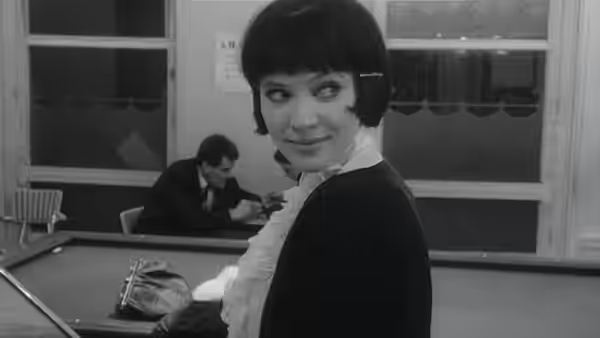
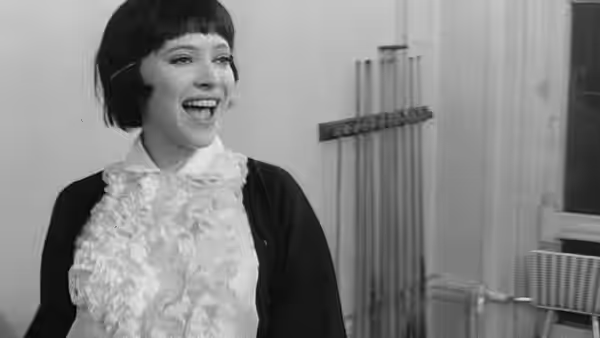
Two scenes did it for us. In the third chapter Nana sits alone in a cinema watching Dreyer’s La Passion de Jeanne d’Arc, and Godard cuts between Falconetti’s face and Karina’s as she cries at it, in silence. We knew exactly what he was doing, one suffering face set beside another, and it moved us anyway; what got us was that Karina’s tears look like a real person’s, blotchy and unflattering, not a close-up’s. Later she puts a coin in a jukebox and dances round a pool table for a young man who barely looks up, all elbows and kicked heels, while Raoul (Sady Rebbot) talks business at a table. We smiled the whole way through it, and then the record ended.

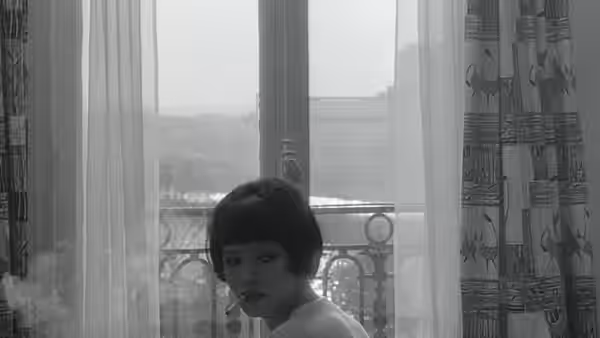
Coutard shoots in black and white with what looks like the light that was already there when the crew walked in. He tracks along bars and settles behind shoulders, and when Nana writes a letter asking for work in a brothel he holds on the page for minutes while she thinks about the spelling. In the eighth chapter Raoul recites the hours, prices and regulations of the trade in a flat voice over a run of hotel doors, stairwells and clients undressing, and Agnès Guillemot, cutting with Godard, keeps the pictures as level as the voice. Christiane Fageol puts Karina in a dark coat with a fur collar and leaves her the bob, and Legrand’s theme returns a dozen times and never gets to the end of itself.

The chapter most critics call the dead patch is the eleventh, in which Nana sits in a café with a philosopher, played by the philosopher Brice Parain, and asks whether a person could live without speaking. He tells her about Porthos, who dies because he stops to think. It is the one stretch where Godard’s interests plainly outrun Nana’s, and it nearly works anyway, because Karina listens like someone hearing the idea for the first time and Parain talks to her as if she had a right to it.

The twelfth chapter is where the film goes wrong. A young man (Peter Kassovitz) reads Poe’s “The Oval Portrait”, about a painter whose picture of his wife takes her life as it takes her likeness, and the voice reading it is Godard’s own, dubbed over the actor. Karina was married to Godard when they made this, and for the length of that scene the film is about him rather than her. What follows we will not describe, except that it turns into a different sort of film in about two minutes, and it is the only part that feels as though he had stopped caring how it looked.

Set against his other work it is the plainest thing he made in those years: fewer gags, fewer quotations, one face. Watch it with the subtitles off if your French will stand it, and if not, do not spend the whole time reading. Most of what Nana thinks is in what Karina does between the lines.
Critical consensus AI synthesised

80
Positive
9
Mixed
2
Negative
0
Radio Times
★★★★★ · Adrian Turner
100

Turner presents the film as a New Wave masterpiece, emphasizing its spiritual portrait of Nana. He singles out Godard’s chapter-based storytelling and Raoul Coutard’s camerawork as notable features.

Read the full review →
The AV Club
21 April 2010 · A · Keith Phipps
95

Phipps finds the film’s philosophical ideas somewhat patchwork, but says Godard’s cinematic confidence and mounting tragedy bring it together. He praises the distancing compositions for deepening the film’s portrayal of desire and humiliation.

Read the full review →
Empire
1 January 2000 · David Parkinson
90*

Parkinson calls the film Godard’s forgotten masterpiece and says it makes cinema-going worthwhile. He singles out Anna Karina’s bewitching performance and the film’s beautiful photography.

Read the full review →
The Guardian
6 September 2015 · Philip French
90*

French regards the film as an influential, highly original work and says its power endures. He praises its carefully composed shots for questioning cinema, appearance and reality, and perception.

Read the full review →
The New Yorker
25 May 2008 · David Denby
85*

Denby presents the film as a fatalistic, fragmented portrait of Nana that culminates in a moving ending. He praises Anna Karina’s vivacity and soulfulness for unifying the portrait despite Godard’s distancing techniques.

Read the full review →
Slant Magazine
19 April 2010 · ★★★★ · Eric Henderson
80

Henderson praises the film as a compelling, finely balanced work shaped by the tension between Godard and Karina. He especially singles out Karina’s vivid, captivating performance.

Read the full review →

Straight answers AI written, from our review

Is Vivre Sa Vie worth watching?
Vivre Sa Vie is worth watching, and we scored it 86. It is the Godard film we would hand to anyone who has found the rest of him hard going: twelve short chapters, 84 minutes, one face, and Anna Karina making nearly every scene ache. The final chapter is the only weak one, and by then the rest has earned it.
How long is Vivre Sa Vie, and what is it rated?
Vivre Sa Vie runs 1h 24m. It is a drama film.
Where can I watch Vivre Sa Vie in Spain?
Vivre Sa Vie is not on any streaming or rental service in Spain at the moment. It is available in 7 other countries; change your country at the top of the page to see where. Availability is checked daily.
How does Vivre Sa Vie compare to Cléo from 5 to 7?
Vivre Sa Vie and Cléo from 5 to 7 are both Paris films from 1962 about a woman watched by a camera, and they suit different moods. Godard's is the colder and stranger, told in numbered chapters and pulled together by Karina; Varda's is livelier and warmer once its prickly first half hour is past. Start with Varda if you want to be charmed, with Godard if you want to be unsettled.
What should I watch after Vivre Sa Vie?
After Vivre Sa Vie, try Cléo de 5 à 7 (1962, Fi1m 88): Varda’s Paris afternoon, another woman watched by a camera that mostly likes her. Then Pandora's Box (1929, Fi1m 88): Louise Brooks, the bob Karina borrowed, and a Berlin as indifferent as Godard’s Paris.

Cast

Awards

Grand Jury Prize of the Venice Film Festival, 1962

Won
Grand Jury Prize of the Venice Film Festival

If you liked this, try…

  1. Cléo de 5 à 7 (1962, Fi1m 88)Varda’s Paris afternoon, another woman watched by a camera that mostly likes her.

  2. Mouchette (1967) · not on Fi1m yetBresson’s country girl, filmed with the same refusal to console her or us.

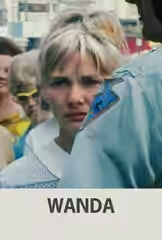
  3. Wanda (1970) · not on Fi1m yetBarbara Loden drifts through Pennsylvania; the American answer to Nana, with even less money.

  4. Pandora's Box (1929, Fi1m 88)Louise Brooks, the bob Karina borrowed, and a Berlin as indifferent as Godard’s Paris.

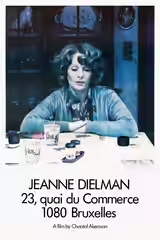
  5. Jeanne Dielman, 23 quai du Commerce, 1080 Bruxelles (1975) · not on Fi1m yetAkerman takes the letter scene’s patience and stretches it across three days.