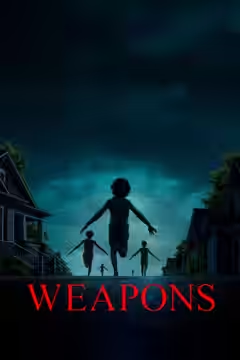
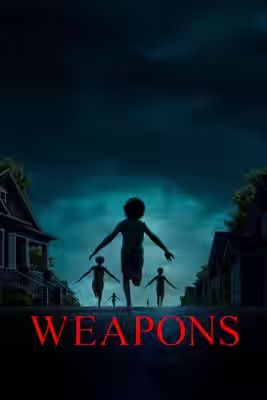
Weapons poster

Weapons

2025 · Directed by Zach Cregger
2h 09mHorrorMystery18
75
Fi1m score
76
Critics · 21
Audience · not yet

Where to watch in the UK

Checked 10 September at 22:29. Prices and availability change; the service’s page is the last word.

Synopsis

One night at 2:17, every child in Mrs Gandy’s class gets out of bed, opens the front door and runs into the dark. None of them comes back. The one pupil who did not go is Alex (Cary Christopher), who will not say what he knows. Their teacher, Justine (Julia Garner), becomes the town’s suspect by default. Archer (Josh Brolin), whose son is among the missing, wants answers and does not care how he gets them. Zach Cregger’s film follows them, and a local policeman (Alden Ehrenreich), a drifter (Austin Abrams) and the headteacher (Benedict Wong), chapter by chapter, each picking up a little before the last left off. Amy Madigan plays Gladys, Alex’s aunt, who arrives to help.

Fi1m review

In a sentenceThe children run off at 2:17 in the morning; the grown-ups take 129 minutes and one alarming aunt to work out why

Zach Cregger’s follow-up to Barbarian is a horror-mystery about a class of children who vanish in the night, told chapter by chapter and made with skill. The first hour frightened us; the last half hour is louder and sillier, and we liked it less.

A child’s voice (Scarlett Sher) sets it out at the start, the way you might tell a story at a sleepover. One night at 2:17, every child in one class got out of bed, went downstairs, opened the front door and ran into the dark, and none of them came back. Zach Cregger, whose last film was Barbarian, then spends 129 minutes on the town they left behind. It is a good horror film, frightening for an hour and clever for longer than that, and in its last act it becomes a louder, sillier film that we enjoyed less.

The best thing in it comes early. Larkin Seiple shoots the streets at night under orange lamps with a great deal of black between them, and the children run down the middle of the road with their arms held straight out behind them, as children do when they pretend to fly. Some of it we see on doorbell cameras, small and grey and silent. We felt cold watching it, a cold that started in the shoulders, and nothing in the film’s later, busier stretches came near it.

The film is built in chapters, each named for one person and each starting a little before the last one ended. Julia Garner plays Justine, the class’s teacher, who has done nothing wrong and is treated by the town as though she had; Garner keeps her tight and jumpy, drinking in the car, with a temper showing under the fear. Josh Brolin is Archer, whose son is among the missing, and he plays grief as a man who has decided to be angry instead. Alden Ehrenreich is a local policeman with troubles of his own, Austin Abrams a thief who keeps ending up in the wrong houses, Benedict Wong the headteacher with an empty classroom to explain. Joe Murphy cuts so that a scene we watched from the pavement turns up again from inside the window, and that is a real pleasure. It also has a cost. By the fourth chapter we knew the rhythm and were waiting for it.

Somewhere in the middle Amy Madigan arrives as Gladys, an aunt of Alex (Cary Christopher), the one boy who stayed in bed, and the film gets its second wind. Trish Summerville dresses her in a bright wig, a cardigan and make-up a shade too heavy, so that she looks like a children’s entertainer who has stopped caring, and Madigan plays her with a flat cheerfulness that turns every ordinary line into a threat. We will not say what she is. We can say that we laughed at her and were frightened of her inside the same minute, and that Tom Hammock’s design of the house where she settles, curtains drawn, things on the table that do not belong in a family home, does half her work for her.

The music, by Cregger with Ryan Holladay and Hays Holladay, is mostly a low hum under the scenes that now and then jumps at you, and it is used sparingly enough that the jumps land. Cregger’s real skill is the pause before the thing: a corridor held a beat too long, a figure at the back of the frame who has not moved and should have.

Then the last half hour, which we will not describe, except to say that the film stops being a mystery and becomes a chase, and explains its mechanism as thoroughly as a manual. The gore goes up, the comedy goes up with it, and the audience we sat with cheered. We laughed too, and then felt slightly ashamed of ourselves, because the question the film had spent an hour making us care about, why did those children walk out, gets a plain answer, and the answer is smaller than the question. Some critics have called the film hollow. We would not go that far; a horror film owes us fear, not a thesis. But nothing here will follow you to bed the way the running children do.

Set against Barbarian this is bigger, more populated and more confident, and it ends in much the same place, with a monster and a joke. At 129 minutes it is a quarter of an hour too long, and the quarter is in the chapters that revisit rather than advance.

See it in a full cinema for the last act and at home with the lights off for the first hour. You will not get both in one sitting.

Critical consensus AI synthesised

76
Positive
16
Mixed
4
Negative
1

Most critics like Weapons, and a good many like it a great deal. The praise clusters around Cregger’s chapter structure, which tells the story of the disappearing children from several overlapping points of view, and around the way the film keeps horror and comedy in the same room without either spoiling the other. Amy Madigan’s turn as Aunt Gladys is named again and again as the performance that lifts it, and several reviews single out the final chapter as the pay-off the puzzle earns. The reservations are consistent too: a minority find the film slick but shallow, more weird than frightening, with the Financial Times and the Guardian both complaining that the ideas run thin once the mystery is solved. Little White Lies thinks it retreads Barbarian. The New Yorker is the one outright dissenter, finding the ending a gross-out joke. The spread is wide at the bottom and crowded at the top.

Time Out
6 August 2025 · ★★★★★ · Phil de Semlyen
100

The critic calls it one of the best horror movies of the year and possibly the best comedy, hailing its wildly creepy, bleakly hilarious invention and satisfying final reel that ties up the knotty narrative. They single out the playful, unexpected path and the way it packs playfulness and invention for praise.

Read the full review →
IndieWire
6 August 2025 · A · David Ehrlich
95

The critic hails the film as a wildly satisfying genre epic and antidote to recent trauma-focused horror, praising its ambitious cross between domestic horror and sketch comedy.

Read the full review →
Empire
6 August 2025 · John Nugent
90*

The critic calls it a hugely accomplished horror achievement and significant step up from Barbarian. They single out the masterful balancing of serious themes with scares, humour and a cathartic, well-staged finale.

Read the full review →
The Times
7 August 2025
90*

The critic hails the film as gorgeous, terrifying and the best thriller of the year, praising its remarkable handling of the story of disappearing children.

Read the full review →
Los Angeles Times
7 August 2025 · Amy Nicholson
85*

The critic calls it a spellbinding, disorderly mystery that layers overlapping perspectives to reveal the truth piecemeal. Cregger excels at fusing the ordinary with the outrageous and leaves viewers with potent unanswered questions.

Read the full review →
The AV Club
6 August 2025 · B+ · Jacob Oller
83

The critic calls it a delightfully nasty, bold, funny, and endlessly scary follow-up that spirals from unimaginable loss with clever mystery, likable characters, and playful horror.

Read the full review →

Cast

If you liked this, try…

Barbarian poster

Barbarian

2022 · Cregger’s previous film: smaller, meaner, and the same trick of changing the film halfway through.

Picnic at Hanging Rock poster

Picnic at Hanging Rock

1975 · Schoolgirls vanish on an outing and Peter Weir declines to explain; the not knowing lasts for decades.

The Vanishing poster

The Vanishing

1988 · A Dutch thriller about a disappearance that answers its question, and the answer is worse than silence.

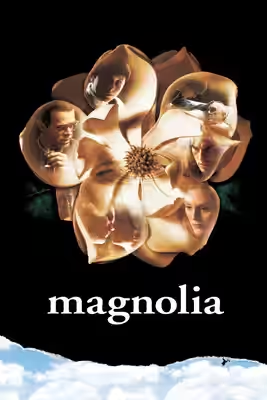
Magnolia poster

Magnolia

1999 · Many lives in one town, cut together until they collide; the structure Cregger is borrowing.

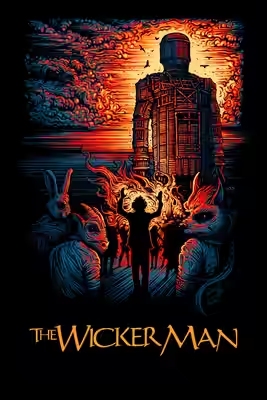
The Wicker Man poster

The Wicker Man

1973 · A policeman, a missing child, a community that smiles too much; the original British version of this dread.