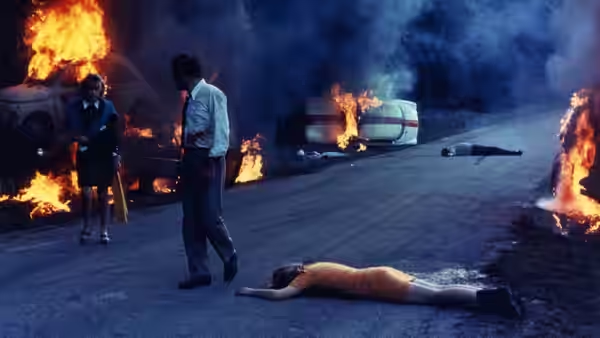
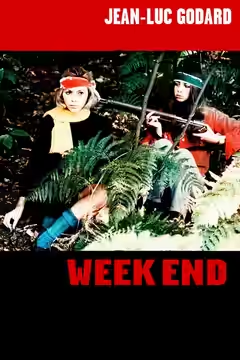
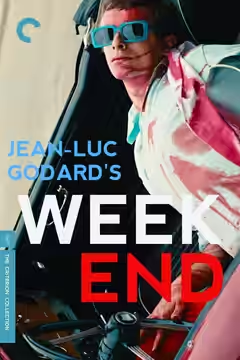
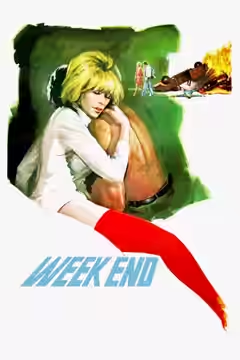
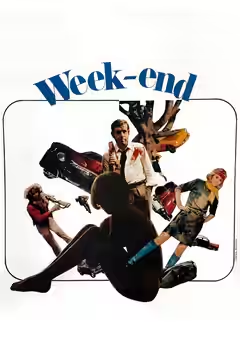
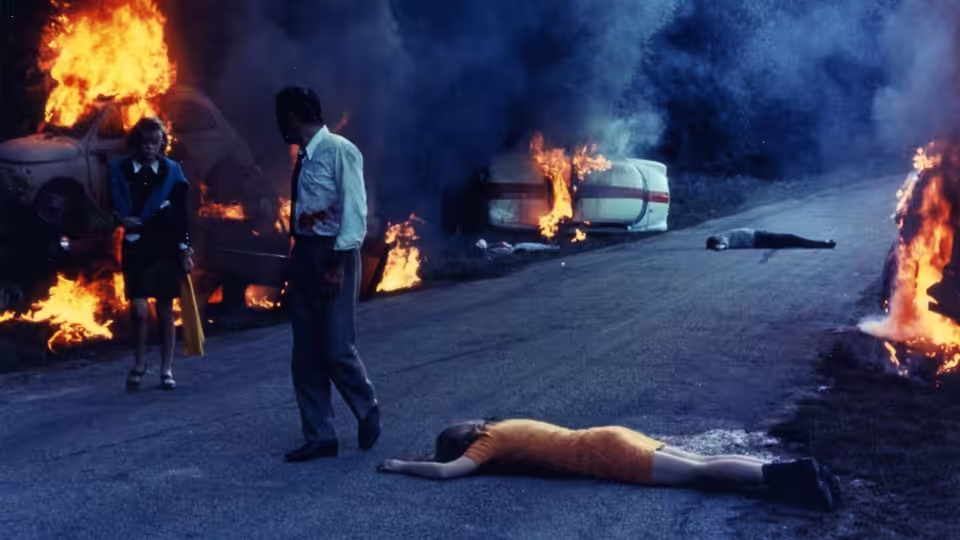
Corinne and Roland stand among burning cars as a woman lies stretched across the road
Film review

Weekend

1967 · Directed by Jean-Luc Godard · 1h 44m

In a sentenceA traffic jam full of people we would hesitate to help with a flat tyre

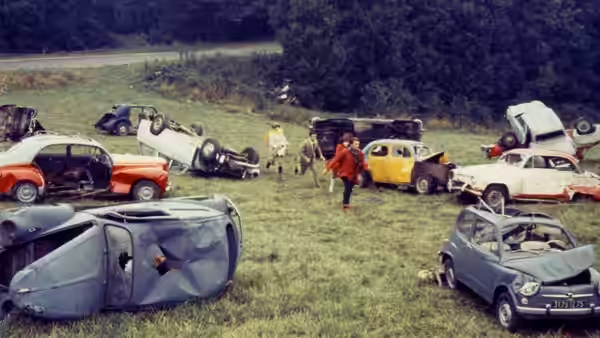
Corinne Durand (Mireille Darc) and Roland Durand (Jean Yanne) are trying to get through a traffic jam. Cars crowd the road, and the pair’s progress depends on a queue of other motorists who also want to move. A young middle-class accident victim (Juliet Berto) is among the figures in the roadside disorder. The camera follows the line of vehicles without cutting away, making the stalled journey last. Getting past other people and their possessions becomes the immediate business of an outing that offers little opportunity to relax.

Plays from YouTube when you press play; nothing loads from them until then.

Fi1m review

Jean-Luc Godard makes a traffic jam funny, ugly and frightening in Weekend, a fierce comedy about people and their possessions. The images remain sharper than the political speeches, which sometimes try our patience.

Weekend is a fierce, funny film with a tiresome habit of explaining why it is angry. Jean-Luc Godard writes and directs a comedy in which being stuck in traffic becomes reason enough to lose faith in respectable people. His attack on consumerism works because the objects are so ordinary: a road full of cars needs little explaining. We recommend it, provided long political speeches do not cancel out the pleasure of watching a film this willing to interrupt itself.

The traffic-jam tracking shot is the clearest reason to stay. Raoul Coutard’s camera travels beside the queue without a cut, allowing the sheer quantity of cars to become oppressive. We laughed, then began to feel trapped. The shot keeps going beyond the point at which the joke would usually end, making us spend time with a blockage we would ordinarily pass in an edit. Its length makes the impatience physical, and the lurid colour gives us little relief.

Mireille Darc’s Corinne Durand and Jean Yanne’s Roland Durand give that hostility two human faces. Their flatness is funny: neither actor works hard to win our affection. That suits a comedy in which the wish to get on with one’s own business can look thoroughly ugly, and their attachment to possessions gives us enough to recognise. Spending so long with such limited sympathies does have a cost, though, and the performances cannot supply much warmth when the writing starts to lecture.

Agnès Guillemot’s editing helps keep interrupting the film’s progress, so the long traffic shot never establishes a pace we can settle into. The changes in image and sound can be abrasive, but they keep familiar comic situations from becoming comfortable. Antoine Duhamel’s music adds to the unease, and there is little encouragement to sit back and enjoy the journey. The interruptions demand attention even when the story has given us little reason to care about anybody in it.

The political talk is less successful, and this is where the writing starts to exhaust the goodwill earned by the pictures. Some passages go on after their point is clear, leaving us with little to do except register agreement or resistance. We have already understood the disgust with consumerism by watching the queue, so being told about it feels unnecessary. A speech can keep insisting without adding anything, whereas the tracking shot keeps giving us more to look at.

Among comedies about class, Weekend is unusually unwilling to let us enjoy the bad manners and then go home pleased with ourselves. Its nastiness can be exhausting, and 104 minutes is ample time to discover how much of it we can take. Yet the traffic jam stays troubling because it makes such recognisable selfishness look both ridiculous and dangerous. Choose it for a night when an argument afterwards would be welcome.

Critical consensus AI synthesised

83
Positive
5
Mixed
1
Negative
0

Most critics are strongly favourable towards Weekend, praising Godard’s attack on consumerism and bourgeois society as well as the disruptive techniques through which he delivers it. The praise centres on the film’s political anger, its unsettling use of image and sound, and the uninterrupted tracking shot through a traffic jam. Across the positive reviews, its formal experiments are central to why the satire continues to register, rather than distractions from its targets.

The reservations concern moments when the politics become overbearing and tensions within the film’s rejection of bourgeois culture. Slant Magazine finds one passage of political dialogue slips into diatribe. The New Yorker notes ideological and aesthetic tensions, finding wistfulness in the Mozart performance sequence. The recorded scores range from mixed to enthusiastic, but the lower-scored New York Times entry has no accessible text, limiting what can be said about its dissent.

Slant Magazine
29 August 2005 · ★★★★/4 · Eric Henderson
100

The critic finds the film’s nihilism compelling and its formal experimentation makes it endure as one of Godard’s most beloved works. They single out its lurid visual and audio-visual disruptions, while noting that one stretch of political dialogue becomes diatribe.

Read the full review →
The AV Club
7 September 2005 · Nathan Rabin
90*

Rabin presents the film as an exhilarating, still-resonant work of apocalyptic anger. He particularly praises its legendary, uninterrupted traffic-jam tracking shot and its incisive attack on consumerism.

Read the full review →
The New Yorker
12 October 2011 · Richard Brody
90*

Brody regards Godard’s film as a superb, furious rejection of consumerism, while noting its ideological and aesthetic tensions. He singles out the Mozart performance sequence as a wistful glimpse of an artistic world the film leaves behind.

Read the full review →
Time Out
· TM
80*

The critic presents the film as a savage satire of bourgeois society. The description also singles out its vision of bourgeois cataclysm, while noting Godard’s later retreat from commercial cinema.

Read the full review →
Empire
21 July 2006 · David Parkinson
75*

Parkinson regards the film as a politically driven polemic that nevertheless succeeds as a masterpiece. He singles out its audacious, formally disruptive use of cinematic techniques and its famous traffic-jam sequence.

Read the full review →
The New York Times
5 January 2001
64*

The page content is unavailable, so the critic’s verdict cannot be determined. No praise or complaint from the review can be verified.

Read the full review →

Straight answers AI written, from our review

Is Weekend worth watching?
Weekend is worth watching for its fierce social comedy and unnerving visual invention; we score it 81 out of 100. The unbroken journey along a traffic jam makes ordinary selfishness funny and oppressive, but the long political speeches test our patience. We recommend it for an evening when abrasive humour and an argument afterwards would be welcome.

How long is Weekend, and what is it rated?
Weekend runs 1h 44m. It is a comedy film.
Where can I watch Weekend in Croatia?
Weekend is not on any streaming or rental service in Croatia at the moment. It is available in 4 other countries; change your country at the top of the page to see where. Availability is checked daily.
How violent or frightening is Weekend, and is it suitable for children?
Weekend carries a UK 18 certificate and is not suitable for children. We find its prolonged traffic jam, lurid colour and abrasive changes in image and sound oppressive, while the comedy makes recognisable selfishness seem dangerous. The certificate marks it as adult viewing, though those details alone do not establish how graphic its violence is.
How does Weekend compare to The Exterminating Angel?
Weekend makes social cruelty loud and abrasive, while The Exterminating Angel gives it a colder treatment, trapping the rich in a drawing room rather than a traffic jam. We favour the latter for viewers drawn to unexplained absurdity; Godard’s film suits those who want an explicit political attack, though its speeches are less effective than its images.
What should I watch after Weekend?
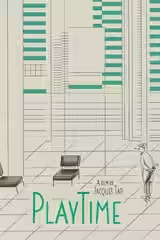
After Weekend, try The Exterminating Angel (1962, Fi1m 87): Polite society discovers how little civilisation survives a prolonged inconvenience. Then Playtime (1967, Fi1m 88): Modern life becomes an elaborate visual joke, with considerably more affection; and Wild Tales (2014, Fi1m 83): Everyday grievances become violent farce, with selfish motorists among the offenders.

Cast

If you liked this, try…

  1. The Exterminating Angel (1962, Fi1m 87)Polite society discovers how little civilisation survives a prolonged inconvenience.

  2. Playtime (1967, Fi1m 88)Modern life becomes an elaborate visual joke, with considerably more affection.

  3. Songs from the Second Floor (2000) · not on Fi1m yetDeadpan absurdity and social anger, delivered through crowded, stubbornly unhurried images.

  4. Wild Tales (2014, Fi1m 83)Everyday grievances become violent farce, with selfish motorists among the offenders.

  5. High-Rise (2015) · not on Fi1m yetClass resentment and consumer comfort turn neighbours into increasingly unpleasant company.