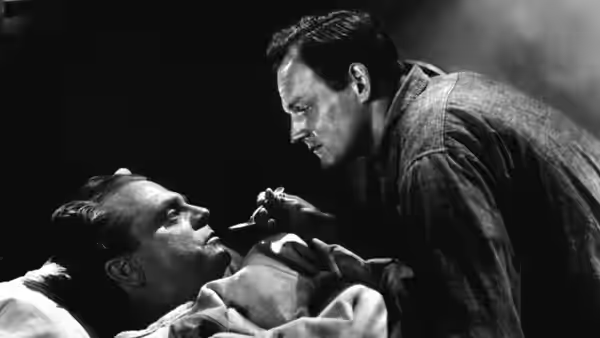
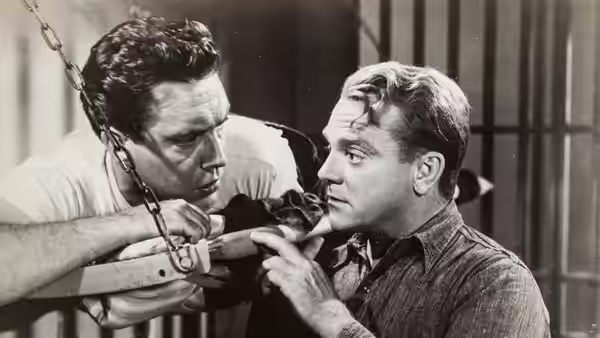
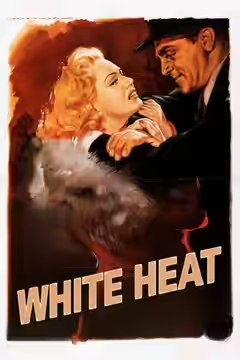
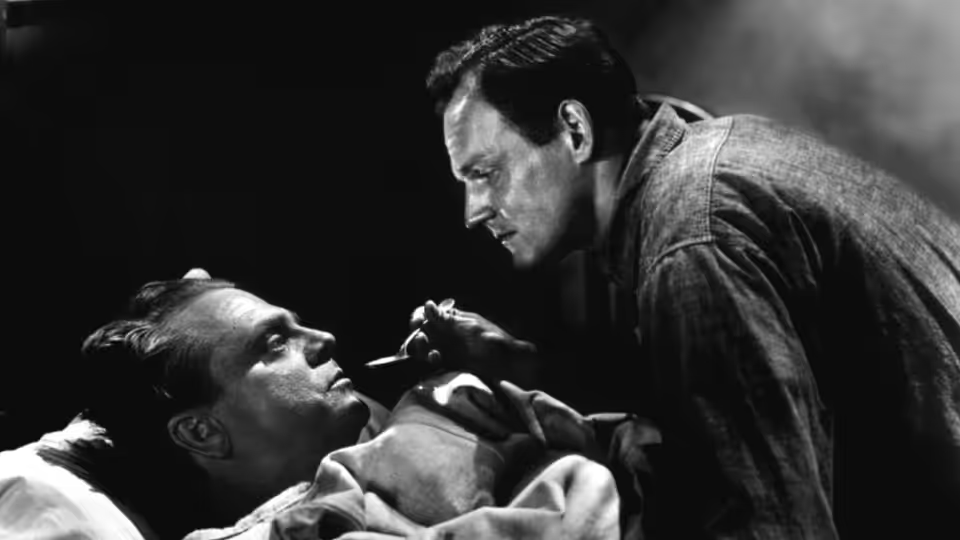
Cody Jarrett (James Cagney) leans over a man lying on a bed
Film review

White Heat

1949 · Directed by Raoul Walsh · 1h 54m

In a sentenceJames Cagney makes a mother’s boy look like a public safety problem

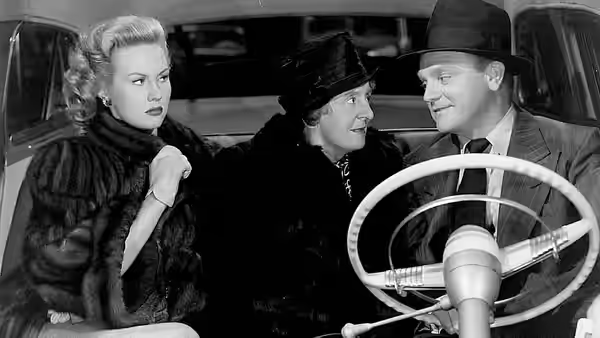
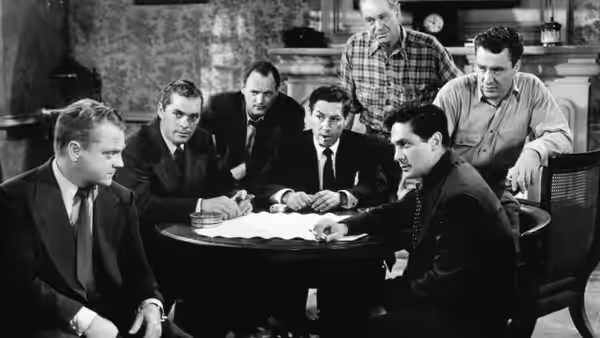
Arthur ‘Cody’ Jarrett (James Cagney) is a criminal whose attachment to his mother, Ma Jarrett (Margaret Wycherly), shapes his dealings with the people around him. Verna Jarrett (Virginia Mayo) and ‘Big Ed’ Somers (Steve Cochran) are part of that circle. Heists bring danger into a life already complicated by Jarrett’s dependence on Ma. He wants to exercise authority over others, but his need for his mother makes that authority unstable. Their relationship sits at the centre of his criminal life.

Fi1m review

Raoul Walsh’s crime thriller is worth seeing for James Cagney’s frightening performance alone. Thin psychology and an underused Virginia Mayo hold it back, but the mother-son relationship is difficult to shake.

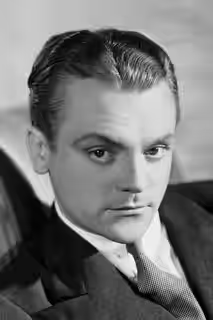
Raoul Walsh’s White Heat is a frightening gangster film, and we recommend it despite its rather easy psychology. James Cagney gives Arthur ‘Cody’ Jarrett enough force to make familiar criminal business feel unsafe. The fascination lies in watching a man who can intimidate others yet depends so heavily on his mother. That dependence is central to the film, and the performance makes it disturbing enough to survive the screenplay’s eagerness to explain him.

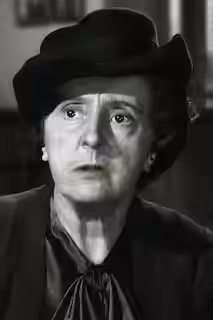
Margaret Wycherly’s Ma Jarrett matters because she makes that attachment convincing without making it comforting. There is something troubling about seeing maternal devotion beside criminal aggression, with neither cancelling the other out. We were unnerved by that closeness, because the need for comfort does nothing to curb his aggression. James Cagney allows the dependence to remain embarrassing, and trusts us to feel the danger in it without needing to like the man.

Sidney Hickox’s cinematography gives the central performance the attention it needs, keeping us alert to a face that never seems entirely settled. We kept watching for the next change of expression, sometimes with more anxiety than the criminal business itself prompted. Owen Marks’s editing helps sustain that vigilance; the pace has purpose without making every pause feel like a delay. The film runs 114 minutes, and its strongest stretches hold our attention through the uncertainty of how Jarrett will respond.

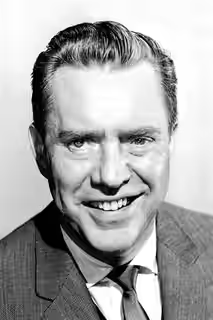
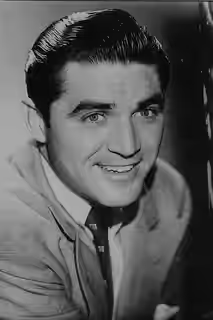
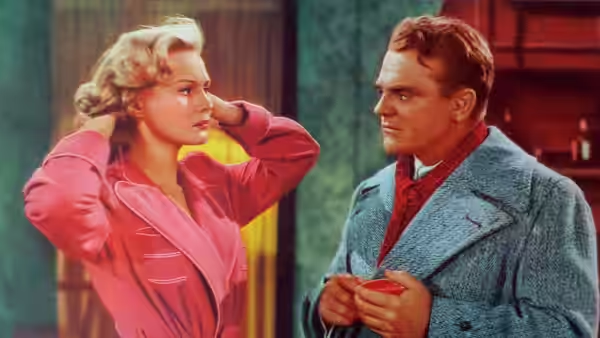
Edmond O’Brien is important to that tension as Vic Pardo, giving the film someone whose care for Jarrett can bear comparison with Ma’s. His steadiness prevents James Cagney’s performance from making everybody else seem incidental. Steve Cochran also registers firmly as ‘Big Ed’ Somers, though Virginia Mayo has far less to work with as Verna Jarrett. She holds our attention, but the writing gives her too little opportunity to make that attention count for much.

The weakness is in how readily the screenplay by Ben Roberts and Ivan Goff treats the mother-son attachment as an explanation. It is a compelling relationship to watch, but it can make a complicated man seem too easily accounted for. The performances suggest feelings that this psychology cannot comfortably explain. That limitation matters because the film asks us to examine Jarrett closely, then seems too satisfied with what it has found in his dependence on Ma.

Max Steiner’s music is effective at sustaining the pressure, though its insistence sometimes feels unnecessary beside such an emphatic lead performance. Raoul Walsh is more persuasive when he lets the people supply the threat. The gangster film’s attraction to forceful men can become an excuse for enjoying their cruelty without much thought. Here, the uncomfortable need for motherly care makes that enjoyment harder, and the film benefits from the discomfort.

This is one to watch when there is time to pay attention to the actors, especially the people sharing a scene with James Cagney. Their responses help us judge how far Jarrett might go, and how much they understand about him. The familiarity of the crime story should not be a deterrent. Choose it for the performances, without expecting a persuasive explanation of what makes a man dangerous.
Critical consensus AI synthesised

74
Positive
2
Mixed
4
Negative
0

The reviews lean favourable, though qualified responses outnumber outright endorsements. Praise centres on James Cagney: the most enthusiastic accounts stress the force and unsettling realism of his performance, and see the film as a disturbing examination of a criminal mind. Even the more reserved assessments find him compelling. The strongest support rests on how vividly he embodies the character’s disturbance, with supporting performances also drawing notice.

Reservations concern the psychology and the familiarity of the material. Slant Magazine finds the Freudian explanation shallow, but credits Edmond O’Brien’s caretaking role with a crucial contribution. Variety treats the film as familiar Cagney territory, praises Steve Cochran and finds Virginia Mayo’s role limited to sex appeal. The recorded scores span qualified approval to strong enthusiasm, with no negative assessments, although two verdicts are inaccessible, limiting how fully the reasons behind the spread can be established.

Radio Times
★★★★★ · Adrian Turner
100

Turner calls it one of the greatest gangster films, describing a nightmarish portrait of a maladjusted criminal. He singles out James Cagney’s demented final outburst as a striking moment.

Read the full review →
Empire
1 January 2000 · David Parkinson
90*

The review calls the film a magnificent examination of the criminal mind and a career high point for Cagney. It especially praises the force and unsettling realism of Cagney’s performance.

Read the full review →
The New York Times
3 September 1949 · Bosley Crowther
65*

The page content is inaccessible, so the critic’s verdict cannot be verified. No specific praise or complaint is available from the accessible text.

Read the full review →
Time Out
· PH
65*

The available page identifies this as a review, but its verdict is not accessible. The snippet singles out Cagney’s relationship with his mother and the mythological framing of the heists.

Read the full review →
Slant Magazine
4 February 2005 · ★★½/4 · Eric Henderson
62

The review finds the film compelling as a showcase for Cagney, despite criticizing its shallow Freudian psychology. It praises Edmond O’Brien’s role as crucial to the film’s success and highlights the parallel between his character’s caretaking and the mother-son relationship.

Read the full review →
Variety
31 December 1948 · Variety Staff
60*

The review presents the film as a familiar but still-popular showcase for James Cagney. It praises Steve Cochran’s capable supporting performance, while noting Virginia Mayo has little to do beyond looking sexy.

Read the full review →

Straight answers AI written, from our review

Is White Heat worth watching?
White Heat is worth watching for James Cagney’s frightening performance, especially if we want a gangster film that makes its central criminal uncomfortable company; we score it 86 out of 100. His dependence on his mother gives the familiar crime story its disturbing force, though the psychology is too tidy and Virginia Mayo deserves more to do.
How long is White Heat, and what is it rated?
White Heat runs 1h 54m. It is a crime and drama film.
Where can I watch White Heat in Argentina?
White Heat is not on any streaming or rental service in Argentina at the moment. It is available in 4 other countries; change your country at the top of the page to see where. Availability is checked daily.
How violent or frightening is White Heat, and is it suitable for children?
White Heat has a UK 15 certificate and is unsuitable for children, with its frightening criminal aggression making it a better fit for older teenagers and adults comfortable with menace. We find Cagney’s unstable authority and unsettling dependence on his mother disturbing; the threat comes as much from uncertainty about his responses as from the criminal business.
How does White Heat compare to The Public Enemy?
White Heat is our choice over The Public Enemy for a more unsettling central relationship, while the earlier film suits an appetite for brisk gangster storytelling and biting dialogue. We find Cagney frightening in both, but his dependence on his mother gives White Heat a particular discomfort, despite a screenplay too eager to explain him through it.
What should I watch after White Heat?
After White Heat, try The Public Enemy (1931, Fi1m 83): James Cagney’s aggression supplies another reason to distrust a gangster’s charm. Then The Long Good Friday (1980, Fi1m 88): A commanding criminal finds that confidence cannot keep his world in order; and Animal Kingdom (2010, Fi1m 84): Family protection grows frightening when maternal loyalty extends to a criminal household.

Cast

Awards

Academy Awards, 1950

Nominated
Best Story

If you liked this, try…

  1. The Public Enemy (1931, Fi1m 83)James Cagney’s aggression supplies another reason to distrust a gangster’s charm.

  2. Rififi (1955) · not on Fi1m yetFor criminal professionalism, uneasy loyalties and suspense built through patient attention.

  3. Pale Flower (1964) · not on Fi1m yetAnother dangerous criminal becomes compelling through restraint, uncertainty and careful observation.

  4. The Long Good Friday (1980, Fi1m 88)A commanding criminal finds that confidence cannot keep his world in order.

  5. Animal Kingdom (2010, Fi1m 84)Family protection grows frightening when maternal loyalty extends to a criminal household.