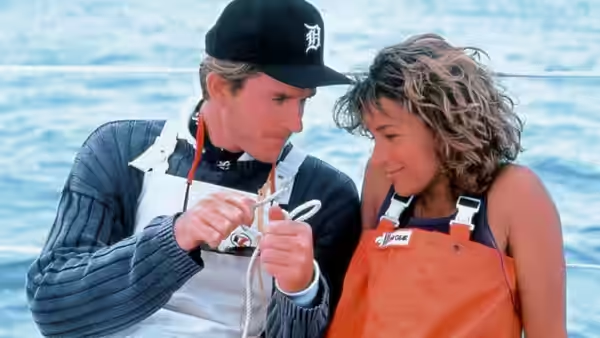
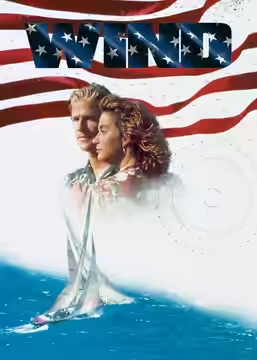
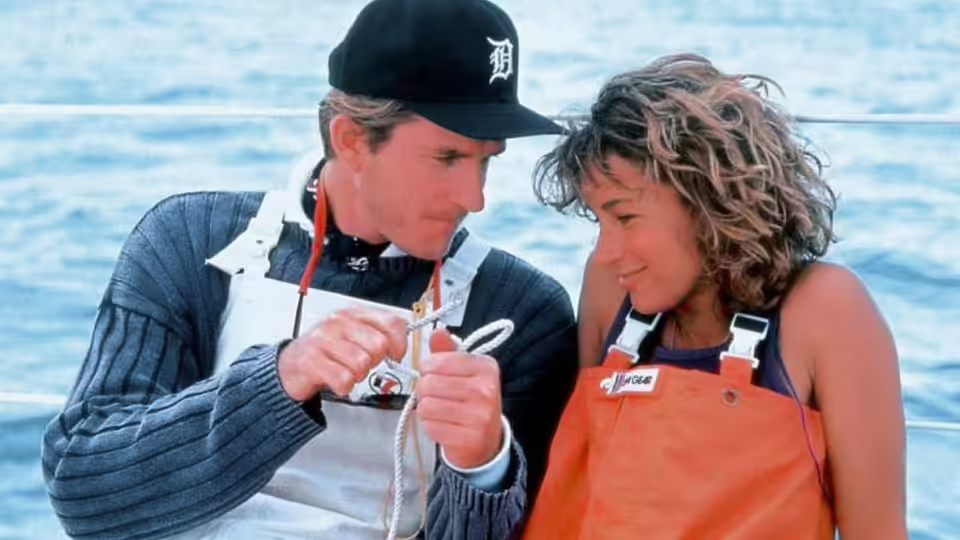
Will Parker (Matthew Modine) shows Kate Bass (Jennifer Grey) how to handle sailing lines beside the water
Film review

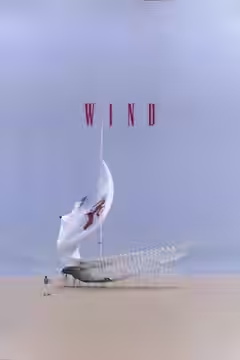
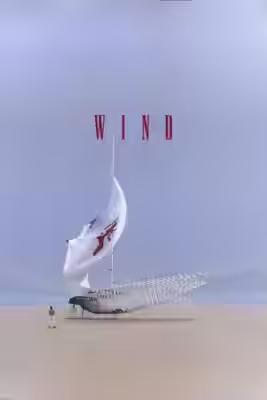
Wind

1992 · Directed by Carroll Ballard · 2h 06m

In a sentenceGlorious on the water, becalmed the moment anyone steps ashore

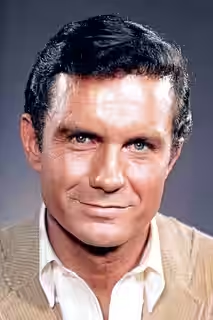
Newport, Rhode Island. Will Parker (Matthew Modine) sails on the crew of Morgan Weld (Cliff Robertson), the wealthy yachtsman who holds the America’s Cup and means to keep it. Will’s girlfriend Kate Bass (Jennifer Grey) is as good a sailor as any man aboard, and Weld will not have a woman on his boat, so she is left behind. The challenger is Australian, skippered by Jack Neville (Jack Thompson), who has crossed the world to take the Cup home. The first act is the defence: the big racing yachts towed out of the harbour at dawn, the grinders at their handles, the start-line duels, the spinnakers going up. Then, in the deciding race, Will makes one call on the water, and the Cup leaves America.

Plays from YouTube when you press play; nothing loads from them until then.

Fi1m review

Carroll Ballard shoots the racing from the rail, with spray on the lens and the deck tilted past forty degrees, and it is thrilling every time. Between races the film tells a thin story about a thin man, and the wind drops.

Carroll Ballard made The Black Stallion and Never Cry Wolf, two films in which a person is attached to something larger than themselves and the camera is more interested in the larger thing. Wind is the same arrangement with yachts. Will Parker (Matthew Modine) sails for Morgan Weld (Cliff Robertson) in the defence of the America’s Cup, loses it, and spends the rest of the film trying to get it back, and the shape of that, from a story by Roger Vaughan, Jeff Benjamin and Kimball Livingston and a script by Mac Gudgeon and Rudy Wurlitzer, is the shape of every sports picture ever made. The verdict is simple. On the water this is as good as sailing has ever looked on a screen. On land it is a film waiting for the tide.

The racing is the reason it exists and the reason to see it. John Toll puts the camera on the rail with the deck tilted past forty degrees, down at water level with the bow coming over the lens, and up in a helicopter looking down on two white triangles on a green sea. You see the grinders’ arms, the sheets running out, the spinnaker going up in a bag and then filling with a crack. Michael Chandler cuts between the two boats so that, without knowing a thing about the sport, we always knew who was ahead and by how much, which is more than most racing films manage. Basil Poledouris scores it with brass and a wide string theme that would be too much anywhere else and is right here.

When Weld’s boat loses the Cup, we felt it as a blow, and we were surprised, because nothing in the writing had earned it. Toll and Chandler had, by letting us watch the two yachts tack towards the mark for several minutes with almost no dialogue, so that one wrong call on the water reads as plainly as a dropped catch. That is Ballard’s gift. He trusts a picture to carry a scene and he is usually right.

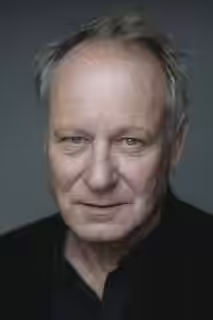
Then everyone goes ashore. Modine plays Will as an agreeable blank; asked to be a man who has thrown away the oldest trophy in his sport, he looks like a man who has mislaid a jumper. Jennifer Grey has the better part, a sailor as good as anyone on the crew who is kept off the boat because Weld does not want a woman aboard, and the script raises that grievance in the first reel and then more or less forgets it. Robertson plays Weld as a man whose money has made him courteous, which is nicely judged and little used. Jack Thompson, as the Australian skipper Jack Neville, is the only person who appears to be enjoying himself, and we were glad every time he turned up. Stellan Skarsgård, as the designer Joe Heiser, gives a part that could have been silly a dry intelligence, and Rebecca Miller as Abigail Weld does what she can with a woman defined by her cheque book.

The middle hour is the problem. The story takes Will inland and the film, which has been alive on the water, goes slack. There is a romance that neither Modine nor Grey seems to believe in, a stretch of boat-building that Lawrence Eastwood’s production design makes handsome, all sawdust and cold light in a long shed, and a good deal of talk about wanting it badly enough. We were bored in the desert, and bored in a way that felt avoidable, because every time the film cut back to water it recovered inside a shot. Marit Allen’s costumes, faded cottons and crew jackets, are more carefully observed than most of the people wearing them.

Measured against Ballard’s own earlier films, Wind is the weakest of the three, because the first two had the sense to keep their human beings quiet. The Black Stallion goes most of an hour with a boy and a horse and almost no words. Here the sailors talk, and what they say is what sailors say in films. At 126 minutes there is a tighter picture inside this one, and it would be nearly all sea.

Most critics have found the story clumsy enough to sink the whole, and we see their point. We are a little warmer because of what Toll did on the water, and because we have not often sat through a sport we do not follow and understood every tack. See it on the largest screen you have, and expect to reach for the remote whenever the boats are tied up.

Critical consensus AI synthesised

47
Positive
0
Mixed
2
Negative
3
RogerEbert.com
64*

The page appears to be a review of the specified film, but its contents are inaccessible. I cannot determine the critic’s verdict or what the review singles out.

Read the full review →
The New York Times
11 September 1992 · Janet Maslin
64*

The page’s article text is inaccessible, so the critic’s verdict cannot be established. No specific praise or complaint can be verified from the available page.

Read the full review →
Time Out
· MK
40*

The available description suggests a mixed-to-negative verdict, calling the film formulaic despite its buoyant feel. It singles out the competitive-yachting setting while faulting the familiar sports-movie formula.

Read the full review →
Empire
1 January 2000 · Matt Mueller
35*

The critic finds the film’s sailing action exhilarating but says formulaic, slow stretches keep it from becoming an exceptional adventure. The recreation of the America’s Cup final is singled out for its physicality and suspense.

Read the full review →
Los Angeles Times
11 September 1992 · Kenneth Turan
30*

Turan finds the film’s sailing races exciting but judges its story inept and dramatically choppy. He praises the vivid racing footage and occasional romantic sentimentality, which cannot overcome the plot’s weaknesses.

Read the full review →

Straight answers AI written, from our review

Is Wind worth watching?
Wind is worth watching for anyone who wants to see sailing filmed as well as it has ever been, and we scored it 60. The America’s Cup racing, shot by John Toll from the rail with the deck tilted past forty degrees, is thrilling every time; the story ashore, with Matthew Modine as an agreeable blank, is thin and slack for most of the middle hour.
How long is Wind, and what is it rated?
Wind runs 2h 06m. It is an action and drama film.
Where can I watch Wind in Canada?
Wind is available to rent from Amazon Prime Video from CA$4.99. Availability is checked daily; the links above go straight to each service.
How does Wind compare to The Black Stallion?
Wind is Carroll Ballard’s weaker film, and The Black Stallion is the one to choose. Both attach a person to something larger than themselves and point the camera at the larger thing, but the earlier film keeps its people quiet for most of an hour, while here the sailors talk and the film goes slack whenever they step ashore. If you only want the racing, Wind delivers it; for a whole picture, go to the horse.
What should I watch after Wind?
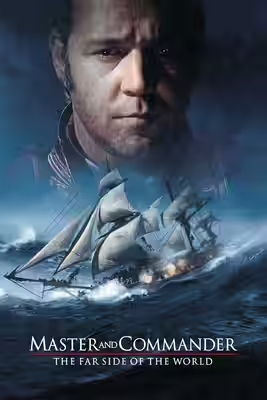
After Wind, try The Black Stallion (1979, Fi1m 87): Ballard at his best, trusting a boy, a horse and a beach to carry an hour. Then Maiden (2018, Fi1m 80): The all-woman crew Kate Bass was never allowed to join, round the world and for real; and Master and Commander: The Far Side of the World (2003, Fi1m 86): Sail, weather and wood photographed with the same seriousness, plus a story that holds.

Cast

If you liked this, try…

  1. The Black Stallion (1979, Fi1m 87)Ballard at his best, trusting a boy, a horse and a beach to carry an hour.

  2. Maiden (2018, Fi1m 80)The all-woman crew Kate Bass was never allowed to join, round the world and for real.

  3. Master and Commander: The Far Side of the World (2003, Fi1m 86)Sail, weather and wood photographed with the same seriousness, plus a story that holds.

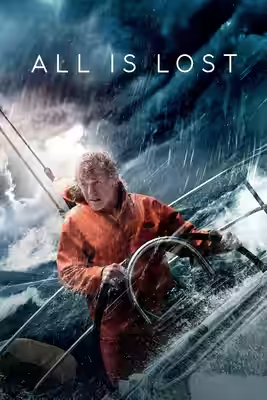
  4. All Is Lost (2013, Fi1m 82)One man, one sinking yacht, almost no dialogue; what Wind might have been ashore too.

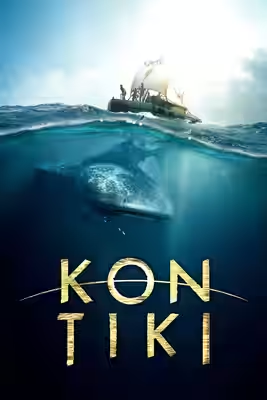
  5. Kon-Tiki (2012) · not reviewed yetA Norwegian raft across the Pacific, shot with a camera that loves open water.

Free account

Know what to watch tonight

Two lists that know where things are streaming, collections you can share, your own score beside ours, and Discover that remembers what you have seen.

  • Want to see, sorted by what is streaming now
  • Seen, with your score out of ten
  • No adverts, ever