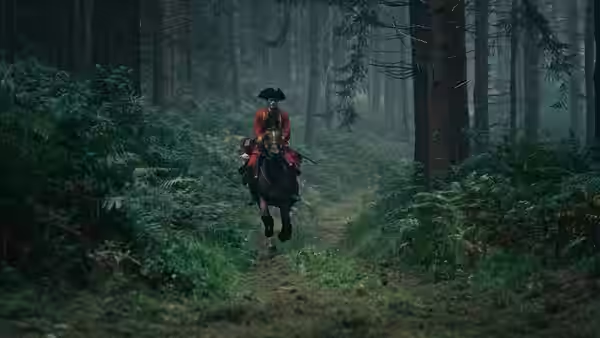
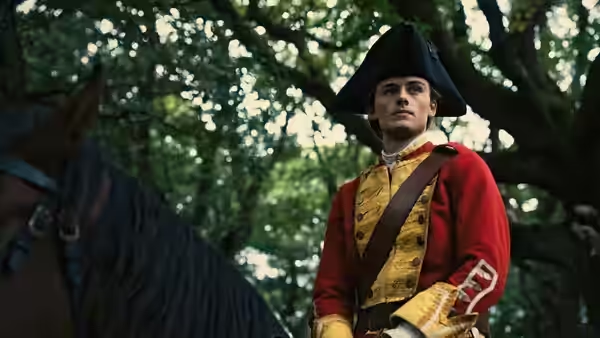
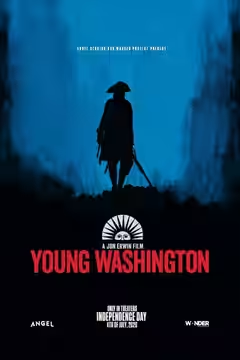
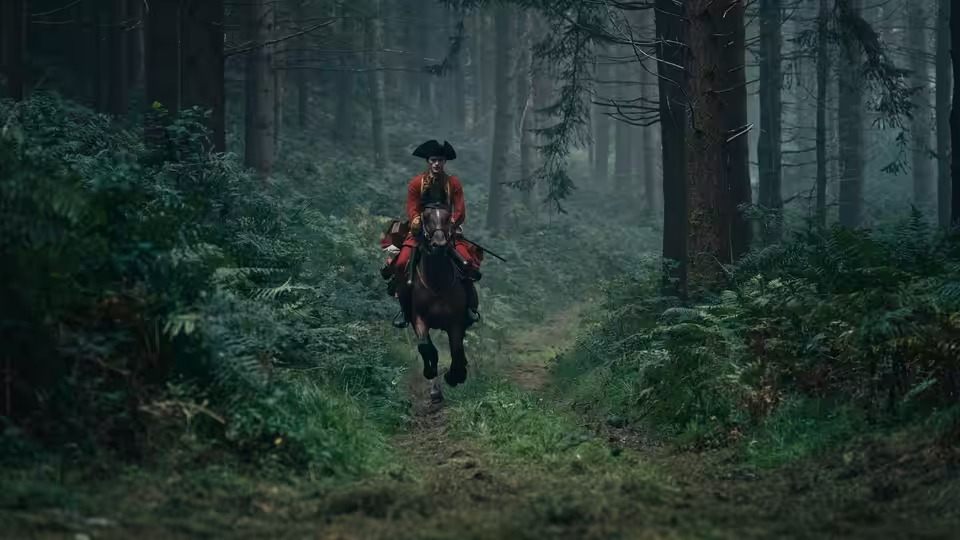
George Washington (William Franklyn-Miller) rides a horse along a forest path
Film review

Young Washington

2026 · Directed by Jon Erwin · 2h 01m · MPA PG-13

In a sentenceA George Washington who cannot lose, cannot doubt and, on this evidence, cannot be interesting

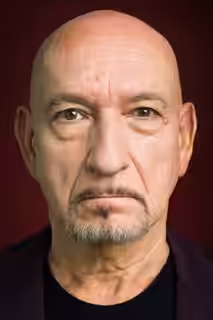
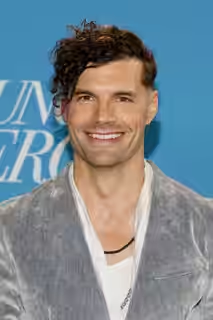
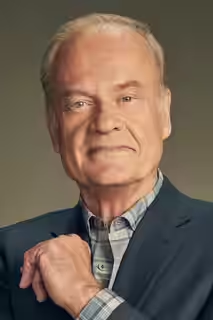
Virginia, the 1750s. George Washington (William Franklyn-Miller), a young surveyor from a planter family, wants to follow his older half-brother Lawrence (John Foss) into a soldier’s commission. Lieutenant Governor Robert Dinwiddie (Ben Kingsley) sends him west with the frontiersman Christopher Gist (Leo Hanna) to carry a message to the French, who are building forts in the Ohio country that Britain claims. At home his mother Mary (Mary-Louise Parker) would rather he stayed on the land, Lord Fairfax (Kelsey Grammer) is the patron who can make his career, and Sally Cary (Mia Rodgers) is the young woman he cannot stop looking at, though William Fairfax (Joel Smallbone) is the one courting her. Somewhere behind him, General Edward Braddock (Andy Serkis) is bringing British regulars.

Plays from YouTube when you press play; nothing loads from them until then.

Fi1m review

Jon Erwin’s account of George Washington’s first war is handsomely built and stiff as a portrait. It admires its man so completely that it forgets to make him one, and the battles it stages with care are undone by a hero nothing can touch.

Jon Erwin directs, and writes with Tom Provost and Diederik Hoogstraten, a film about George Washington before anybody had heard of him: a young Virginia surveyor in the 1750s, sent west by Lieutenant Governor Robert Dinwiddie into forests where Britain and France are arguing over the Ohio country. The tagline says that 250 years of history begins with one man, and the film believes it. That is the trouble. William Franklyn-Miller plays Washington as tall, quiet and correct in every scene, and in 121 minutes we did not see him do one thing he turned out to be wrong about. A man who is never wrong is not a character. He is a statue that has been given lines.

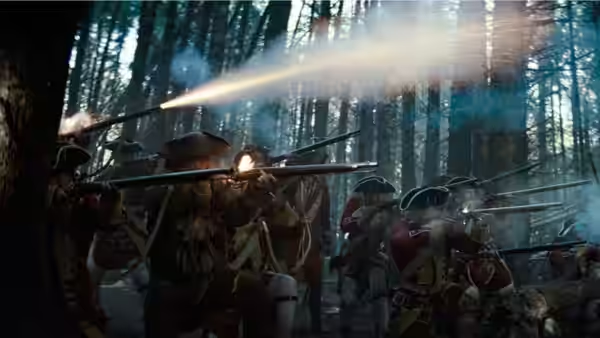
The ground it stands on is solid. Kristopher Kimlin shoots the woods and rivers in clear grey daylight, and in the fighting you can always tell which side is where, which is more than many larger war films manage. Chad Krowchuk’s production design gives the Virginia houses and the frontier forts a used look; the timber seems cut rather than bought. Nadine Powell’s costumes let you tell a British regular from a colonial officer from a woodsman at a glance. The skirmishes are staged with evident care for how the thing was actually done, and for a while we thought the film might earn its plainness.

The cast is better than the writing. Ben Kingsley plays Dinwiddie as a man counting the cost of everything, and he supplies the few dry minutes the film has. Kelsey Grammer’s Lord Fairfax is a patron who enjoys being one. Mary-Louise Parker, as Mary Washington, is given a worried mother and does what can be done with a worried mother. Mia Rodgers and Joel Smallbone, as Sally Cary and William Fairfax, are the two points of a love triangle that one of the film’s own teasers, titled around who Sally will choose, sells harder than the film does. Andy Serkis arrives as General Edward Braddock, a man who knows how war is fought and will not be told otherwise, and he is the only person on screen allowed to be a fool.

The screenplay is the problem, and it is the problem most critics have named. Everyone speaks in sentences that could be cut into a plaque. Washington is told he is destined for something, and then he is destined for it, and nothing between the telling and the arriving costs him anything. We were bored, and then we minded being bored, because a young man with a rich patron, a dead brother’s example and a war he helped start is not boring material. The enslaved people who worked the land these families lived from do not appear, and the film does not seem to have noticed the gap. Parker Adams and David de Vos cut it as a run of episodes, each ending on a lesson, so that it plays like a very expensive schools programme.

The last stretch, which we will not describe, sends Washington through a battle as though he had been issued with a different set of rules from everyone else. The effects that have to carry it, the smoke and the shot, are not good enough to bear the weight, and the Kiners’ score climbs under every near miss to tell us how to feel about it. We laughed once, at a moment plainly built to lift us out of our seats, and then felt slightly mean, because the film’s earnestness is not a crime. It is only a substitute for drama.

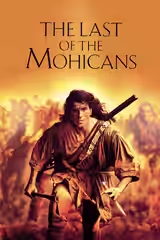
Michael Mann filmed this same war in The Last of the Mohicans (1992) and understood that the forest was frightening and the men in it were tired and afraid. Erwin’s forest is a backdrop and his men are examples. Against the genre’s own standards this is a modest, tidy picture that never once risks the audience’s good opinion of its hero.

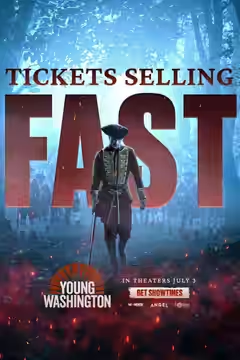
One of its teasers calls it the number one action film in America, and there is an appeal for money attached to the end. Both tell you what sort of film this is. Families who want their history with the awkward parts sanded off will get exactly that, and a decent cast in good coats. Everyone else will spend two hours waiting for the man to make a mistake, and he never does.

Critical consensus AI synthesised

30
Positive
0
Mixed
2
Negative
4
Variety
30 June 2026 · Owen Gleiberman
50*

Gleiberman finds the film watchable but stolid, offering schoolbook patriotism rather than a nuanced sense of history. He praises its competent, crisp evocation of the childhood biographies’ feel while cautioning against mistaking feel-good heroism for historical lessons.

Read the full review →
Los Angeles Times
2 July 2026 · Katie Walsh
20*

Walsh finds the film simplistic and unentertaining, calling it a hagiographic history lesson rather than a compelling blockbuster. She singles out Washington’s lack of complexity, blaming a cookie-cutter screenplay for flattening him into a basic hero.

Read the full review →
The Hollywood Reporter
2 July 2026 · Frank Scheck
20*

Scheck finds the film stiff, stodgy, and overly patriotic. He praises the battle scenes’ historical accuracy but says unconvincing effects undermine them.

Read the full review →
The AV Club
6 July 2026 · Jacob Oller
15*

Oller pans the film as empty, self-aggrandizing mythmaking disguised as an action movie. He especially criticizes its finale for portraying Washington as a near-invulnerable, single-handed battlefield hero.

Read the full review →
Deadline
2 July 2026 · Pete Hammond
60*

Hammond finds the patriotic origin story watchable, though it feels more suited to the History Channel than a wide summer theatrical release. He praises the realistically staged battle sequences and their cinematography.

Read the full review →
The Wrap
2 July 2026
25*

The critic finds the biopic somewhat competent but ultimately undermined by its patriotic simplifications and fundraising appeal. They praise its visual clarity and convincing settings, while objecting to its omission of slavery and its romanticized account of Washington.

Read the full review →

Straight answers AI written, from our review

Is Young Washington worth watching?
Young Washington is not worth watching for most people, and we scored it 33. It is handsomely built, with clear battle scenes and a decent cast in good coats, but its hero is never allowed to be wrong, doubt anything or lose, so two hours pass without drama. Families who want their history with the awkward parts sanded off will get exactly that.
How long is Young Washington, and what is it rated?
Young Washington runs 2h 01m and is rated PG-13 by the MPA in the US. It is a history and war film.
Where can I watch Young Washington in the US?
Young Washington is available to rent from Amazon Prime Video and Apple TV from $19.99. Availability is checked daily; the links above go straight to each service.
What should I watch after Young Washington?
After Young Washington, try The Last of the Mohicans (1992, Fi1m 84): The same war, with fear in the forest and men who can actually die. Then Barry Lyndon (1975, Fi1m 85): Kubrick’s eighteenth century: candlelight, muskets and a hero who is wrong about nearly everything; and John Adams (2008, Fi1m 81): A founder who is vain, difficult and human, across seven patient episodes.

Cast

If you liked this, try…

  1. The Last of the Mohicans (1992, Fi1m 84)The same war, with fear in the forest and men who can actually die.

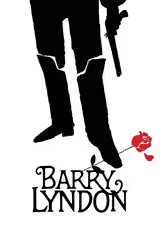
  2. Barry Lyndon (1975, Fi1m 85)Kubrick’s eighteenth century: candlelight, muskets and a hero who is wrong about nearly everything.

  3. Culloden (1964) · not on Fi1m yetPeter Watkins films a 1746 battle as a newsreel; nobody comes out of it a legend.

  4. John Adams (2008, Fi1m 81)A founder who is vain, difficult and human, across seven patient episodes.

  5. Turn: Washington's Spies (2014) · not on Fi1m yetWashington at a distance, and the ordinary people who lied for him.