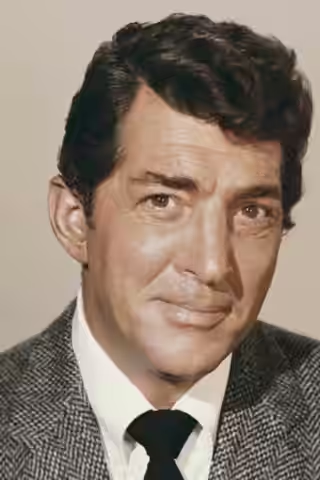
Dean Martin's trick was to look as though he had not prepared, and to have prepared exactly enough. In the right part that is acting. In the wrong one it is a man waiting to go back on stage.
Fi1m perspective
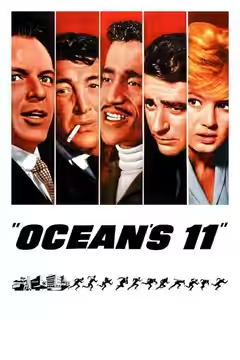
Sam Harmon is found at a piano in Ocean's Eleven (1960), and he sings, and for a moment it is hard to say whether we are watching a character or the act. That is where Dean Martin sits in most of his films. He arrives looking as if he has not read the pages, lands the line half a beat late and half a tone lower than anyone expected, and gives the impression he could take or leave the whole business. The job for the viewer is working out when that is the part and when it is the man.
He came to films as half of an act. Martin and Lewis formed in 1946 and made sixteen films together before the split in 1956, which was not friendly; Martin sang and Lewis did the rest. His first film alone, Ten Thousand Bedrooms (1957), did not suggest anything better was coming. Then, inside two years, came The Young Lions (1958) with Brando and Clift, Some Came Running (1958) with Sinatra and Shirley MacLaine, and Rio Bravo (1959), in which Howard Hawks cast him as Dude beside John Wayne and people began to take him seriously as an actor. Three films, and a reputation.
After that came the Rat Pack, and with it the image: the glass, the drawl, the look of a man between sets. Ocean's Eleven fixed it, and we did not much like the film. We were bored through its first hour and then irritated at being bored, because Martin, like everyone in it, was plainly capable of more and had decided not to bother. He was still the one we minded least. Sam Harmon is written as the sceptic who thinks the job is a bad idea, and Martin's half-asleep delivery is what a sceptic sounds like. Sinatra plays a man who cannot be surprised and comes across as a man who cannot be interested; Martin plays a man who is not interested and makes that the character.
That is the limit as well as the gift. From 1965 to 1974 he hosted a television variety programme on which the not-bothering was the whole act, tipsy and under-rehearsed on purpose, and the films of those years asked for the same. Once the image is what you are hired for there is nothing to play against. Airport (1970) was a large film and he was Dean Martin in it, which is what the audience had come for and less than Hawks had got out of him. Hawks wanted an actor. Most of what came later wanted a name.
He said of a Martin and Lewis shoot, "Why the hell should I come in on time? There's not a damn thing for me to do." He was complaining about the work. It also describes the problem. Start with Rio Bravo, where somebody gave him something to do, and come to Ocean's Eleven afterwards, with the first hour forgiven in advance.
Biography
Dean Martin was an American actor and singer. Born Dino Paul Crocetti on 7 June 1917 in Steubenville, Ohio, he died on 25 December 1995.
He first gained prominence as part of a comedy double act with Jerry Lewis, appearing together in films such as My Friend Irma (1949) and At War with the Army (1950). The partnership ended in 1956. Martin subsequently pursued a solo career in film, television and music.
He was a member of the Rat Pack alongside Frank Sinatra, Sammy Davis Jr., Peter Lawford and Joey Bishop. His film roles include Dude in Rio Bravo (1959), Bama Dillert in Some Came Running (1958), Sam Harmon in Ocean's Eleven (1960), Vernon Demerest in Airport (1970) and Jamie Blake in The Cannonball Run (1981).