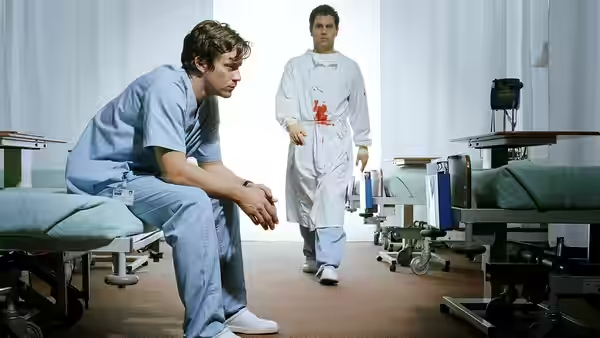
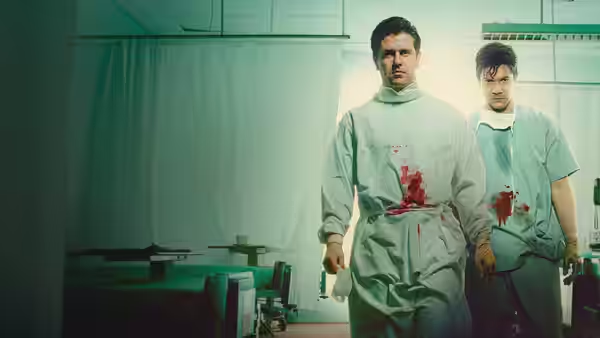
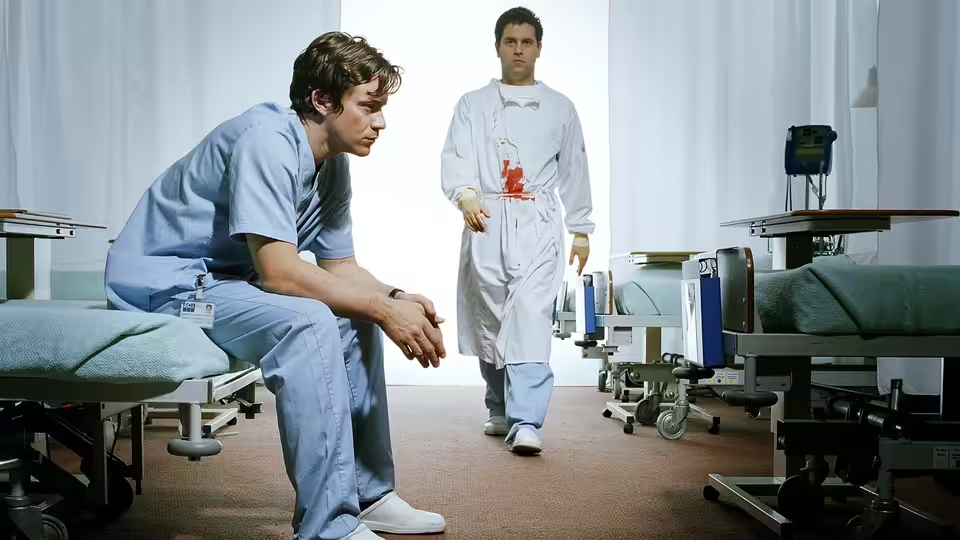
Man in blue scrubs sits on hospital bed as blood-stained colleague stands nearby
Series review

Bodies

2004 · Created by Jed Mercurio · Series · 1h 00m

In a sentenceA hospital drama in which asking for the consultant is not necessarily an improvement

On an obstetrics and gynaecology ward, medical mistakes become entangled with the relationships between the people responsible for patients’ care. Doctors and nurses negotiate professional loyalties, personal affairs and decisions about how to respond when something goes wrong. Max Beesley plays Rob Lake, Patrick Baladi plays Roger Hurley, and Keith Allen plays Tony Whitman. Created and written by Jed Mercurio, the series follows a workplace where failures of communication and judgement can have consequences beyond the staff involved. The cast also includes Tamzin Malleson as Polly Grey and Neve McIntosh as Donna Rix.

Fi1m review

A hospital drama worth braving for Patrick Baladi’s frighteningly plausible consultant. Jed Mercurio’s writing sometimes wanders into workplace romance, but its account of medical failure earns the distress it causes.

Created and written by Jed Mercurio, Bodies makes a hospital ward frightening without needing anyone to behave like a villain. This is an absorbing, often upsetting series, with performances good enough to carry its occasional lapses into soap. The obstetrics and gynaecology setting puts responsibility for other people’s bodies into unusually sharp focus. Mercurio concentrates on the dreadful possibility that the person entrusted with that responsibility may be bad at the job, and that everyone nearby still has a working day to get through.

Patrick Baladi’s Roger Hurley is the crucial performance: an incompetent consultant played without a reassuring label telling us to hate him. Baladi makes us look for danger in ordinary professional behaviour, where a more emphatic performance would let us spot it at once. He avoids the familiar hospital tyrant who announces himself with every entrance, and the lack of warning is disturbing. We were horrified by the medical blunders, and Baladi’s matter-of-fact playing made them harder to bear.

Mercurio’s writing is sharpest about the difficulty of recognising a problem and then doing something useful about it. Miscommunication and friction between colleagues have consequences here; they cannot be tidied away as background business while the doctors get on with saving lives. That gives the moral dilemmas weight without requiring us to admire everyone caught in them. The series understands how readily a workplace can make a reasonable person concentrate on surviving the shift rather than questioning the way things are done.

Max Beesley plays Rob Lake and Keith Allen plays Tony Whitman, in an ensemble whose naturalistic acting gives the ward a convincing sense of people obliged to keep working together. Nobody needs to be likeable for that to hold our attention. The strength of the performances is that the characters’ disagreements feel like problems they must live with, rather than opportunities to deliver a speech. Even the quieter exchanges carry the pressure of having consequences beyond the conversation.

Under directors John Strickland, Iain B. MacDonald and Douglas Mackinnon, the series is most effective when it lets unease develop slowly. The pace gives us time to consider the harm that poor communication can do, without an emergency supplying all the tension. The graphic medicine is difficult to watch, but it would be easier to shrug off without those slower stretches. The direction trusts the actors to keep us watching when there is nothing immediately shocking on screen.

The weakness is the handling of the affairs between doctors and nurses. They belong in a programme about colleagues whose private and professional lives overlap, but the changes of emphasis can make the storytelling feel untidy. At times, attending to a relationship seems to interrupt a more difficult and more interesting conversation about the work. These detours do not always repay the attention they demand, particularly when the malpractice already gives the characters so much to contend with.

Hospital dramas often offer competence as a consolation: the day may be awful, but somebody knows what to do. Bodies asks us to sit with the possibility that professional standing is no guarantee of that competence. Allow for the wandering relationship plots, and we recommend it for the performances and the seriousness with which it treats preventable harm. Perhaps not on the evening before a hospital appointment.

Critical consensus AI synthesised

73
Positive
4
Mixed
0
Negative
0
The Guardian
14 November 2004
70*

The critic calls Bodies a compulsively gory and plausible medical drama about malpractice on an obs-gyn ward, with strong performances especially from Patrick Baladi as the incompetent consultant. It is described as brilliantly dark and one of the best unfunny series yet from BBC3, though it may leave viewers yearning for lighter fare.

Read the full review →
The Times
11 November 2004
70*

The review highlights Bodies as a bleakly watchable drama about a malpractice-prone obstetrics and gynaecology ward, mixing acronyms, human error, moral dilemmas and doctor-nurse affairs in a more potent blend than typical hospital shows, with an authentic bleak undertone from former doctor Jed Mercurio.

Read the full review →
Variety
27 September 2005 · Brian Lowry
70*

The series is slow-moving yet absorbing, soapy and occasionally disjointed, but delivers through uneasy moments of quiet tension and natural performances that capture the consequences of miscommunications and office politics in a hospital setting.

Read the full review →
Den of Geek
26 May 2016 · Louisa Mellor
85*

The critic calls the 2004 series an excellent, unflinching medical drama and real horror that stands out for its graphic surgical scenes and honest portrayal of hospital staff as flawed professionals dealing with malpractice, incompetence, and institutional pressures rather than saintly figures.

Read the full review →

Straight answers AI written, from our review

Is Bodies worth watching?
Bodies is worth watching for anyone who can bear an upsetting hospital drama about medical incompetence, and we scored it 84. Patrick Baladi's consultant is the reason to watch: an incompetent doctor played without any signal telling us to hate him. The affairs between doctors and nurses are the weak part, and they sometimes interrupt the more interesting story about the work.
How long is Bodies, and what is it rated?
Bodies has episodes of about 1h 00m. It is a drama series.
Where can I watch Bodies in the UAE?
Bodies is not on any streaming or rental service in the UAE at the moment. It is available in 4 other countries; change your country at the top of the page to see where. Availability is checked daily.
How violent or frightening is Bodies, and is it suitable for children?
Bodies carries a UK 18 certificate and is not suitable for children. The medicine is graphic and difficult to watch, and the series dwells on preventable harm to patients on an obstetrics and gynaecology ward. The squeamish, and anyone with a hospital appointment coming up, should think twice.
How does Bodies compare to A Separation?
Bodies and A Separation both watch decent people become unreliable when responsibility for someone's care goes wrong, but one is a British hospital series and the other an Iranian family drama. A Separation is the tighter and fairer of the two; Bodies is the more frightening, and its relationship subplots wander. Choose the film for moral argument, the series for professional dread.
What should I watch after Bodies?
After Bodies, try A Separation (2011, Fi1m 93): A dispute over care reveals how quickly decent people become unreliable witnesses. Then This Is Going to Hurt (2022, Fi1m 84): Obstetrics, exhaustion and bad decisions, with more jokes but no easy reassurance.

Cast

If you liked this, try…

  1. Cardiac Arrest (1994) · not reviewed yetAnother hospital workplace where professional survival competes with the business of treating patients.

  2. The Death of Mr Lazarescu (2005) · not reviewed yetOne patient’s care exposes the exhaustion and indifference of an entire system.

  3. The Hospital (1971) · not reviewed yetHospital dysfunction turns savage and absurd, with little comfort from the people in charge.

  4. A Separation (2011, Fi1m 93)A dispute over care reveals how quickly decent people become unreliable witnesses.

  5. This Is Going to Hurt (2022, Fi1m 84)Obstetrics, exhaustion and bad decisions, with more jokes but no easy reassurance.

Free account

Know what to watch tonight

Two lists that know where things are streaming, collections you can share, your own score beside ours, and Discover that remembers what you have seen.

  • Want to see, sorted by what is streaming now
  • Seen, with your score out of ten
  • No adverts, ever