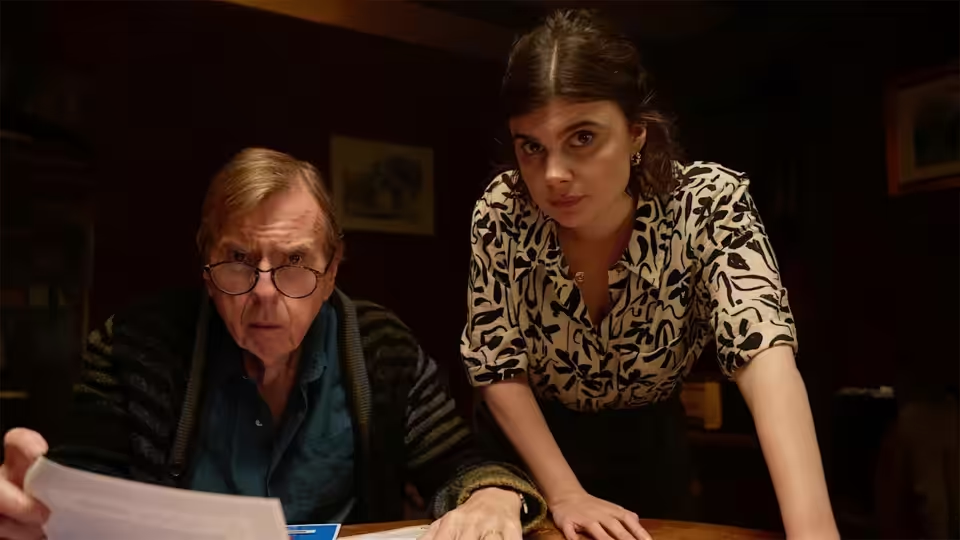
Timothy Spall and Gwyneth Keyworth make Death Valley a warm, enjoyable cosy mystery. The cases can feel flimsy and the comedy sometimes strains, but the central partnership makes it worth trying.
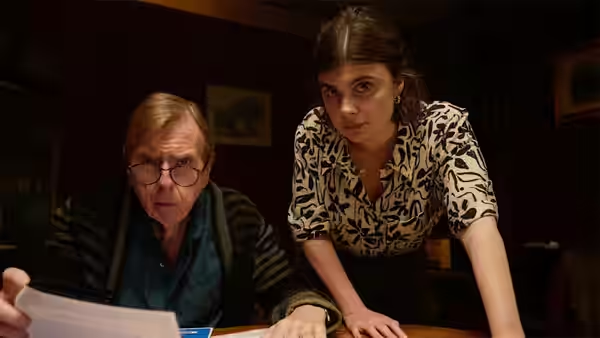
Death Valley is good company, provided the murder puzzle is not the only reason we have settled down to watch. Creator and writer Paul Doolan makes the partnership between John Chapel and Janie Mallowan the main attraction, and Timothy Spall and Gwyneth Keyworth justify that decision. The familiar cosy-crime machinery is easy enough to recognise. What makes this series worth an evening is the pleasure of watching two performers find a shared rhythm without making every exchange look like a rehearsed double act.
Timothy Spall has the more immediately conspicuous presence, but Gwyneth Keyworth is essential to keeping their scenes light on their feet. She is allowed to contribute to the comedy rather than merely receive it, and their exchanges benefit from that equality. We found their company cheering, because the give-and-take feels relaxed enough for the humour to arise between them rather than wait for a marked punchline. Both performers make the partnership seem easy, and their conversations are where the programme works most consistently.
The mysteries are less dependable. There is enough complication to hold our attention, though the plotting sometimes invites closer scrutiny than it can withstand. A cosy mystery still needs to make its clues and suspicions matter; liking the investigators should not mean doing all the work of believing the case. These investigations provide sufficient curiosity to keep things moving, but anyone principally interested in assembling evidence may find the writing a little casual about the details.
Directors Claire Winyard and Simon Hynd keep the programme approachable, and its willingness to be silly is often welcome. The trouble comes when the humour grows broader than the performances need it to be. Some of the comic business feels pushed, as though a quieter exchange might leave us insufficiently entertained. That is frustrating because the central pairing has already earned our attention, and the extra insistence can turn an amusing scene into one that seems to be asking for a louder laugh.
The scripts, also credited to Nina Metivier, Sian Harries and Ian Jarvis, have enough liveliness to keep the familiar setup from becoming a serious obstacle. The lighter tone suits the leads, and there is no need for the series to become grimmer simply to make its murders seem important. It does, however, become more satisfying when an investigation is allowed to occupy our attention without quite so much clowning around it. A little more restraint would help the comedy as well as the cases, particularly when the actors have already made an exchange amusing.
By the standards of comfort television, this is a good version of a familiar proposition, with limitations that are easy to identify and reasonably easy to forgive. Its recurring appeal is clear: the central pair can sustain interest through a case that might otherwise seem thin. We would recommend it to anyone who enjoys a murder mystery with plenty of room for conversation, while making no great claims for its ingenuity. Try it when agreeable company matters more than checking every clue.