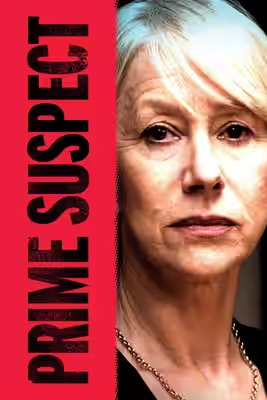
A missing-persons drama that skips the days most series would dwell on and is stronger for it. Penelope Wilton and Patrick Malahide carry the waiting; the final episode hurries to an answer the first four did not need.
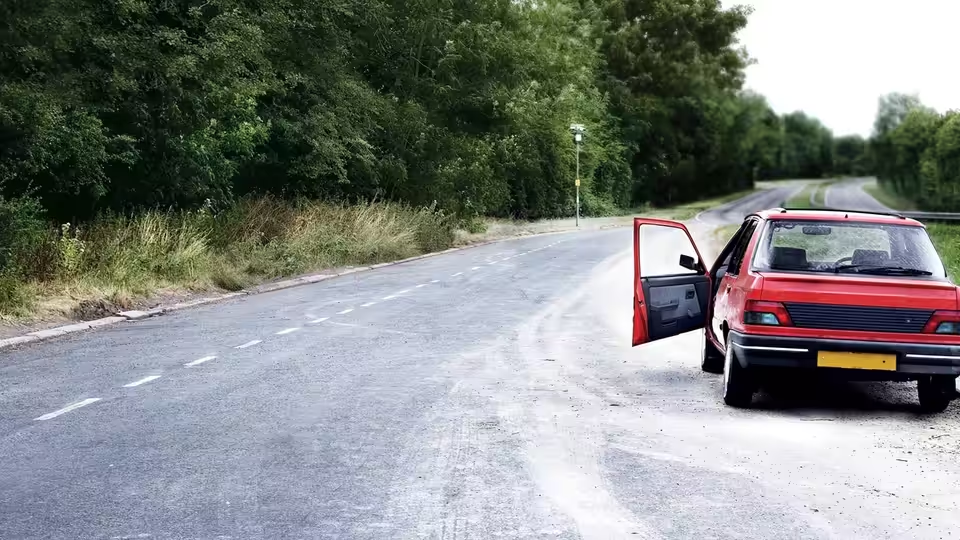
Five Days takes a missing-person case and shows us five days of it, spread across nearly three months, with the gaps left for us to fill in. On the first of them Leanne Wellings (Christine Tremarco) stops to buy flowers at a roadside stall and does not come back to the car, and two of her children go with her. The series then jumps: to day three, to day twenty-eight, and on, each episode an hour, five episodes in all. It is a good idea, and it gets better as it goes, because the days it skips are the ones a lesser drama would have spent its money on. We arrive after the press conference, after the reconstruction, after the first lead has gone cold, and we are asked to work out what happened in between from the state of the people.
The people are the reason to watch. Penelope Wilton plays Barbara Poole, Leanne’s mother, and what got at us, more than the mystery, was watching her make tea for the detectives in her own kitchen because it is the last useful thing left in the house. Patrick Malahide, as her husband John, plays a man who has decided that being practical is the same as being calm and is wrong about that; the gap between what he says and what his hands are doing is the best acting in the series. Edward Woodward, as the grandfather Vic Marsham, has less to do and does it almost without moving, a man who has had more years of bad news than anyone else in the house.
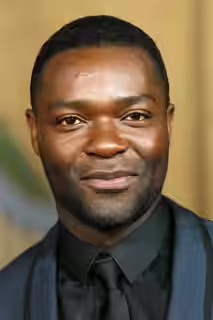
The police are drawn with the same care and no more glamour. Hugh Bonneville’s DSI Iain Barclay is decent, tired, and visibly aware that the odds get worse with each day that passes; he is not a genius and the series does not pretend he is. Janet McTeer, as DS Amy Foster, is the officer who sits with the family, and she plays the job as it must actually be, a kindness that is also surveillance. Charlie Creed-Miles’s DC Stephen Beam does the legwork on the road and the stall. David Oyelowo’s Matt Wellings, the husband, is the man everyone looks at first, and Oyelowo lets us look without telling us what to think. Sarah Smart’s reporter, Sarah Wheeler, is the weakest strand; the series knows the press is part of these cases and is not sure what else to say about it.
It is plainly made. Three directors, Otto Bathurst, Simon Curtis and Peter Hoar, share the five episodes, and we could not see the joins: flat daylight, ordinary semi-detached houses, incident rooms with the lights left on, and almost nothing on the soundtrack that is not someone talking. Curtis also produces, which may explain the consistency. There is no music telling us a scene is sad. The scenes are sad because of what is in them, and the camera waits.
The trouble is the last hour. For four episodes the structure does the work, each jump landing us somewhere worse without having to show the fall. In the fifth the series has to produce an answer, and it produces one in a hurry, with a run of explanations that arrive faster than the preceding four hours had taught us to expect. We will not say what it is. We will say that the first four episodes did not need it, and that a version which trusted the gaps right to the end would have been braver. Anne Reid and Al Weaver have small strands of their own that we will leave for you to find, and that are better than the resolution they feed into.
Most critics have liked it, and so do we; the one mixed review we have read makes the same complaint about the ending and is right to. A second series followed on 1 March 2010 with a different case, and this verdict does not include it. Set against the run of British missing-child dramas, this one is unusual for how little it shouts and how much it leaves out, and that is a recommendation.
Watch it over two evenings rather than five. The jumps land harder when the previous day is still in your head, and you will mind the last hour less if you have not spent a week waiting for it.