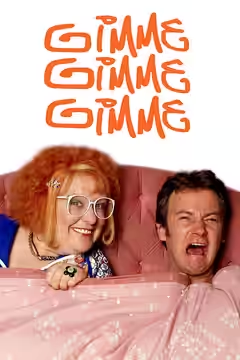
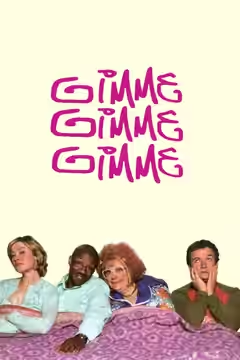
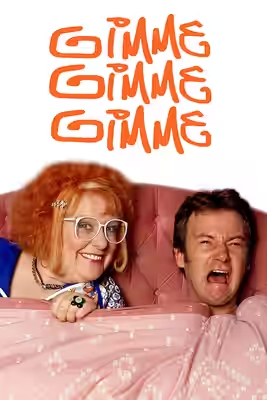
Linda La Hughes (Kathy Burke) and Tom Farrell (James Dreyfus) lie under covers, reacting
Series review

Gimme Gimme Gimme

1999 · Created by Jonathan Harvey · Series · 25m

In a sentenceKathy Burke in a ginger wig, making a bad script look like a choice

A shared flat in London, late 1990s. Linda La Hughes (Kathy Burke) is unemployed, ginger, loud, and convinced that every man she meets wants her; she says so, to their faces, in detail. Her flatmate Tom Farrell (James Dreyfus) is a gay actor nobody is casting, and he thinks the same of himself. Downstairs are Suze Littlewood (Beth Goddard), posh and nosy, and her husband Jez (Brian Bovell), and the landlady Beryl Merit (Rosalind Knight), a pensioner with a filthier mouth than either of her tenants. Linda wants a man, any man. Tom wants a part, any part. Each episode sends one of them after it, through an audition, a date or a scheme, while the other sabotages the attempt from the sofa. Three series of six episodes, 25 minutes each, from 8 January 1999.

Fi1m review

Jonathan Harvey’s flat-share sitcom is loud, crude and written with a mallet, and Kathy Burke is so good in it that for whole minutes you forget. A performance worth your time in a show that keeps getting in its way.

Jonathan Harvey, who wrote Beautiful Thing for the stage before anyone filmed it, created and wrote this one, and what he wants is plain from the first minute: a sitcom built like a pantomime, with two monsters in a flat and a studio audience there to be shocked. Linda La Hughes (Kathy Burke) is unemployed, ginger and certain she is irresistible. Tom Farrell (James Dreyfus) is an actor nobody will cast, and he is certain of the same thing about himself. They share a London flat and each believes the other is lucky to have them. It is loud, it is crude, and about half of it is funny, which is a better ratio than the reviews so far would have you believe.

Burke is the reason to watch and we will not pretend otherwise. Linda has no self-doubt at all, which is hard to play without playing contempt for her, and Burke never does. She gives Linda a strut, hips first, a laugh like a blocked drain, and a habit of lowering her voice to a purr for any man who has wandered within range, and the gap between what Linda thinks she is doing and what we can see is where the best laughs live. Burke also does the one thing the script does not: she lets you see, for a second at a time, that Linda knows. Then the moment passes and she asks a stranger about his arse.

Dreyfus is the lighter half of the act, all hands and offended vowels, and he is good at it. Tom’s vanity is smaller and sadder than Linda’s, because he has the evidence of his own career in front of him and chooses not to look at it. The two of them work best when they are on the sofa insulting each other, and the show knows this and keeps sending them there. Beth Goddard’s Suze gets the sane-neighbour role and plays it as a woman who is slightly thrilled by what she disapproves of, and Rosalind Knight’s Beryl is handed the filthiest lines in the building and delivers them like a reading of the minutes, which is the right way. Su Pollard, Mark Benton and Frances Barber turn up along the way and are used, by and large, as targets.

The trouble is Harvey’s writing, and it is the trouble the one notice we have read, in the Guardian in 2001, lays at his door. We think that review goes too far, but it is not wrong about the method. Every joke is about sex, weight or somebody’s face, and every joke is announced before it arrives, so that the audience is laughing at the set-up and the punchline has nowhere to go. The same insult is made of Linda’s looks four or five times an episode, with the same pause, and Mykola Pawluk and Graham Carr’s cutting holds on the laugh each time as though it were a new one. Tristram Shapeero and Liddy Oldroyd direct it as a stage play seen from the stalls, three cameras and a wide shot, and James Dillon’s flat looks like what it is, a set with a sofa in it. Philip Pope’s stings between scenes are the only thing in the show that is ever quiet.

We laughed, loudly, at things we would not repeat at a dinner table, and we were not ashamed of it, because Burke earns those laughs with her body and her timing rather than with the words. We were bored, though, by the third episode in a row, and the boredom came from repetition: the one joke, told again, with the drum roll in the same place. Watched a week apart, as it first went out, that would matter less. Watched in a run, it is the thing you notice.

Watch the first episode of the first series. If Burke’s strut across the living room makes you laugh, carry on, and you will have a decent fortnight of evenings. If it does not, nothing in the next seventeen episodes will change your mind, and the script is not going to help.


Critical consensus AI synthesised

1 of 6
Positive
0
Mixed
0
Negative
1
The Guardian
3 November 2001 · Gareth McLean
5*

The critic condemns the sitcom as atrocious and painfully unfunny. They single out Jonathan Harvey’s crude, laboured jokes as its central failure.

Read the full review →

Straight answers AI written, from our review

Is Gimme Gimme Gimme worth watching?
Gimme Gimme Gimme is worth watching for Kathy Burke and not much else, and we scored it 52. Her Linda La Hughes is a loud, strutting, self-deluded monster played without a trace of contempt, and about half the jokes land. The script repeats the same insults with the same pause, so watch the first episode and stop if her strut does not make you laugh.
How long is Gimme Gimme Gimme, and what is it rated?
Gimme Gimme Gimme has episodes of about 25m. It is a comedy series.
Where can I watch Gimme Gimme Gimme in Bulgaria?
Gimme Gimme Gimme is not on any streaming or rental service in Bulgaria at the moment. It is available in 1 other country; change your country at the top of the page to see where. Availability is checked daily.
How violent or frightening is Gimme Gimme Gimme, and is it suitable for children?
Gimme Gimme Gimme is not violent or frightening, but its 15 certificate is earned by relentless sex talk and crude personal insults, and it is not for children. Nearly every joke is about sex, weight or somebody's face, delivered to a studio audience there to be shocked. Teenagers may enjoy it; anyone easily offended by filthy language should give it a miss.
How does Gimme Gimme Gimme compare to Absolutely Fabulous?
Gimme Gimme Gimme and Absolutely Fabulous are both sitcoms about two monsters in a flat, and Absolutely Fabulous is the better show. Jennifer Saunders and Joanna Lumley have the sharper writing and a daughter to be ashamed in front of, which gives the selfishness a target. Jonathan Harvey's series has Kathy Burke, who is as good as either of them, in a script that keeps telling the same joke.
What should I watch after Gimme Gimme Gimme?
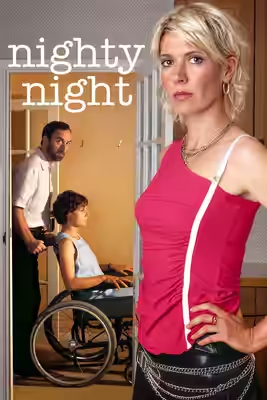
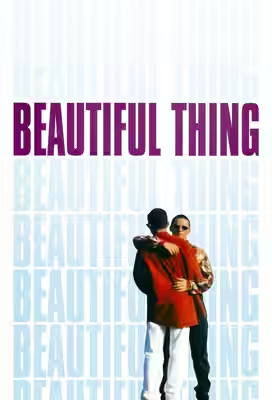
After Gimme Gimme Gimme, try Absolutely Fabulous (1992, Fi1m 81): Two monsters in a flat, done with a daughter to be ashamed in front of. Then Nighty Night (2004, Fi1m 82): Julia Davis’s self-deluded horror of a lead, written with far sharper teeth; and Beautiful Thing (1996, Fi1m 80): Harvey’s own script, tender where this one is loud; the better side of him.

Cast

If you liked this, try…

  1. Absolutely Fabulous (1992, Fi1m 81)Two monsters in a flat, done with a daughter to be ashamed in front of.

  2. Nighty Night (2004, Fi1m 82)Julia Davis’s self-deluded horror of a lead, written with far sharper teeth.

  3. Beautiful Thing (1996, Fi1m 80)Harvey’s own script, tender where this one is loud; the better side of him.

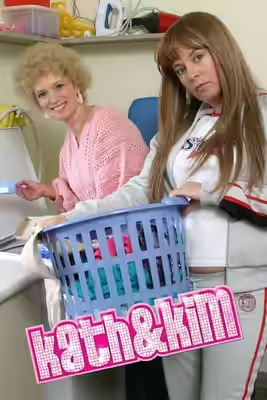
  4. Kath & Kim (2002) · not reviewed yetAustralian suburbia’s answer to Linda, with the same complete absence of self-doubt.

  5. The Young Ones (1982, Fi1m 82)The flat-share sitcom as riot, and the one this show is quietly copying.

Free account

Know what to watch tonight

Two lists that know where things are streaming, collections you can share, your own score beside ours, and Discover that remembers what you have seen.

  • Want to see, sorted by what is streaming now
  • Seen, with your score out of ten
  • No adverts, ever