Say Nothing is gripping when Lola Petticrew and Hazel Doupe lead it, less assured when its stories pull apart. The Price sisters give this historical drama its force, but nine episodes do not quite bring everyone into focus.
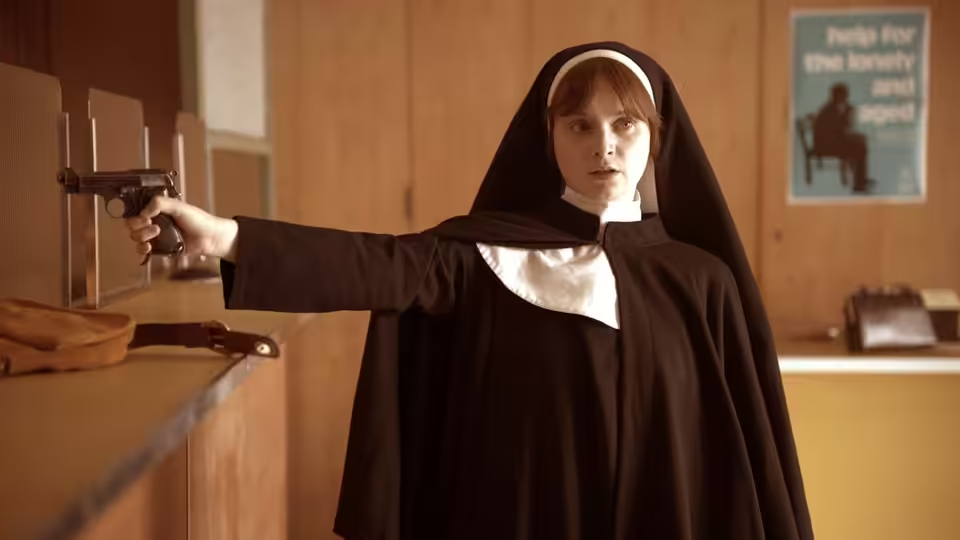
Joshua Zetumer’s Say Nothing is a good historical thriller with two performances that make its shortcomings worth tolerating. Lola Petticrew and Hazel Doupe give the Price sisters an immediacy that the wider story cannot always match. Across nine episodes, the programme considers the IRA’s cause through the attraction of belonging to it, while asking us to reckon with the violence. That is a sound approach, though it needs a more even distribution of attention than the series manages.
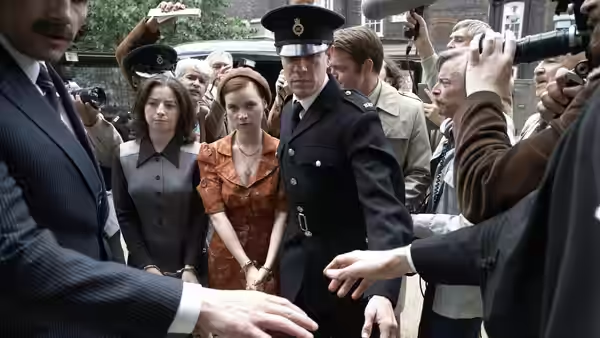
Lola Petticrew gives Dolours Price a spirited certainty that makes her company attractive, while Hazel Doupe makes Marian Price an equally compelling reason to stay with the story. We were unsettled by how readily we warmed to the sisters. Their shared commitment and the attraction of the IRA’s cause draw us towards them, making the violence harder to watch comfortably. The performances matter because we need to understand why these women believe in what they are doing, even when we cannot accept it.
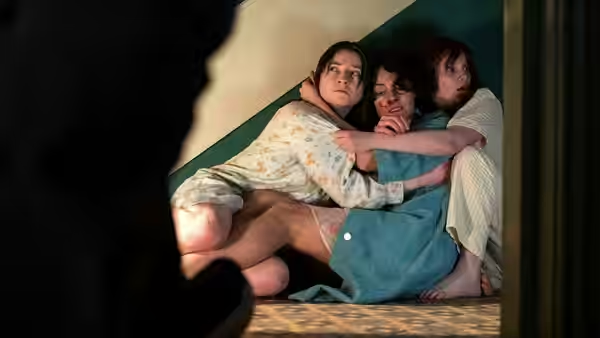
Jean McConville’s abduction gives the series a necessary point of comparison. Beside the Price sisters’ commitment, it puts the experience of someone subjected to violence, and the difference is hard to ignore. The drama deserves credit for making political conviction comprehensible without routinely treating it as an excuse. At times, though, the sisters’ appeal draws so much attention that the people harmed by the cause receive less of it.
Caroline Story’s production design and Jane Petrie’s costumes make the period setting feel inhabited. The detail helps us accept that people have ordinary lives here, even with danger close by, rather than treating the past as somewhere built for a thriller. Sion Trefor’s music supports the tension, although the cast supplies most of it. An archival-footage sequence is particularly effective: it briefly takes us away from the actors and makes the historical setting harder to regard simply as entertainment.
Anthony Boyle as Brendan Hughes and Josh Finan as Gerry Adams help keep the broader story watchable, but neither displaces the sisters as our main interest. Maxine Peake, playing Older Dolours Price, faces a different problem: the contemporary scenes do not have the same grip as the historical ones. The writing has made youthful commitment so immediate that the later material struggles to compete for attention. Some of that material also gets too little time, leaving the programme feeling hurried in places despite its nine episodes.
As historical crime television, Say Nothing gains much of its tension from our interest in people whose convictions lead towards violence. Its narrow scope is not automatically a failing, but the separate stories do not always achieve the emotional depth they promise. That leaves a good series whose cast often makes us wish the writing had stayed with them longer. We recommend it for the sisters and for its readiness to make political commitment feel attractive and dangerous. For an evening of undemanding crime television, choose something else.