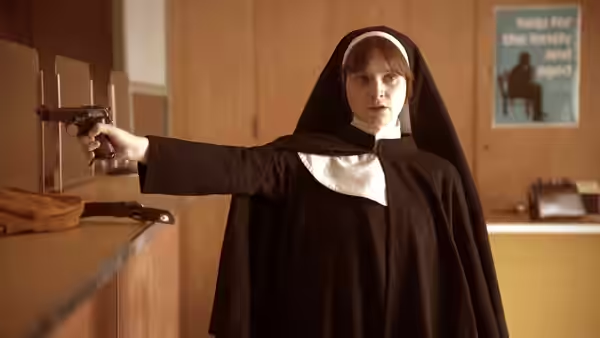
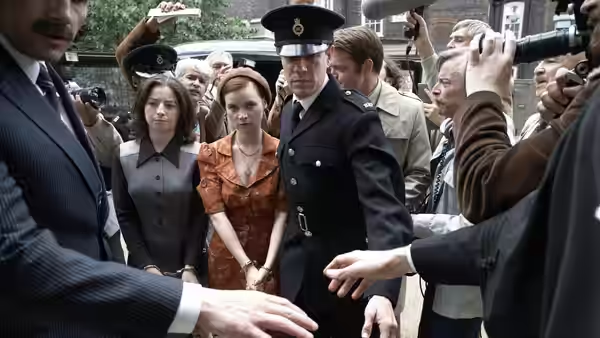
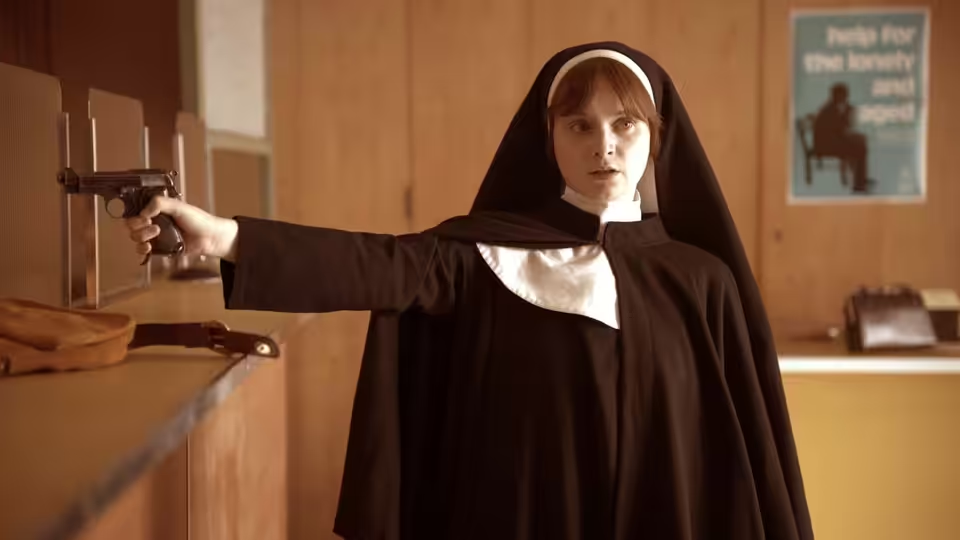
Dolours Price (Lola Petticrew) aims a handgun across a room in a nun’s habit
Series review

Say Nothing

2024 · Created by Joshua Zetumer · Series

In a sentenceLola Petticrew makes revolutionary certainty look attractive enough to worry us

During the Troubles, Dolours Price (Lola Petticrew) and her sister Marian Price (Hazel Doupe) commit themselves to the IRA’s cause. Brendan Hughes (Anthony Boyle) and Gerry Adams (Josh Finan) also figure in a story of resistance, violence and sacrifice. Dolours wants to act on her convictions, but the demands of that commitment reach beyond her own life. Alongside the sisters’ story is the abduction of Jean McConville, a disappearance that the programme follows across its nine episodes. Political action brings the sisters a shared purpose, while exposing other people to the consequences of their choices.

Fi1m review

Say Nothing is gripping when Lola Petticrew and Hazel Doupe lead it, less assured when its stories pull apart. The Price sisters give this historical drama its force, but nine episodes do not quite bring everyone into focus.

Joshua Zetumer’s Say Nothing is a good historical thriller with two performances that make its shortcomings worth tolerating. Lola Petticrew and Hazel Doupe give the Price sisters an immediacy that the wider story cannot always match. Across nine episodes, the programme considers the IRA’s cause through the attraction of belonging to it, while asking us to reckon with the violence. That is a sound approach, though it needs a more even distribution of attention than the series manages.

Lola Petticrew gives Dolours Price a spirited certainty that makes her company attractive, while Hazel Doupe makes Marian Price an equally compelling reason to stay with the story. We were unsettled by how readily we warmed to the sisters. Their shared commitment and the attraction of the IRA’s cause draw us towards them, making the violence harder to watch comfortably. The performances matter because we need to understand why these women believe in what they are doing, even when we cannot accept it.

Jean McConville’s abduction gives the series a necessary point of comparison. Beside the Price sisters’ commitment, it puts the experience of someone subjected to violence, and the difference is hard to ignore. The drama deserves credit for making political conviction comprehensible without routinely treating it as an excuse. At times, though, the sisters’ appeal draws so much attention that the people harmed by the cause receive less of it.

Caroline Story’s production design and Jane Petrie’s costumes make the period setting feel inhabited. The detail helps us accept that people have ordinary lives here, even with danger close by, rather than treating the past as somewhere built for a thriller. Sion Trefor’s music supports the tension, although the cast supplies most of it. An archival-footage sequence is particularly effective: it briefly takes us away from the actors and makes the historical setting harder to regard simply as entertainment.

Anthony Boyle as Brendan Hughes and Josh Finan as Gerry Adams help keep the broader story watchable, but neither displaces the sisters as our main interest. Maxine Peake, playing Older Dolours Price, faces a different problem: the contemporary scenes do not have the same grip as the historical ones. The writing has made youthful commitment so immediate that the later material struggles to compete for attention. Some of that material also gets too little time, leaving the programme feeling hurried in places despite its nine episodes.

As historical crime television, Say Nothing gains much of its tension from our interest in people whose convictions lead towards violence. Its narrow scope is not automatically a failing, but the separate stories do not always achieve the emotional depth they promise. That leaves a good series whose cast often makes us wish the writing had stayed with them longer. We recommend it for the sisters and for its readiness to make political commitment feel attractive and dangerous. For an evening of undemanding crime television, choose something else.

Critical consensus AI synthesised

75
Positive
7
Mixed
2
Negative
0

Most critics find Say Nothing gripping and emotionally forceful, with praise clustering around its performances and period detail. Lola Petticrew and Hazel Doupe receive particular attention for their portrayal of the Price sisters, while the production and costume design make the setting feel convincingly lived in. Several reviews admire the series’ ability to convey revolutionary commitment without overlooking the damage done by violence. Its strongest notices also praise the pacing and tightly shaped episodes.

The reservations concern both storytelling and sympathies, and the spread runs from enthusiastic recommendations to mixed assessments. Some critics find the contemporary scenes less engaging or argue that compelling later material gets too little time. The Hollywood Reporter praises the central performances but finds the separate stories too scattered to form an emotionally satisfying whole. The Guardian raises a sharper objection: despite finding the series compelling, it considers the account’s sympathies too apparent.

Variety
14 November 2024 · Alison Herman
85*

Herman finds the series moving, empathetic and evenhanded, while noting that some of its most compelling later material gets too little time. She praises its ability to give specificity to the IRA’s cause without excusing its atrocities.

Read the full review →
IndieWire
14 November 2024 · B+ · Ben Travers
83

Travers finds the series an impressive, dynamic historical thriller, though its account of resistance and sacrifice is heartbreaking. He praises the strong cast, especially Lola Petticrew and Hazel Doupe, alongside the vivid production and tightly shaped episodes.

Read the full review →
Vulture
14 November 2024 · Nicholas Quah
82*

Quah finds the series compelling, praising its ability to balance the romance of revolutionary commitment with the human costs of violence. He singles out the claustrophobic portrayal of the Price sisters’ hunger strike as especially powerful.

Read the full review →
The i Paper
14 November 2024 · Ed Power
75*

The critic finds the series gripping and powerful, though its contemporary scenes are less engaging and its historical scope is narrow. He praises its focused portrayal of Jean McConville’s abduction and the corrosive consequences of violence.

Read the full review →
The AV Club
7 November 2024 · B- · Tim Lowery
70

The review finds the series stylish and compelling, but less immersive than the book it adapts. It praises Lola Petticrew’s spirited performance and singles out an archival-footage sequence as especially effective.

Read the full review →
The Guardian
14 November 2024 · 3 out of 5 stars
52*

The critic finds it gripping and compelling overall, but ultimately fatally flawed. The account’s sympathies are too apparent, despite its shocking story of the Price sisters.

Read the full review →

Straight answers AI written, from our review

Is Say Nothing worth watching?
Say Nothing is worth watching for its compelling performances and its unsettling treatment of political commitment; we score it 77. We recommend it to viewers who want demanding historical crime drama, with the caveat that the Price sisters command attention more consistently than the separate stories spread across nine episodes.
Where can I watch Say Nothing in Panama?
Say Nothing is streaming on Disney+ in Panama. Availability is checked daily; the links above go straight to each service.
How violent or frightening is Say Nothing, and is it suitable for children?
Say Nothing carries a UK 18 certificate and is not suitable for children, with IRA violence and Jean McConville’s abduction central to its drama. We find it unsettling because the Price sisters’ appeal makes the consequences of their commitment harder to watch comfortably; this is demanding adult viewing rather than undemanding crime television.
How does Say Nothing compare to The Battle of Algiers?
Say Nothing is less consistently gripping than The Battle of Algiers, but we recommend both for their unsettling examinations of revolutionary commitment and violence. The film’s documentary style brings the campaign frighteningly close, while the series draws us towards the Price sisters through its performances; choose the film for clarity, the series for those compelling central characters.
What should I watch after Say Nothing?
After Say Nothing, try The Battle of Algiers (1966, Fi1m 93): For revolutionary commitment examined through the frightening practical work of resistance. Then The Lives of Others (2006, Fi1m 84): For surveillance and political conviction brought down to the scale of individual lives; and Small Axe (2020, Fi1m 88): For political history that gives people lives beyond the struggle consuming them.

Cast

If you liked this, try…

  1. Bloody Sunday (2002) · not on Fi1m yetFor another close, unsettling account of political violence and the people caught in it.

  2. The Battle of Algiers (1966, Fi1m 93)For revolutionary commitment examined through the frightening practical work of resistance.

  3. Army of Shadows (1969) · not on Fi1m yetFor the secrecy, loyalty and appalling choices that make resistance possible.

  4. The Lives of Others (2006, Fi1m 84)For surveillance and political conviction brought down to the scale of individual lives.

  5. Small Axe (2020, Fi1m 88)For political history that gives people lives beyond the struggle consuming them.

Say Nothing (2024) review: Strong leads carry an uneven drama (Panama) | Fi1m