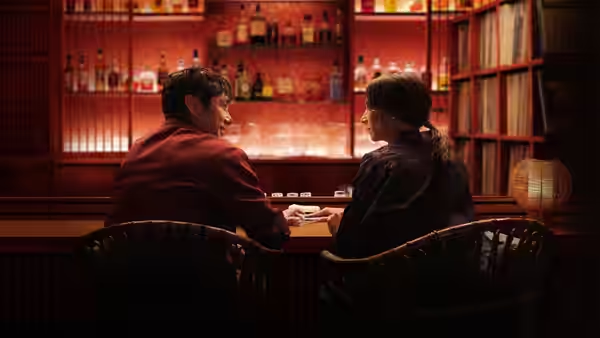
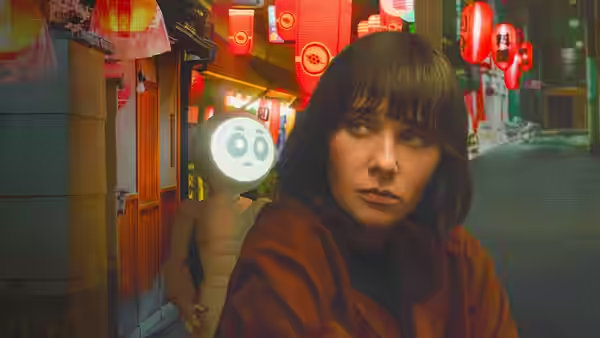
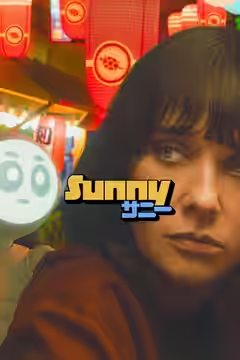
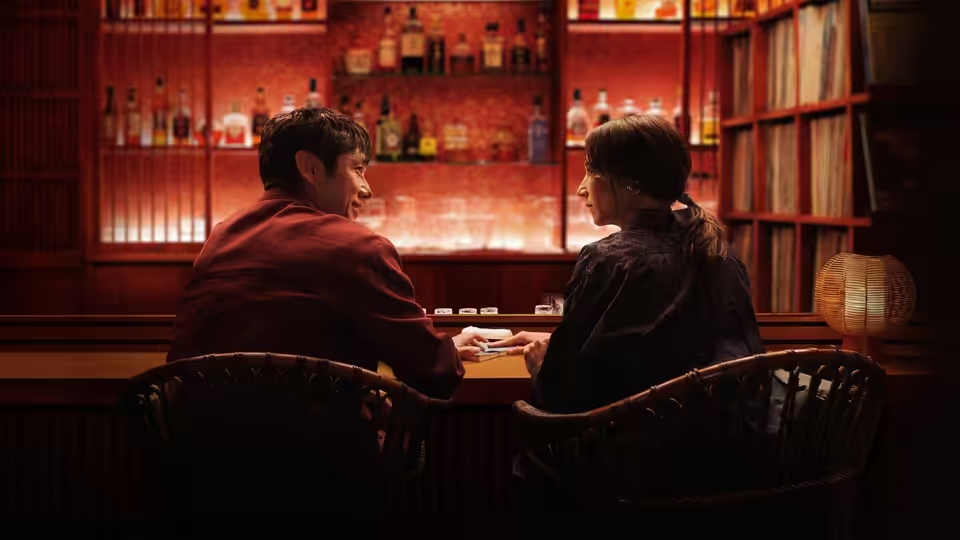
Suzie (Rashida Jones) and Masa sit together at a warmly lit bar
Series review

Sunny

2024 · Created by Katie Robbins · Series

In a sentenceThe robot’s face is two dots and a line, and it out-acts half the cast

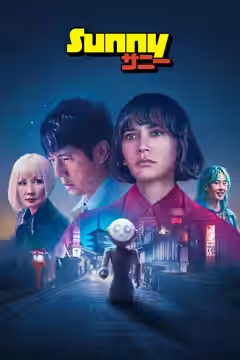
Kyoto, in a near future where every household owns a robot. Suzie Sakamoto (Rashida Jones), an American who has never learned much Japanese, loses her husband Masa (Hidetoshi Nishijima) and their son Zen (Fares Belkheir) when their plane goes down. Into her grief comes a stranger from Masa’s employer with a gift: Sunny (voiced by Joanna Sotomura), a round white homebot that Masa, she is told, programmed for her. Suzie distrusts robots and wants it gone. She also learns that Masa, who she believed made refrigerators, worked in robotics. With her disapproving mother-in-law Noriko (Judy Ongg) and a bartender, Mixxy (annie the clumsy), she starts asking what her husband really did, while a yakuza boss’s daughter, Himé (YOU), starts asking the same question for her own reasons.

Plays from YouTube when you press play; nothing loads from them until then.

Fi1m review

Katie Robbins’s near-future Kyoto mystery is handsome and well played, with Rashida Jones and a sweetly voiced robot doing most of the carrying. The mystery underneath is thinner than the design, and ten episodes is more than it has to say.

Katie Robbins has turned Colin O’Sullivan’s novel into ten episodes about an American widow in Kyoto and the robot her dead husband left behind. The year is never given; it is near enough that the taxis look familiar and far enough that every kitchen has a homebot standing in the corner. Suzie Sakamoto (Rashida Jones) wants nothing to do with hers. The series is at its best in that kitchen, with a woman and a machine learning to share a house, and at its weakest whenever it leaves to chase its plot. It is handsome, often funny, well acted, and about three episodes longer than it needs to be.

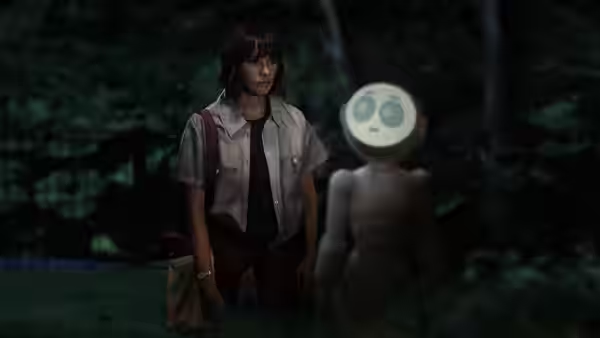
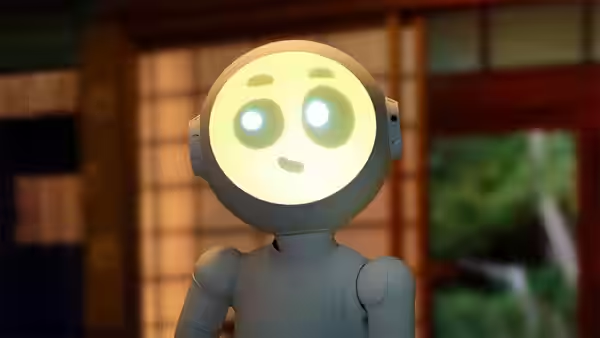
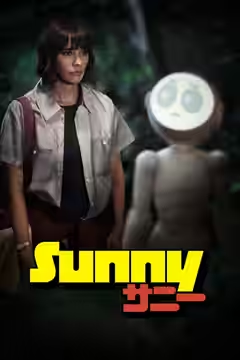
The robot is the reason to watch. Sunny is a rounded white body on wheels with a black screen for a face, and on that screen two dots and a curved line do most of the acting. Joanna Sotomura’s voice does the rest: eager, a little too helpful, wounded when Suzie is unkind and quick to pretend she is not. Suzie is unkind a good deal. Jones plays grief as temper rather than tears, snapping at the help, at her mother-in-law, at Kyoto, and it is both truer and funnier than the alternative.

The look is the other reason. Larry Smith and Ryoma Kohari shoot Kyoto in warm, saturated colour, orange light through paper screens and neon on wet streets, and they keep the camera low so the robots are always slightly in the way. Shinsuke Kojima dresses the near future in old things: wood panelling, pastel plastic, dials where you would expect touchscreens, so the homebots look like appliances from a 1970s catalogue rather than from a laboratory. Analucia McGorty puts Suzie in dark, oversized knitwear she has plainly not changed in days. Daniel Hart’s score is light and jazzy and keeps insisting this is a comedy, which is right about half the time.

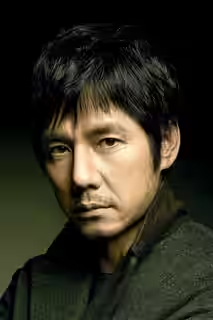
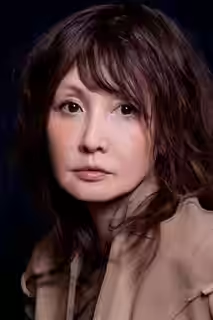
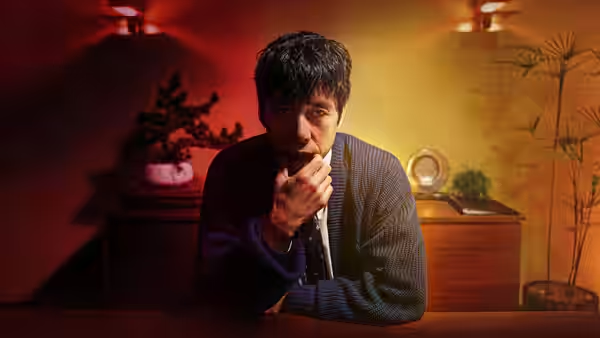
Around the pair, the casting holds up. Judy Ongg’s Noriko is the mother-in-law who never thought Suzie good enough for her son and is not about to stop saying so now he is gone; her scenes with Jones are small, sharp and well judged. annie the clumsy, as the bartender Mixxy, gives Suzie the one friend who talks back. YOU plays Himé, a yakuza boss’s daughter angling to inherit her ailing father’s operation, with a flat, bored menace that works better than any shouting would. Hidetoshi Nishijima’s Masa appears mostly in flashback and is quietly good as a man keeping something from his wife.

The trouble is the mystery, and it is a structural trouble. Four directors and five editors are credited across the ten episodes, and it shows: the tone lurches from kitchen comedy to gangster film to grief drama, sometimes within a scene, and the yakuza plot never makes clear what anyone wants or why Suzie should care. One episode is framed as a television game show and another as a dream, and both are inventive and both stop the story dead. By the seventh episode we were counting how many were left. We were never bored, exactly; we had simply stopped believing the plot knew where it was going, and the finale confirmed it.

And yet. There is a moment early on when Suzie comes home drunk and Sunny gets her to bed, saying nothing clever, and the two dots on the screen go soft, and we were moved more than we expected to be by a face with no features in it. That is the series working: one idea, one room, a machine doing something kind for a woman who has told it to leave.

Her and After Yang each took one idea about a machine and a lonely person and followed it to the end. Sunny has that idea, and a good one, and keeps putting it down to answer a phone call from the plot. Watch the first three episodes, which are the best, and see whether the robot has you. If she does, she will carry you further than the story deserves. It is certified 15, and the yakuza earn it.

Critical consensus AI synthesised

72
Positive
9
Mixed
2
Negative
1

Most critics like Sunny, and the praise gathers in two places: Rashida Jones, whose surly, grounded performance several reviews credit with holding the series together, and the look of it, a retrofuturistic Kyoto whose production design even the least enthusiastic reviews call vivid and immersive. Joanna Sotomura’s warm voice work as the robot draws separate notice, as does a tone the reviews describe as dark, funny and quietly sinister, with a real interest in grief under the android comedy.

The reservations are about the storytelling. Several critics find the plot scattered and the protagonist thin, and more than one calls the finale weak. The spread is wide: The Guardian gives it five stars and calls it the most original show of the week, while IndieWire finds it too muddled for its treatment of grief to land, and The Hollywood Reporter thinks the characters are kept at a distance. Variety admires the world-building but finds it unsatisfying as a mystery. Even the dissenters like how it looks; the disagreement is over whether the story holds.

The Guardian
14 July 2024 · ★★★★★ · Andrew Anthony
100

The critic calls Sunny the most original and tonally arresting show of the week. They praise its dark, funny, quietly sinister tone and its futuristic Japanese setting.

Read the full review →
The AV Club
8 July 2024 · B+ · Saloni Gajjar
83

The critic finds the mystery entertaining and thought-provoking, though its scattered storylines make it feel overlong and less cohesive. Rashida Jones’s performance and the immersive retrofuturistic production design are singled out for praise.

Read the full review →
Evening Standard
5 July 2024 · ★★★★ · Hayley Spencer
80

Spencer finds the genre-bending series kooky, gripping, and ultimately very watchable. She praises Rashida Jones’s snarky, endearing performance and the show’s nuanced treatment of grief and loneliness.

Read the full review →
Empire
15 July 2024 · David Opie
75*

The review finds the series strange, moving and largely successful, despite some pacing problems and limited insight into AI. It especially praises Joanna Sotomura’s warm, expressive performance as Sunny.

Read the full review →
Radio Times
26 June 2024 · Nicola Austin
75*

The review presents the series as a winner. It singles out its android antics as a strength.

Read the full review →
The i Paper
10 July 2024 · Marianne Levy
75*

Levy finds the series stylish, beautiful and promising, with the makings of a twisty drama full of humour and heart. She especially praises how convincingly its Homebot makes the near-future feel unnerving and highlights the questions it raises about AI.

Read the full review →

Straight answers AI written, from our review

Is Sunny worth watching?
Sunny is worth watching for the robot and for Rashida Jones, and we scored it 64. The kitchen scenes between a grieving widow and the homebot she wants gone are warm, funny and sometimes moving, but the yakuza mystery underneath is thin and ten episodes is too many. Watch the first three and see whether the robot has you.
Where can I watch Sunny in Croatia?
Sunny is not on any streaming or rental service in Croatia at the moment. It is available in 45 other countries; change your country at the top of the page to see where. Availability is checked daily.
How violent or frightening is Sunny, and is it suitable for children?
Sunny is certified 15 in the UK and TV-MA in the US, and the yakuza plot earns it, so it is not for children. The violence comes from the gangster strand rather than the domestic comedy, and the series opens with a woman losing her husband and son in a plane crash. Teenagers of fifteen and over should manage it.
How does Sunny compare to Devs?
Sunny and Devs are both handsome, slow tech mysteries, but they want different things from you. Devs is chilly and patient and its plot adds up, with Nick Offerman and Alison Pill making the philosophy bearable; Sunny is warmer, funnier and better company, but its mystery wanders. Choose Devs if you want answers, Sunny if you want to like the people.
Is Sunny based on a true story or a book?
Sunny is based on a novel by Colin O'Sullivan, not on a true story, adapted for television by Katie Robbins. The near-future Kyoto, the widow and the robot her husband left her all come from the book, though the series adds its own set-piece episodes, including one framed as a game show. You do not need to have read it.

Cast

If you liked this, try…

  1. After Yang (2021) · not on Fi1m yetA family’s android stops working and the grief is quieter and sharper than here.

  2. Robot & Frank (2012) · not on Fi1m yetAn old burglar and his carer robot; the odd-couple idea done in ninety minutes.

  3. Air Doll (2009) · not on Fi1m yetKore-eda’s Tokyo fable about a thing that learns to feel, sadder and stranger.

  4. Devs (2020, Fi1m 68)Garland’s tech mystery, slow and chilly, for those who wanted the plot to add up.

  5. Tokyo Vice (2022) · not on Fi1m yetA foreigner among the yakuza, with the crime story taken seriously throughout.

Sunny (2024) review: a lovely robot in a thin mystery (Croatia) | Fi1m