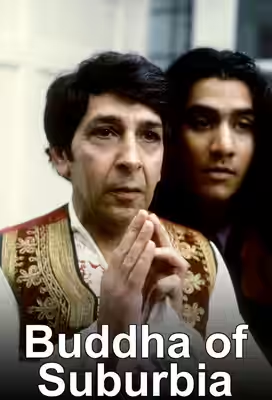
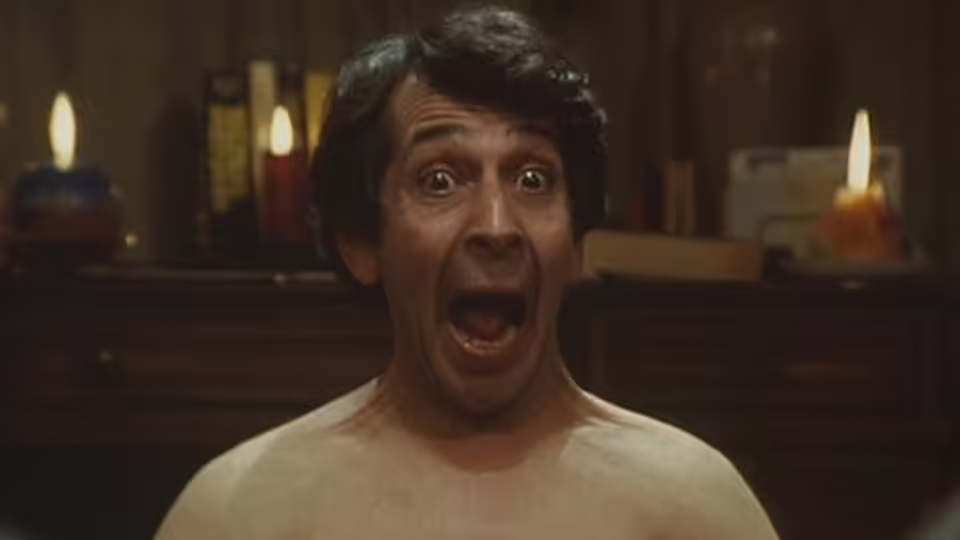
A bare-shouldered man cries out in a dim room lined with books and candles
Series review

The Buddha of Suburbia

1993 · Created by Hanif Kureishi · Series · 1h 00m

In a sentenceEvery boy in south London wants to be David Bowie, and David Bowie is doing the music; the joke more or less writes itself

South London, the 1970s. Karim Amir (Naveen Andrews), seventeen, half Indian and wholly suburban, lives in a semi with his English mother Margaret (Brenda Blethyn) and his father Haroon (Roshan Seth), a clerk from Bombay who has taken up yoga and the Upanishads. One evening Haroon is invited to speak on Eastern wisdom in the front room of Eva Kay (Susan Fleetwood), to an audience of neighbours in flares, and finds he is good at it. Karim comes along and meets Eva’s son Charlie (Steven Mackintosh), a schoolboy who dresses as David Bowie and intends to be famous. Karim wants Charlie, London and a way out of the suburbs; what stands in the way is a father in the middle of reinventing himself and a mother who can see exactly what is coming.

Fi1m review

Hanif Kureishi adapts his own novel as four funny, frank and crowded hours, with Roshan Seth and Brenda Blethyn giving the best performances in it. Too long for a story this quick, but we would rather have too much of this than too little.

Hanif Kureishi adapts his own novel for television as four hour-long episodes, with Roger Michell directing, first broadcast on 3 November 1993. The set-up is a good joke told straight. Haroon Amir (Roshan Seth), a middle-aged clerk from Bombay living in a south London semi, starts lecturing the neighbours on Eastern wisdom from a cushion in Eva Kay’s front room, and discovers that being exotic in the suburbs pays better than being ordinary ever did. His son Karim (Naveen Andrews) watches it happen. The series is about what Karim does with what he sees, and it is sharper, sadder and ruder than its reputation as a period comedy suggests.

Seth is the reason the first episode works. He plays Haroon not as a fraud but as a man who has found, late, a thing people want from him, and who cannot quite believe his luck. The front-room scene, with commuters’ wives in kaftans copying his breathing while Eva (Susan Fleetwood) looks on like a woman who has bought a racehorse, is the funniest thing here. We laughed, and then we caught sight of Blethyn’s Margaret at home in her cardigan, hearing her husband described as a holy man by women who have never addressed her by name, and felt ashamed of laughing. Blethyn does almost all of it with her shoulders and the set of her mouth. It moved us more than we were prepared for in a comedy about yoga in Beckenham-adjacent living rooms, and it is the best piece of acting in the series.

Andrews has the harder job. Karim is a watcher, the kind of narrator a novel can carry and a camera cannot, and there are stretches where the series waits for him to want something and he simply grins. That grin is charming, and Andrews is good at the particular rudeness of a clever boy who has not yet been hurt, but the people around him are more vivid than he is. We noticed it most in the second half, when he is given a career and a love affair and seems to be present at both rather than in them.

Alexandra Byrne’s costumes do a lot of the storytelling the script is too busy for. Charlie (Steven Mackintosh) first appears as a schoolboy Bowie, bolt across the face, scarf and all, while Bowie’s own score plays underneath him, and Michell has the sense not to point at the joke. The score itself is mostly texture, synthesiser washes and guitar under the dialogue, with the title song over the credits the one place Bowie steps forward. It is the best song attached to a television title sequence we can think of, and Michell is right to let it run.

The second half leaves the suburbs for theatre, and the series gets cleverer and colder at the same time. David Bamber’s Shadwell, a fringe director who wants Karim to be more Indian for the audience’s benefit, is a precise and nasty portrait, and Jemma Redgrave’s Eleanor brings a class of English guilt the suburbs never produced. We admired these episodes and missed the earlier ones. The warmest writing in the back half goes to Changez (Harish Patel), who arrives from India to marry Jamila (Nisha Nayar) and turns out to be nothing anyone expected; Patel plays him with a dignity the script keeps testing.

The real flaw is the arithmetic. Four hours sounds generous and is not, because Kureishi is trying to carry the whole book, and so years go by in a cut and relationships are declared rather than shown. There are moments when a scene ends while we are still arriving in it.

The few reviews we have read split sharply, and their average sits well below where we are. One finds the series bland and lethargic, and we think it has mistaken a mild narrator for a mild programme. Nothing around Karim is mild. The 18 certificate is earned, several times and without apology; this is frank about sex in a way British television has grown more careful about since. Watch it across two nights, because four hours of other people’s seventies in one sitting is a lot, and because Seth and Blethyn deserve a fresh audience for every episode they are in.
Critical consensus AI synthesised

2 of 6
Positive
1
Mixed
0
Negative
1

With only 2 reviews in so far, the critics are split almost exactly in two. Variety finds the series consistently entertaining and provocative, with assured performances and a kaleidoscopic way of telling its story, though it notes a certain chill at the heart and a pace so brisk that Karim never quite comes into focus. The AV Club takes the opposite view, calling the drama bland, predictable and lethargic, with a dull lead and supporting roles that are barely written. The one point of agreement is that Karim himself is thinly drawn; the disagreement is over whether everything around him makes up for it.

Variety
9 May 1994 · festival review · Dennis Harvey
70*

Harvey finds the series consistently entertaining and provocative, despite a chill heart and an overpacked narrative. He especially praises its assured performances and kaleidoscopic storytelling, while noting that the breakneck pace leaves Karim insufficiently developed.

Read the full review →
The AV Club
11 April 2002 · Nathan Rabin
20*

Rabin finds the drama bland, predictable, and lethargic. He singles out its dull lead character and underwritten supporting roles as major weaknesses.

Read the full review →

Straight answers AI written, from our review

Is The Buddha of Suburbia worth watching?
The Buddha of Suburbia is worth watching for anyone with an appetite for frank, funny British television about the seventies, and we scored it 74. Roshan Seth and Brenda Blethyn give the best performances in it, and the first two episodes are the strongest. Four hours is more than the story needs, so watch it across two nights.
How long is The Buddha of Suburbia, and what is it rated?
The Buddha of Suburbia has episodes of about 1h 00m. It is a comedy and drama series.
Where can I watch The Buddha of Suburbia in Spain?
The Buddha of Suburbia is not on any streaming or rental service in Spain at the moment. Availability is checked daily.
How violent or frightening is The Buddha of Suburbia, and is it suitable for children?
The Buddha of Suburbia is not violent or frightening, but it carries an 18 certificate in the UK and earns it through frankness about sex, several times and without apology. It is not for children and we would not put it in front of younger teenagers. Adults who do not mind British television being rude about who sleeps with whom will be fine.
How does The Buddha of Suburbia compare to My Beautiful Laundrette?
The Buddha of Suburbia is Hanif Kureishi's longer, more crowded and more suburban London, while My Beautiful Laundrette is his earlier, angrier and shorter one with the same appetite for who sleeps with whom. The film is the tighter piece and the easier evening; the series has more room for its people and the better performances. Start with the film if you want a story, the series if you want the world.
Is The Buddha of Suburbia based on a true story or a book?
The Buddha of Suburbia is based on Hanif Kureishi's novel of the same name, which Kureishi adapted himself for television. The adaptation tries to carry the whole book across four hours, so years pass in a cut and some relationships are declared rather than shown. You do not need to have read it, but readers will notice what has been squeezed.
What should I watch after The Buddha of Suburbia?
After The Buddha of Suburbia, try My Beautiful Laundrette (1985, Fi1m 85): Kureishi’s earlier London, angrier and shorter, with the same appetite for who sleeps with whom. Then East Is East (1999, Fi1m 74): A Salford mixed marriage played for laughs until the laughs run out; and Velvet Goldmine (1998, Fi1m 81): The glam decade Charlie wanted to live in, dressed to the teeth and unembarrassed.

Cast

If you liked this, try…

  1. My Beautiful Laundrette (1985, Fi1m 85)Kureishi’s earlier London, angrier and shorter, with the same appetite for who sleeps with whom.

  2. East Is East (1999, Fi1m 74)A Salford mixed marriage played for laughs until the laughs run out.

  3. Velvet Goldmine (1998, Fi1m 81)The glam decade Charlie wanted to live in, dressed to the teeth and unembarrassed.

  4. Mississippi Masala (1991) · not reviewed yetAnother family relocated twice over, this time to the American South, with Denzel Washington.

  5. Bhaji on the Beach (1993) · not reviewed yetA day trip to Blackpool, three generations of Asian women, and British weather as a character.

Free account

Know what to watch tonight

Two lists that know where things are streaming, collections you can share, your own score beside ours, and Discover that remembers what you have seen.

  • Want to see, sorted by what is streaming now
  • Seen, with your score out of ten
  • No adverts, ever