Burns’s nine-part history has no moving pictures of its war: the photographs, the letters and Jay Ungar’s fiddle undid us within the hour. It is long, it leans on one tune, and it is softer on the Confederacy than it should be.
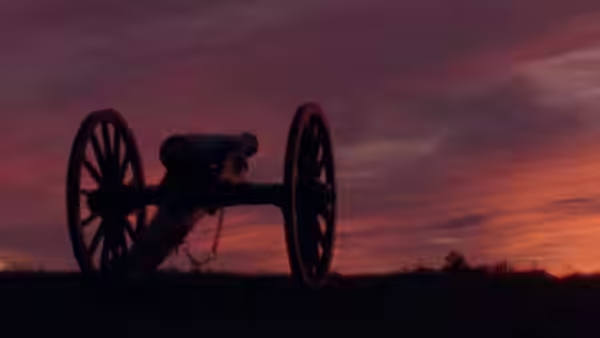
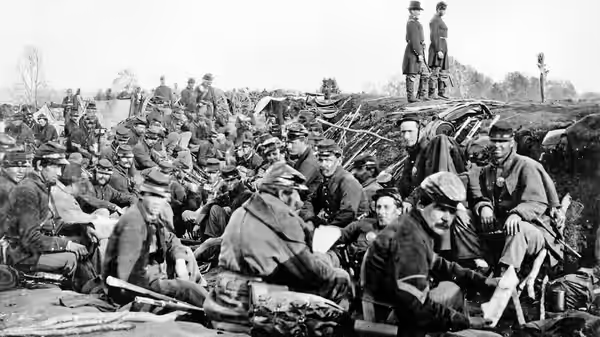
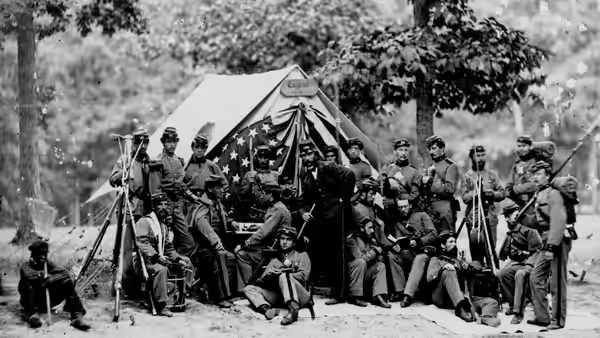
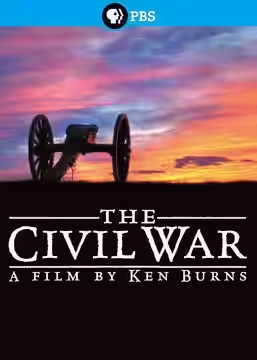
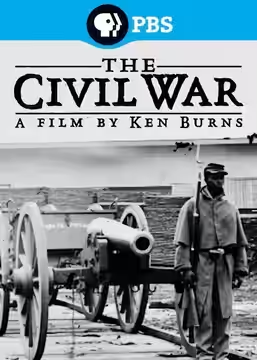
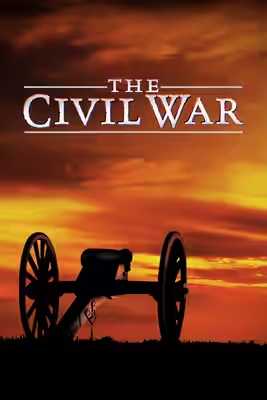
Ken Burns’s The Civil War first went out on 23 September 1990, in nine episodes, and it contains no footage of the war at all. There is none to have; the camera that could record movement arrived after the last surrender. What Burns has instead is photographs, letters, diaries, a handful of historians and a fiddle, and from those he makes something that held us for the better part of a week. It is slow, it repeats itself, and it is kinder to the losing side than the losing side deserved. It is also the finest thing of its kind we know.
The method is simple. Burns, credited as his own cinematographer, puts a photograph under the camera and moves across it: along a line of tents, down a row of faces, in close on a single pair of eyes until the grain shows. Paul Barnes cuts between those movements and the voices, and he is not afraid of silence; a picture of a field will sit there with birdsong under it for longer than television usually allows. David McCullough reads the narration as if telling you something at a kitchen table, with no hurry and no performance. The pictures were taken by men who had to ask their subjects to keep still for the exposure, and the stillness is the point.
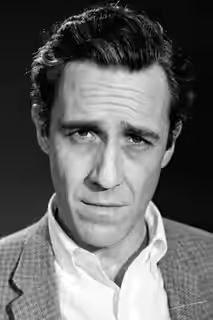
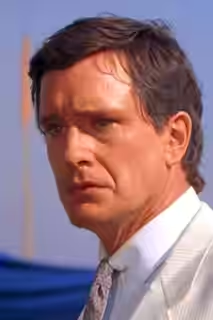
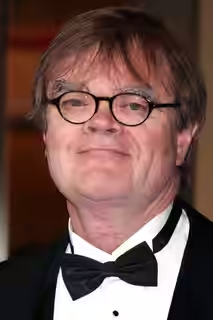
The voices are the second trick. Geoffrey C. Ward and Burns build the script almost entirely from what people wrote at the time, and the cast reads it without acting. Sam Waterston’s Lincoln is dry and careful. Julie Harris, as the Southern diarist Mary Chestnut, is sharp enough to make you grateful she was writing it down. Morgan Freeman reads Frederick Douglass with a held-back anger the series needs and does not always supply elsewhere. Jason Robards gives Ulysses S. Grant the flat voice of a man who found he was good at something terrible. Arthur Miller, the playwright, reads William Tecumseh Sherman, Garrison Keillor reads Walt Whitman, and the oddness of that casting fades inside a minute.
Then there is Jay Ungar’s tune, Ashokan Farewell, a fiddle waltz that returns throughout the nine episodes. Its best-known use is under a letter in the opening episode from a Union officer, Sullivan Ballou, to his wife, written a week before he was killed. We will say plainly that we were in tears before the first hour was out, and slightly annoyed with ourselves about it, because we could see exactly how it was done: a photograph of a plain woman, a slow push in, a voice reading the last paragraph, the fiddle coming in underneath. Knowing the mechanism did not help. It worked again, later, over the photographs of the dead at Antietam, and the certificate is a 15 for those pictures and nothing else.
The talking heads are few, and one of them takes over. Shelby Foote, the novelist and historian, sits in a chair and tells stories in a Mississippi voice so pleasant that the series keeps going back to him, and that is where its trouble is. Foote loves the war as a story, and he loves its Southern generals, and the series comes to share a little of that love. Robert E. Lee, read by George Black, is handled with a gentleness that the men he sent across open ground might have questioned. Slavery is named as the cause in the first hour and then recedes, for long stretches, behind the generalship. Freeman’s Douglass is the corrective, and there is not enough of him.
The length is a problem too. Nine episodes of around 76 minutes means a good deal of map, and the maps are the one place Barnes’s patience turns to slack. The middle episodes, the years of stalemate in Virginia, convey stalemate rather too well. And Ashokan Farewell, by the seventh hearing, has stopped being a tune and become a cue.
Nearly every history documentary made since has copied the method, and the original still has the better eye. Burns looks at a face long enough for it to become a person, and his imitators cut away. Watch it one episode a night, in order, with the lights down. Any faster and the fiddle wins, and you will stop feeling what you are being asked to feel.