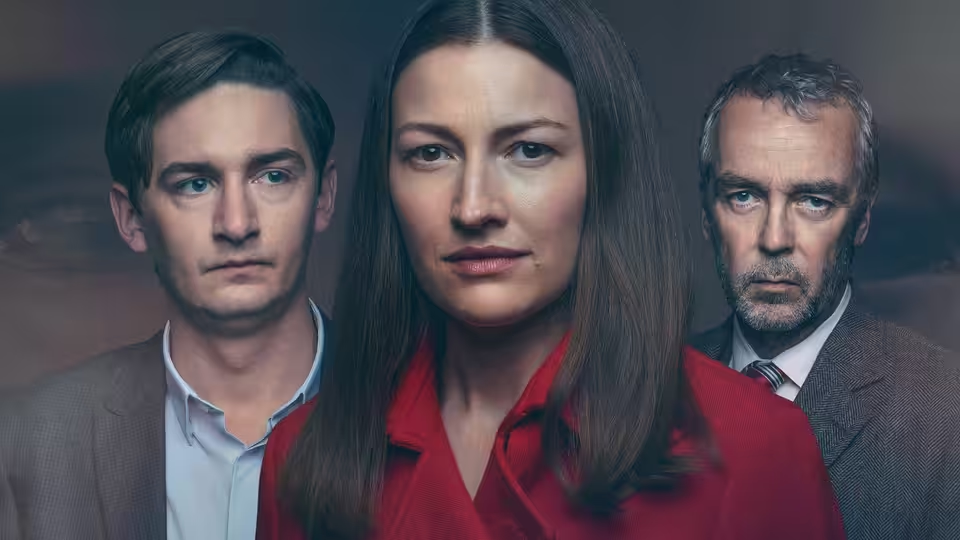
Kelly Macdonald gives this absorbing legal thriller its weight, with John Hannah providing a firm counterbalance. The plotting can press too hard, but the treatment of grief makes its questions worth sitting with.
The Victim is a good legal thriller with a troubling interest in what grief permits people to believe about themselves. Created and written by Rob Williams, it gives its mystery enough emotional weight to sustain four episodes, even when the plotting becomes insistent. We recommend it with a qualification: the people are often more convincing than the machinery keeping their predicament unresolved. That matters in a drama asking us to examine our judgements.
Kelly Macdonald, playing Anna Dean, is the chief reason to stay. Her performance makes the mother’s grief difficult to accommodate comfortably; sympathy does not settle every question about her. We found Anna’s distress upsetting because Macdonald gives it such consuming force, leaving little sense that ordinary reassurance could reach her. The performance asks for sustained attention, particularly when the thriller around it would prefer us to concentrate on the next uncertainty.
John Hannah’s DI Steven Grover supplies a useful steadiness. Hannah gives the legal thriller a firmer centre without making the surrounding emotions seem like distractions from the proper business of detection. James Harkness, as Craig Myers, helps prevent Macdonald’s performance from becoming the only one that matters. There is sufficient weight elsewhere in the cast to keep the series from feeling like an extended invitation to admire its lead.
Director Niall MacCormick maintains pressure effectively, though occasionally the determination to keep us gripped becomes too apparent. Jan Jonaeus’s cinematography and Monica Black’s production design give the drama a sober appearance that suits its subject. Neither encourages us to enjoy the surroundings at the expense of the people. That restraint is welcome, although the visual seriousness can also make the programme feel less varied than the emotional complications deserve.
Editors Mike Phillips and Paul Knight keep the competing concerns legible, an important service when a thriller needs both suspicion and sympathy to remain active. There are stretches, however, when the pace feels dictated by the need to prolong uncertainty. Samuel Sim’s music supports the tension, but the performances are persuasive enough that further emphasis can feel unnecessary. The craft is dependable; it does not always know when to leave well alone.
Williams’s writing is strongest when grief complicates our response to someone rather than explaining that person completely. It is weaker when the questions become so plainly signposted that we can feel the discussion being organised for us. A legal mystery needs to keep us guessing, but predictability is not its only danger: repeatedly insisting that everything is difficult can become its own form of simplification. Here, the actors usually restore the awkwardness that the writing risks tidying away.
Within the crime genre, this is worth choosing for its attention to emotional damage rather than for the novelty of its suspense. Its intelligence is real, even when its handling is heavy. Give it an evening when there is room for difficult people and unresolved feelings. Macdonald is not offering much comfort.