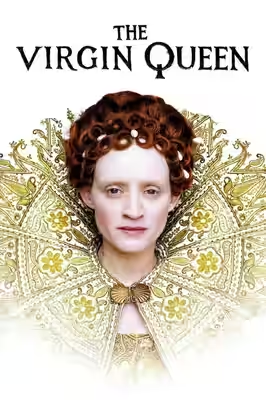
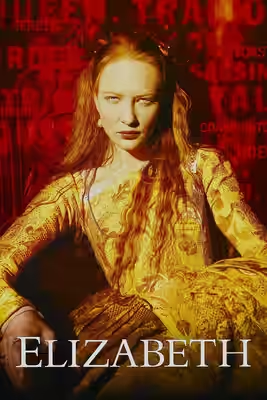
Paula Milne’s four-part account of Elizabeth I is quick, close and sometimes hectic, and Anne-Marie Duff holds all of it together. The first two episodes are the best thing here; the last two try to cover thirty years and show the strain.
The Virgin Queen takes four hours of television and spends them on a whole life, from a frightened girl in a barge on the Thames to an old woman who has outlived everyone she liked. Paula Milne wrote it, Coky Giedroyc directed all four episodes, and it first went out on 22 January 2006, within months of another television Elizabeth. We will make the comparison once and move on: this is the rougher, younger, more restless of the two, and we think the better one. It is good, with a clear fault in its second half, and if Tudor politics are your evening it is worth all four hours.
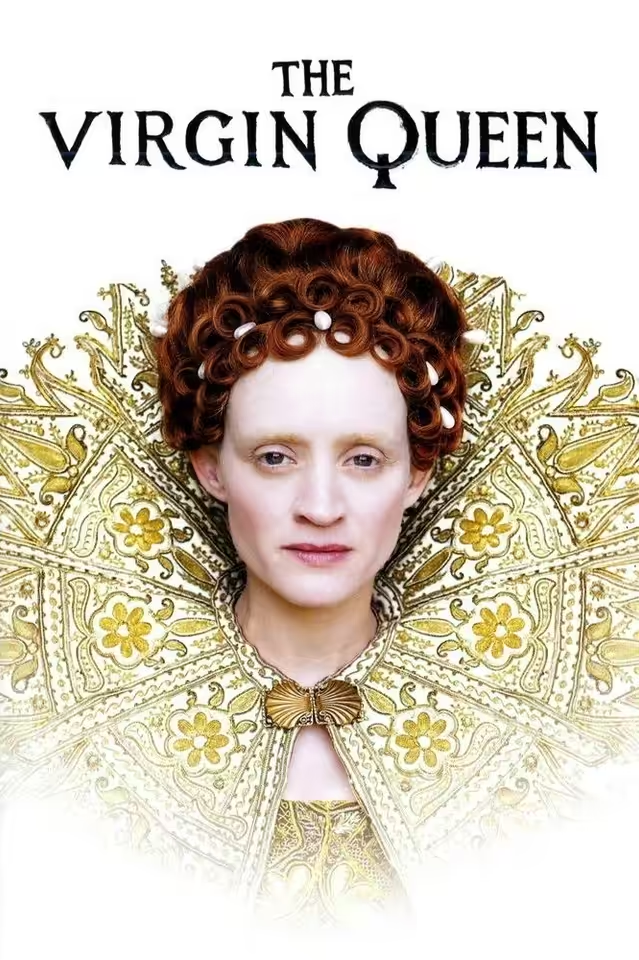
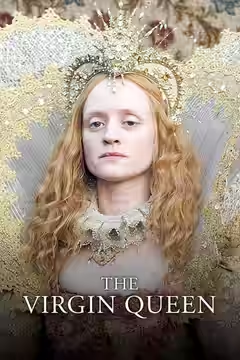
Anne-Marie Duff is the reason to watch. She plays Elizabeth as someone thin, watchful and quick to grin, a woman who has learned that the safest thing to do in a room full of men is to seem to enjoy them. The grin is a weapon and she knows it. What got us was not a speech. It was the moment in the first episode when word of Mary’s death reaches her and Duff lets the face go slack for a second, so that we can see the twenty-five years of fear leave it before the queen arrives to replace them. We did not expect to be moved by a coronation story we have seen told a dozen times. We were.
Around her the casting is mostly shrewd. Ian Hart’s William Cecil is a clerk who has decided to serve a cause rather than a person, and Hart plays him with a pen always nearer his hand than his sword. Tara Fitzgerald’s Kat Ashley is the only adult who is allowed to tell Elizabeth she is being a fool. Dexter Fletcher, as Sussex, brings a bluffness the script needs, and Ben Daniels turns up as Walsingham with the look of a man who already knows how everyone at the council table will die. Kevin McKidd’s Norfolk is given rather less to do than his billing suggests.
Tom Hardy’s Dudley is the one we are less sure of. He lounges, he smirks, he looks good in a doublet, and in the early scenes that is enough: the point of Dudley is that he is the one man at court who is not trying. Later, when the script asks him to be something more than a handsome risk, Hardy does not quite find it. He and Duff have a real heat together, which carries them a long way, but the relationship is written as the spine of the thing and it bends under the weight.
Giedroyc and her cinematographer David Odd shoot the court with a handheld camera that pushes in close and moves when the actors move, so that a council meeting feels like a street fight that happens to be in Latin. Joe Walker cuts fast and does not wait for the end of lines. Donal Woods builds the interiors dark, low and candlelit, with the light coming from one side, and Amy Roberts dresses Elizabeth in plain stuff as a princess and in white and silver as queen, so that her change of station is visible before anyone says it. Martin Phipps’s score sets women’s voices chanting over drums, and it is modern, and it is loud. For two episodes we liked it. By the fourth we wanted it to stop.
That fourth episode is the problem, and the third is not far behind. The first half of the series has room to breathe. The second half has to get through the Scottish queen, the Armada, two or three favourites and the whole business of growing old, and it does so at a jog, with captions. Scenes that should land arrive as summaries. Sienna Guillory’s Lettice Knollys, who matters a great deal to the story, is on screen too briefly for her to matter to us. The ageing make-up on Duff is good; the writing around it is in a hurry.
Still. We can think of several Elizabeths on screen who are grander than this one and none who is more like a person. Watch the first two episodes on one night and the second two on another, and forgive the second pair for trying to do in two hours what the first pair did properly in the same time.