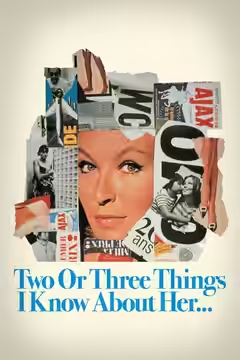
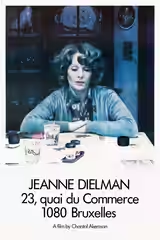
Godard’s essay on a Paris housewife who sells herself to afford the shopping is a fragmented, whispering, sometimes beautiful film that lectures more than it looks. Raoul Coutard’s colours and one close-up of a coffee cup are what stay with you; the arguments do not.
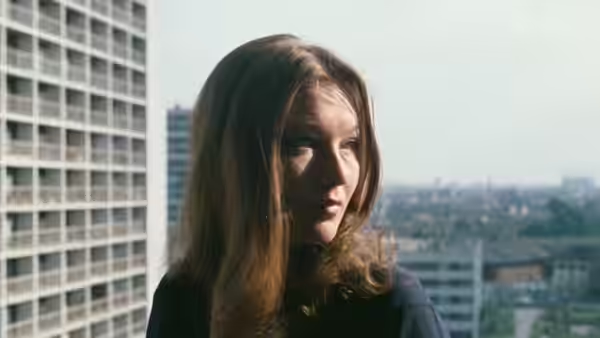
Jean-Luc Godard made this in the year he was leaving stories behind, and you can watch him do it. The “her” of the title is Juliette Jeanson, a housewife on a new estate outside Paris who sells herself in the afternoons, and it is also Paris itself, being knocked down and rebuilt around her. Godard follows one day in her life, and for most of it he is on the soundtrack, whispering, asking whether a word means what it says and whether a camera can show a thought. It is worth an evening if you have liked one Godard and are prepared to be lectured by another.
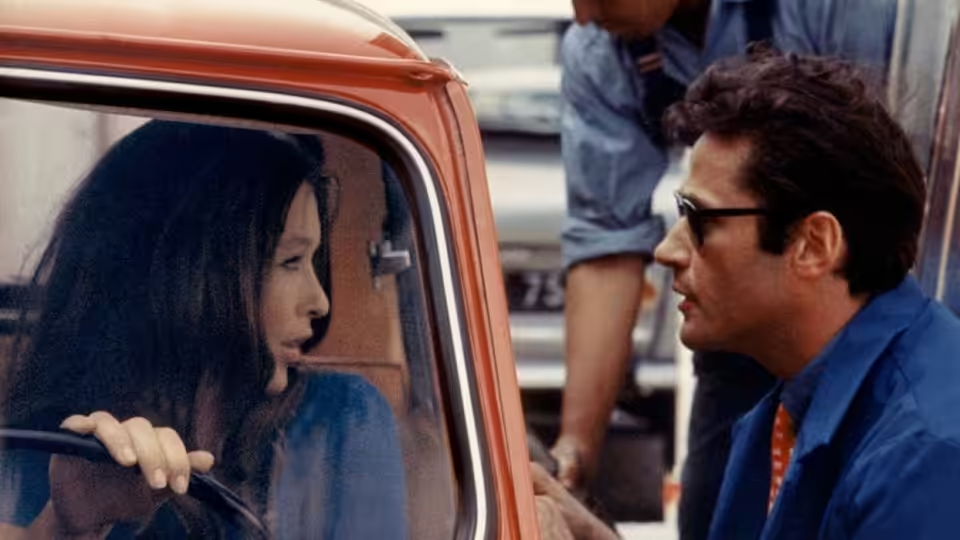
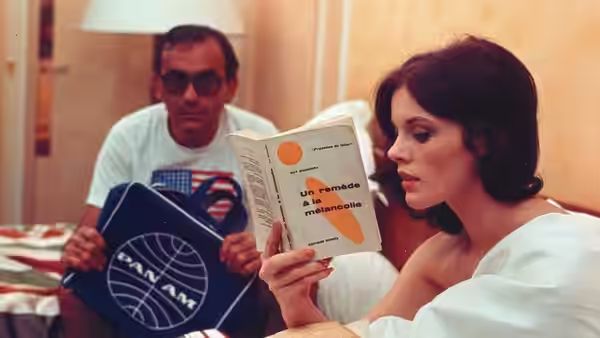
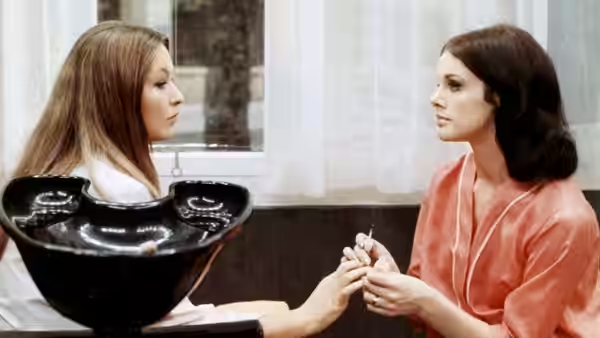
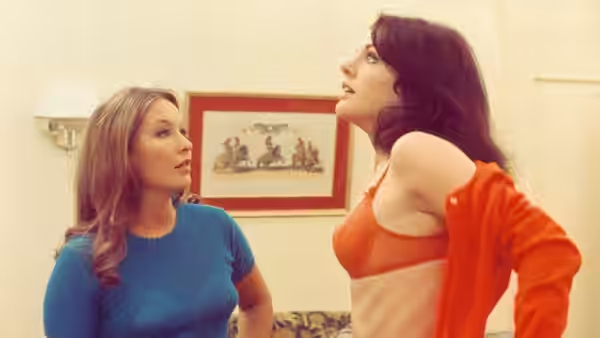
Raoul Coutard shot it in colour and widescreen, and the pictures say more than the whispering does. The estates are white concrete against a flat grey sky, half built. Indoors, everything is the red, white and blue of the French flag and of the packaging: a washing-up bottle, a packet of chewing gum, a paperback cover. Coutard films the shop shelves the way another cameraman would film a face, in close-up and held, until the products seem to be looking back. Gitt Magrini dresses Vlady in the same primary colours as the shelves she walks past, which is the joke.
The scene everyone remembers is in a café. A man stirs his coffee, and Coutard goes in so close that the cup fills the screen, black liquid, foam turning, and Godard whispers over it about consciousness and language and the impossibility of saying anything to anyone. Written down it is a man talking over a cup. Watching it, with the whisper and the slow swirl, we found ourselves holding still, and by the time the foam had settled we were more moved than a beverage has any right to make us. It is the one place in the film where the picture and the talk are the same size.
Marina Vlady is asked to do something difficult, which is to play a character and to answer Godard’s questions about the character at the same time, and she does it without a flicker. Godard fed the actors their lines and his questions through an earpiece while the camera ran, and they answer to us, looking straight down the lens. Vlady’s Juliette is a woman who thinks in slogans because slogans are what she has been handed. Anny Duperey’s Marianne is brighter and sadder. Roger Montsoret, as the husband bent over his radio, is the film’s one ordinary man, and the children, Christophe and Marie Bourseiller, deliver their lines with the seriousness only children have.
The trouble is that Godard does not trust the pictures. He stops to quote philosophers. He cuts in a magazine cover and asks what it means. A long scene in a hotel room, in which an American (Raoul Lévy) back from Vietnam arranges two women like furniture, goes on until we stopped being appalled and started counting the minutes, and we were annoyed with ourselves and then annoyed with him. Françoise Collin and Chantal Delattre cut the film into hard blocks, with bursts of Beethoven stopped mid-phrase, and the rhythm is thrilling for twenty minutes and then simply the way things are. And a film about a woman who sells herself has little curiosity about how she feels afterwards. Godard is interested in what she buys.
Set against his own run, this comes after Pierrot le fou and in the same year as La Chinoise and Weekend, and it is the last of his films for some while in which the people are as interesting as the ideas. Vivre sa vie had covered prostitution with a heart; this covers it with a notebook. Some critics place it much higher than we do, and we understand why. We think the lecture wins too often.
At 87 minutes it does not overstay. Watch it in the afternoon, with the curtains open, and let the whispering wash past when it needs to. The cup of coffee will still be there.