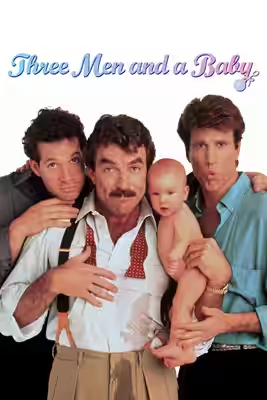
Three well-matched leads make 3 Men and a Baby worth an undemanding evening. Leonard Nimoy gets the childcare bickering right, though a needless crime subplot keeps interrupting the part worth watching.
3 Men and a Baby is good company for an evening when a modest comedy will do. Leonard Nimoy keeps the emphasis on three bachelors discovering how little they know about caring for a child, and gives the actors room to make that familiar situation amusing. The film asks for affection without doing much to complicate it. That limits how far it can go, but the central performances make its modest ambition feel reasonable.
Tom Selleck, Steve Guttenberg and Ted Danson are well matched because none seems anxious to protect his dignity. Their comic timing gives the men’s disagreements a rhythm that makes even the ordinary business of childcare entertaining. We laughed at their bickering over how to care for Mary: the pleasure is in watching three adults collectively fail to supply much expertise. They commit to looking inept without making the baby feel like an excuse for a succession of star turns.
The screenplay by Jim Cruickshank and James Orr is less sure of what to do around them. A drug-smuggling subplot adds business the domestic comedy does not need, and its contrivances are harder to forgive than the men’s ignorance about childcare. We can happily accept exaggerated incompetence when the actors find something funny in it; the crime material is simply an interruption. Having to follow it becomes a chore when spending more time with the baby would have done perfectly well.
Adam Greenberg’s cinematography and Peter S. Larkin’s production design give it a polish that suits this undemanding approach. There is little here to distract from the performers, which is usually the right decision for a comedy built around their reactions to one another. We would not mistake the comfortable presentation for much interest in the less manageable realities of childcare. The film is content to let its stars look foolish in agreeable surroundings.
Michael A. Stevenson’s editing serves the comic timing better than it disguises the script’s changes of direction. The exchanges between the men have enough pace, but cutting away from them cannot make the other material equally appealing. Marvin Hamlisch’s music is serviceable, though the cast do more to earn the film’s warmth. We remember their enthusiasm for the unglamorous work more readily than anything in the score.
By the standards of domestic comedy, the premise is hardly adventurous: three men discover that a nappy is beyond their existing skills. There is something wearing about treating male involvement in childcare as such a novelty. Yet the film gives its bachelors enough willingness to learn that their ineptitude stays mostly endearing. Their mistakes remain the main source of the humour, and the actors avoid congratulating the characters merely for making an effort.
At 102 minutes, it asks for a manageable amount of indulgence, even if some of that time is spent on the wrong plot. We would choose it for a quiet evening rather than expect it to surprise us. Parents may prefer to save it for a night when somebody else has done the changing.