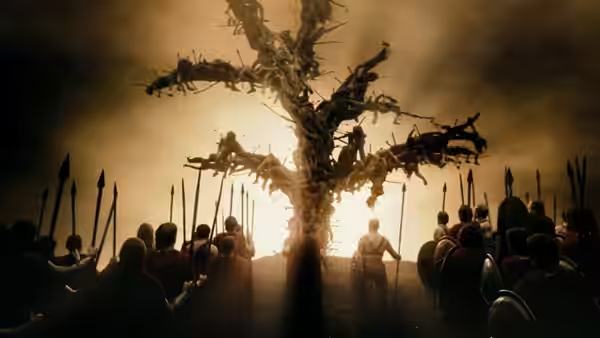
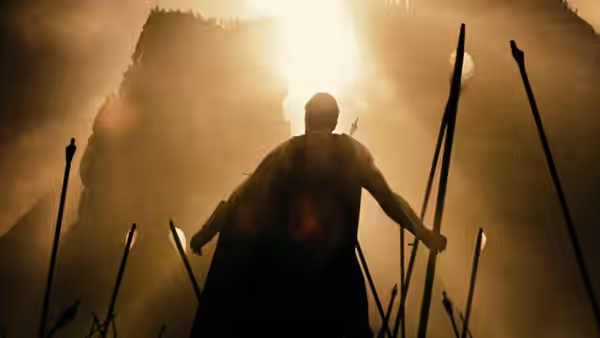
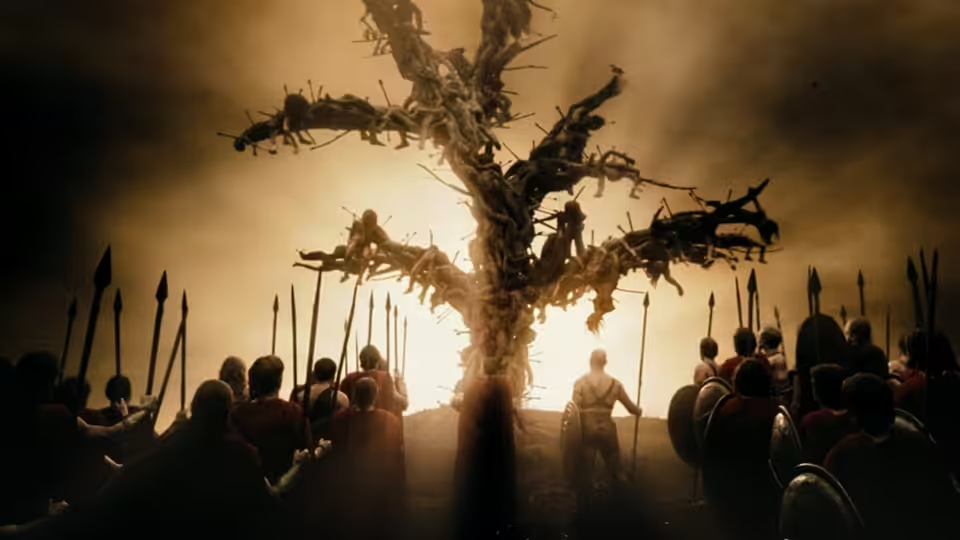
Spartan soldiers gather beneath a tree bearing bodies impaled on its branches
Film review

300

2007 · Directed by Zack Snyder · 1h 57m · ClassInd 16

In a sentenceThe slow motion gives us plenty of time to notice that nobody has much to say

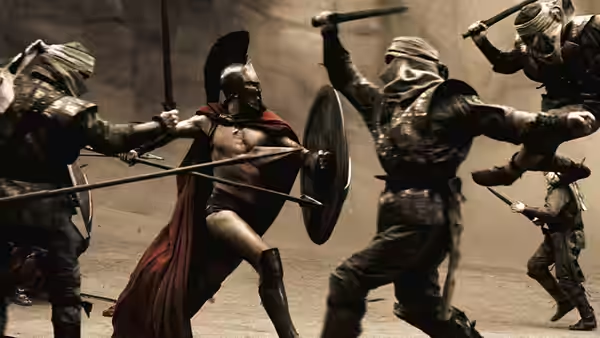
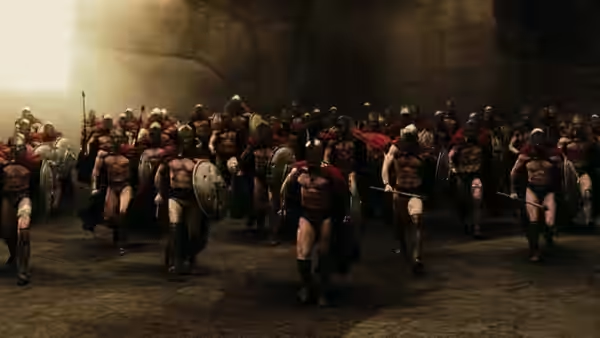
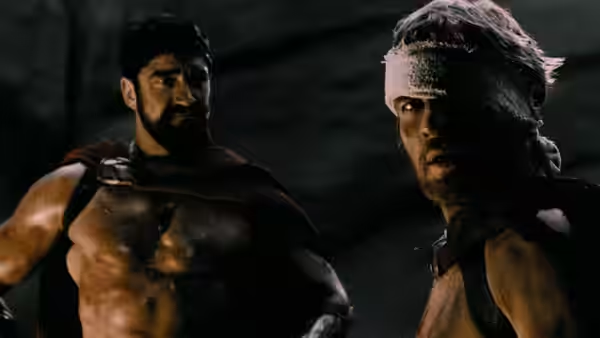
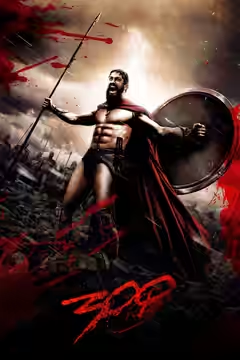
King Leonidas (Gerard Butler) is the central figure in a war story narrated by Dilios/Narrator (David Wenham). Gorgo (Lena Headey), Theron (Dominic West) and Xerxes (Rodrigo Santoro) appear alongside the Captain (Vincent Regan), Stelios (Michael Fassbender) and Astinos (Tom Wisdom). Battles run alongside a political subplot, with speeches and disputes taking the action away from combat. Leonidas remains the focus as the story moves between fighting and politics. The battles use choreographed movement and slow motion, within landscapes presented through a controlled colour palette.

Plays from YouTube when you press play; nothing loads from them until then.

Fi1m review

Zack Snyder makes fighting look carefully arranged and talking feel like an interruption. 300 has considerable visual discipline, but its narrow emotional range and repeated slow motion wear us down.

Zack Snyder builds 300 around the pleasure of watching combat arranged for the camera. It is skilfully done, but the film is too repetitive and too poorly written for us to recommend it. The fighting is given a force and precision that the conversations rarely approach. At 117 minutes, this narrow range becomes a problem: each fresh bout of violence has to justify another stretch in the company of people who barely develop.

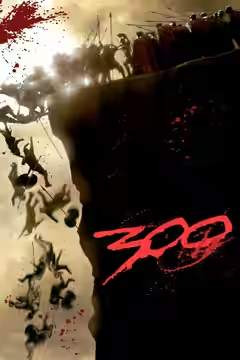
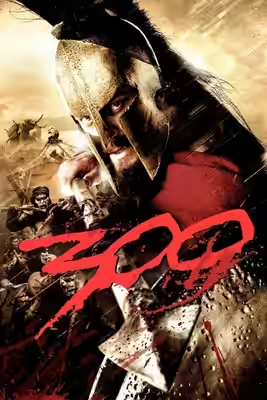
Larry Fong’s cinematography is the strongest reason to stay. The tightly controlled colour makes the combatants legible within busy compositions, while James D. Bissell’s production design gives the fantasy landscapes enough solidity to hold those figures. We felt a surge of excitement at the choreographed fighting, because movement remains readable even when the imagery is heavily stylised. There is care here about where a body sits within a frame, and how the surrounding space directs our attention towards it.

William Hoy’s editing becomes less persuasive as the fighting continues. The repeated use of slow motion keeps announcing the importance of individual blows, until we start noticing the device instead of feeling the impact. A held moment needs something worth examining, and too often the extra time lets us see how little danger these bodies seem to be in. The choreography remains impressive, but the violence starts to feel like an exercise we have already watched.

Tyler Bates’s music compounds the problem. It presses hard for excitement even when the images have already supplied it, leaving little space for tension to develop at a different volume. Less insistent scoring might allow us to attend to an individual movement without being told how much it matters. Instead, the music keeps pushing, and the fighting becomes tiring well before it has exhausted its visual possibilities.

The screenplay, credited to Michael B. Gordon, Zack Snyder and Kurt Johnstad, leaves Gerard Butler with a King Leonidas who has little room to change. Butler supplies the required force, but there is only so much a performance can do when each speech seems to reaffirm the same attitude. The political subplot ought to make the people away from combat matter; instead it interrupts the action without making the stakes more involving. Lena Headey’s Gorgo and Dominic West’s Theron deserve more than this narrow stretch of the film allows them.

There is also something dispiriting about the way the film asks us to enjoy its martial pride. The carefully arranged violence gives us too little sense of what fighting costs the people involved. A war film need not pause for a lecture, but fear and uncertainty would give these combatants something to do beyond looking formidable. We are asked to admire them so insistently that there is barely an opportunity to become concerned about them.

A few stretches of action may be enough for viewers who come solely for the choreography. We would be more cautious about committing to the whole film, particularly if relentless music wears you down. If you need a reason to care who wins, we would look elsewhere.

Critical consensus AI synthesised

53
Positive
3
Mixed
5
Negative
5

The reviews of 300 lean mixed to negative, with praise concentrated on its stylised imagery and battle choreography. Even several detractors admire the colour-controlled, graphic-novel look and elaborate action compositions. More favourable critics find enough excitement in the spectacle to forgive the thin story, while others regard the visual design as the chief achievement of a film with little emotional range. There is far less enthusiasm for the dialogue or characterisation.

The disagreement is over how long those images sustain interest, and what the violence amounts to. Repetitive combat, excessive slow motion and hollow characters recur among the complaints. The spread is wide: Eye for Film embraces the film as forceful entertainment despite its political complications, while Digital Spy finds the writing and repeated violence tedious. The AV Club raises a more pointed objection, finding nationalist, pro-war assumptions beneath action that strips combat of danger and loss.

The Hollywood Reporter
14 February 2007 · festival review · Kirk Honeycutt
70*

Honeycutt finds the film thrilling and visually impressive, while warning that its approach risks becoming repetitive. He especially praises the battle choreography and stylized visual world, but criticizes the weak political subplot and Leonidas’s lack of depth.

Read the full review →
Variety
9 March 2007 · Todd McCarthy
70*

McCarthy finds the film blustery and overindulgent, but visually arresting and likely to satisfy action fans. He praises its stylized, color-coordinated imagery while faulting its suffocating visuals and narrow range of emotion.

Read the full review →
Screen Daily
16 February 2007 · Brent Simon
64*

The page identifies this as a review, but the review text is unavailable in the accessible page. Its verdict and any specific praise or criticism therefore cannot be established.

Read the full review →
Time Out
20 March 2007 · Trevor Johnston
64*

The page identifies this as a review, but its text is unavailable. The critic’s verdict and any specific praise cannot be determined from the accessible metadata.

Read the full review →
RogerEbert.com
9 March 2007 · ★★½/4 · Roger Ebert
62

Ebert gives the film a mixed verdict, finding its style more compelling than its substance. He singles out its striking visual design as its chief achievement.

Read the full review →
Total Film
23 March 2007 · ★★★ · Total Film
60

The review calls the film a beautiful, startlingly gory guilty pleasure, though it criticizes the thin plot and relentless violence. It praises the striking visual style and the terrible beauty of its battle imagery.

Read the full review →

Straight answers AI written, from our review

Is 300 worth watching?
300 has skilfully choreographed action, but we find it too repetitive and poorly written to recommend, scoring it 52 out of 100. Viewers interested solely in carefully arranged combat may find enough to enjoy; thin characters, repeated slow motion and relentless music make the full 117 minutes tiring.
How long is 300, and what is it rated?
300 runs 1h 57m and is rated 16 by the ClassInd in Brazil. It is an action and adventure film.
Where can I watch 300 in Brazil?
300 is streaming on HBO Max and Amazon Prime Video in Brazil, and it is also available to rent from Amazon Prime Video and Apple TV from R$9.90. Availability is checked daily; the links above go straight to each service.
How violent or frightening is 300, and is it suitable for children?
300 carries a UK 15 certificate and contains repeated, heavily stylised combat, making it unsuitable for children under 15. We find the violence tiring rather than consistently tense, with slow motion drawing attention to individual blows; older teenagers and adults who dislike sustained fighting should approach it cautiously.
How does 300 compare to Hero?
300 shares Hero’s carefully controlled colour and precise combat, but we recommend Hero as the more rewarding film. Its sword fights offer comparable visual pleasure alongside a more searching treatment of obedience to power, though we find its characters distant and its view of imperial power indulgent.
Is 300 based on a true story or a book?
300 is adapted from a novel by Frank Miller. That source credit alone does not establish its historical accuracy, and we cannot confirm how faithfully it follows the book or whether familiarity with it helps; our reservations concern the film’s repetitive fighting and thin characterisation.
What should I watch after 300?
After 300, try Hero (2002, Fi1m 77): Colour-controlled combat and a more searching account of obedience to power. Then Ran (1985, Fi1m 92): Armies arranged with precision, and consequences that reach beyond the battlefield.

Cast

Awards

Saturn Awards, 2008

Won
Best Director

Satellite Award for Best Visual Effects, 2007

Won
Satellite Award for Best Visual Effects

Saturn Awards, 2007

Won
Best Action or Adventure Film

If you liked this, try…

  1. Hero (2002, Fi1m 77)Colour-controlled combat and a more searching account of obedience to power.

  2. Ran (1985, Fi1m 92)Armies arranged with precision, and consequences that reach beyond the battlefield.

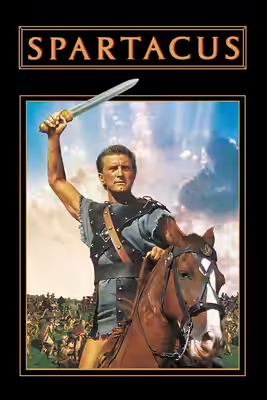
  3. Spartacus (1960) · not reviewed yetA muscular rebellion with more room for the people doing the rebelling.

  4. The Northman (2022) · not reviewed yetWarrior pride, ritual and brutality, with a stronger sense of physical danger.

  5. The Fall (2006) · not reviewed yetFor the elaborate imagined landscapes, with tenderness rather than another battle.

Free account

Know what to watch tonight

Two lists that know where things are streaming, collections you can share, your own score beside ours, and Discover that remembers what you have seen.

  • Want to see, sorted by what is streaming now
  • Seen, with your score out of ten
  • No adverts, ever