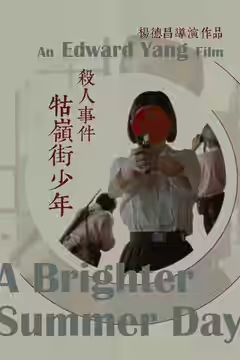
Edward Yang’s account of a Taipei schoolboy, his family and the gangs around him runs 237 minutes and earns them. It asks us to keep track of a great many boys, and we would send a stranger to see it.
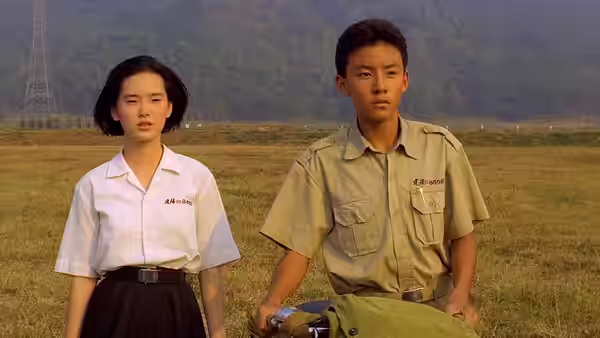
Edward Yang’s film is set in Taipei at the start of the 1960s. Xiao Si’r (Chang Chen) has been sent to night school, where the boys run in gangs. Yang, writing with Alex Yang, Mingtang Lai and Hung Hung, follows his life over 237 minutes. That is nearly four hours, and we would tell a stranger to give them up.
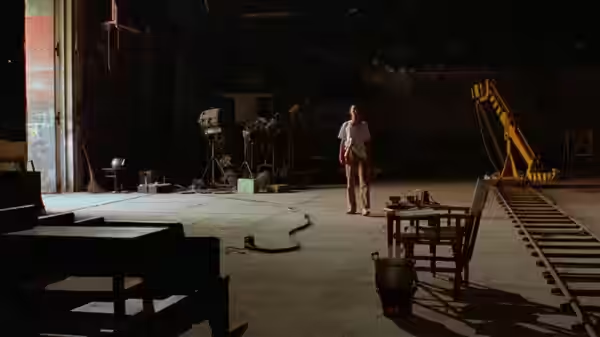
There is the school, with its concrete corridors, and the film studio next door where Xiao Si’r and his friend Cat (Wang Chi-tsan) sneak in to watch the shooting. Xiao Si’r comes away with a torch. There is the ice parlour where Cat sings Elvis, and the low Japanese-era house where Xiao Si’r’s family live on a civil servant’s pay. Yu Wei-Yen, who also produced, designed all of it, and none of it looks dressed.
Chang Hui-kung and Longyu Zhang shoot nearly everything from a distance, the camera left still while people walk in and out of the frame. Faces are often just shapes against a doorway. When the gangs fight, the camera stays where it is and the torch beam swings through the black; we could not see the blows land and did not want to. Zhang Hongda is credited with the music and there is almost none of it; what we hear is Cat’s Elvis records, sung back by children.
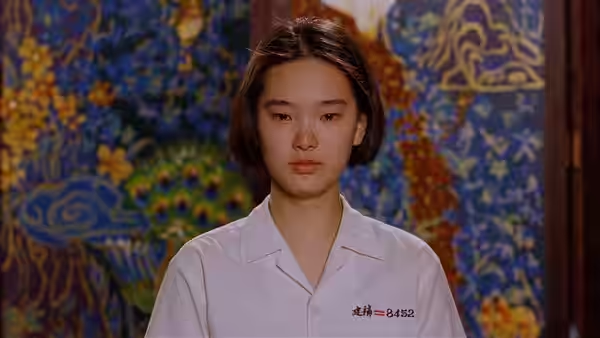
Chang Chen plays Xiao Si’r as a boy who watches. The film trusts us to notice the small shifts, a jaw set a little harder, a hand kept in a pocket. Lisa Yang’s Ming has learned to be liked by whoever is around her, and the film is careful never to tell us how much of that is calculation. Chang Kuo-Chu, as the father, believes in exams and in speaking up to officials; Elaine Jin Yan-Ling, as the mother, is a teacher whose mainland qualifications are not recognised.
The scene that got at us is a small one, early on. The father walks his bicycle home beside his son after the row at the school and tells him that a man who works hard and believes in himself has nothing to be afraid of. We suspect the father knows this is not true. We were quietly undone by it, and by how gently Yang lets it stand without comment.
It is not an easy watch, and not only because of the length. The cast is enormous, the boys go by nicknames, and for the first hour we lost track of who belonged to which gang. Chen Po-Wen’s editing cuts away rather than in, and more than once we had to work out for ourselves that weeks had passed. The strand about the parents and the state is handled so obliquely that a viewer without the history may struggle to follow it.
Yang’s Yi Yi, made nine years later, is the one to see next. Rebel films about boys with knives usually want us to love the boy. This one wants us to understand him, which is harder and less flattering.
Watch it at home in two sittings. Keep the lights off. It was shot for the dark, and on a bright afternoon you will lose half of it.