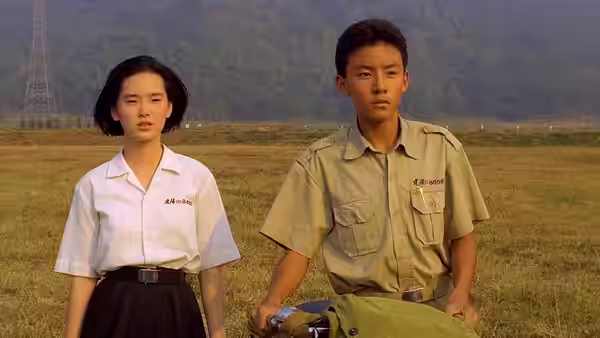
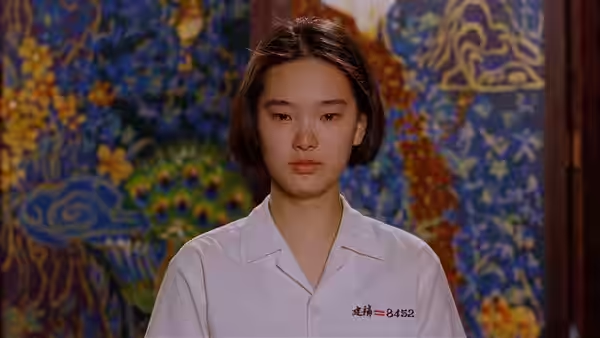
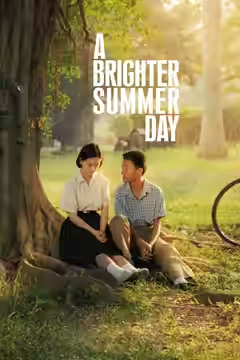
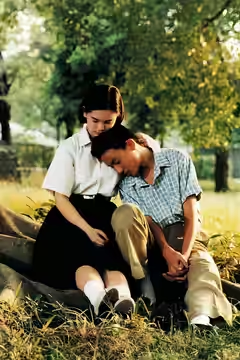
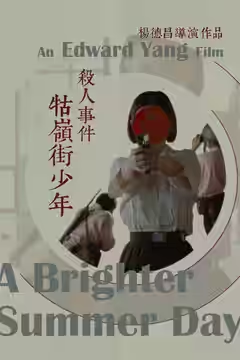
Ming (Lisa Yang) sits beneath a tree as Xiao Si'r (Chang Chen) rests against her shoulder
Film review

A Brighter Summer Day

1991 · Directed by Edward Yang · 3h 57m

In a sentenceA stolen torch, a borrowed Elvis and a boy who cannot see where he is going; nearly four hours, none of it slack

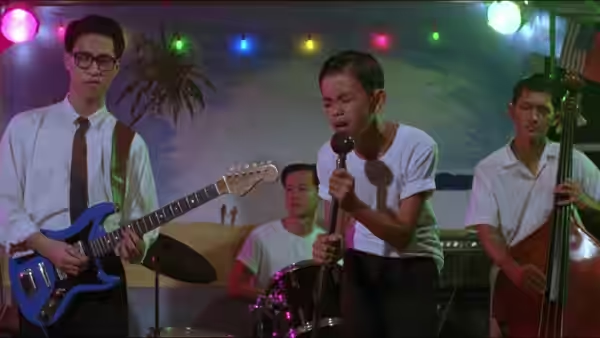
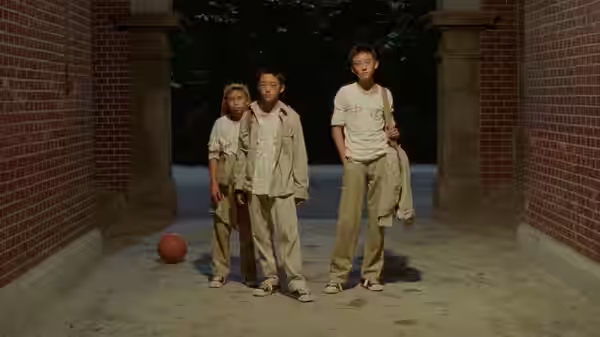
Taipei, at the start of the 1960s. Xiao Si’r (Chang Chen) has been sent to night school, and his father (Chang Kuo-Chu), a civil servant, argues with the school about his exam marks. The boys run in gangs, and Xiao Si’r drifts towards the Little Park gang with his friend Cat (Wang Chi-tsan), who sings Elvis in the ice parlour. In the school infirmary he meets Ming (Lisa Yang), the girlfriend of the Little Park leader, who has gone into hiding. Xiao Si’r tries to find his place among them as their rivalries grow. Next door is a film studio, and he comes out of it one night with a stolen torch.

Fi1m review

Edward Yang’s account of a Taipei schoolboy, his family and the gangs around him runs 237 minutes and earns them. It asks us to keep track of a great many boys, and we would send a stranger to see it.

Edward Yang’s film is set in Taipei at the start of the 1960s. Xiao Si’r (Chang Chen) has been sent to night school, where the boys run in gangs. Yang, writing with Alex Yang, Mingtang Lai and Hung Hung, follows his life over 237 minutes. That is nearly four hours, and we would tell a stranger to give them up.

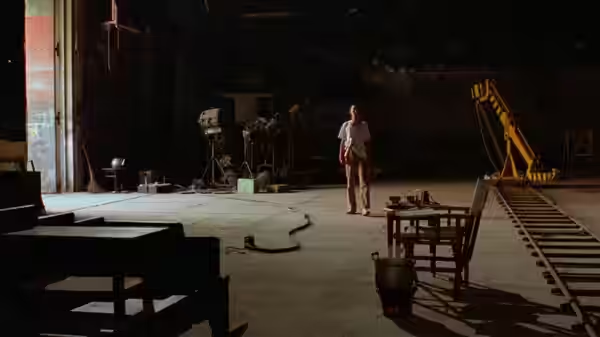
There is the school, with its concrete corridors, and the film studio next door where Xiao Si’r and his friend Cat (Wang Chi-tsan) sneak in to watch the shooting. Xiao Si’r comes away with a torch. There is the ice parlour where Cat sings Elvis, and the low Japanese-era house where Xiao Si’r’s family live on a civil servant’s pay. Yu Wei-Yen, who also produced, designed all of it, and none of it looks dressed.

Chang Hui-kung and Longyu Zhang shoot nearly everything from a distance, the camera left still while people walk in and out of the frame. Faces are often just shapes against a doorway. When the gangs fight, the camera stays where it is and the torch beam swings through the black; we could not see the blows land and did not want to. Zhang Hongda is credited with the music and there is almost none of it; what we hear is Cat’s Elvis records, sung back by children.

Chang Chen plays Xiao Si’r as a boy who watches. The film trusts us to notice the small shifts, a jaw set a little harder, a hand kept in a pocket. Lisa Yang’s Ming has learned to be liked by whoever is around her, and the film is careful never to tell us how much of that is calculation. Chang Kuo-Chu, as the father, believes in exams and in speaking up to officials; Elaine Jin Yan-Ling, as the mother, is a teacher whose mainland qualifications are not recognised.

The scene that got at us is a small one, early on. The father walks his bicycle home beside his son after the row at the school and tells him that a man who works hard and believes in himself has nothing to be afraid of. We suspect the father knows this is not true. We were quietly undone by it, and by how gently Yang lets it stand without comment.

It is not an easy watch, and not only because of the length. The cast is enormous, the boys go by nicknames, and for the first hour we lost track of who belonged to which gang. Chen Po-Wen’s editing cuts away rather than in, and more than once we had to work out for ourselves that weeks had passed. The strand about the parents and the state is handled so obliquely that a viewer without the history may struggle to follow it.

Yang’s Yi Yi, made nine years later, is the one to see next. Rebel films about boys with knives usually want us to love the boy. This one wants us to understand him, which is harder and less flattering.

Watch it at home in two sittings. Keep the lights off. It was shot for the dark, and on a bright afternoon you will lose half of it.


Critical consensus AI synthesised

85
Positive
6
Mixed
1
Negative
0

The reviews lean firmly positive, and the praise gathers in the same few places. Most critics admire Yang’s handling of light and darkness, which they read as carrying feeling and political weight together, alongside the spare, elegant compositions that go with it. Several are struck by how thoroughly the film’s world is built, with a large cast and a specific time and setting that make the protagonist’s slide towards violence feel earned rather than imposed. The way Taiwan’s political and social history runs through private lives is singled out more than any other quality.

Reservations are scarce and the spread is narrow. Length and pace are the only recurring notes: Time Out calls the approach slow, elliptical and understated before praising it anyway, and The Guardian finds the four-hour running time easy to follow. The one mixed mark comes from The New York Times, whose review cannot be read, so no complaint can be attached to it.

Slant Magazine
4 April 2004 · ★★★★/4 · Ed Gonzalez
100

Gonzalez praises Yang’s film as a richly layered exploration of Taiwan’s political and social history. He singles out the spare compositions and careful use of light and darkness for their emotional and political force.

Read the full review →
IndieWire
26 November 2011 · A · Christopher Bell
95

The critic calls the film an immersive, masterful classic. He especially praises Yang’s lived-in world and his subtle use of light to explore identity.

Read the full review →
The AV Club
26 March 2016 · A.A. Dowd
90*

Dowd calls the film a masterful, deeply absorbing epic. He praises how its expansive cast and carefully built world make the protagonist’s descent into violence feel credible.

Read the full review →
The Guardian
9 March 2016 · ★★★★ · Jordan Hoffman
80

Hoffman warmly recommends the film, finding its four-hour running time easy to follow and its tragedy compelling. He singles out Yang’s graceful way of weaving political meaning into the characters’ lives and the film’s specific time and setting.

Read the full review →
Time Out
· GA
80*

The review presents Yang’s account as masterly despite its slow, elliptical, understated approach. It singles out the film’s visual elegance for praise.

Read the full review →
The New York Times
25 November 2011
65*

The page is inaccessible, so the critic’s verdict cannot be established. No praise or complaint from the review is available to identify.

Read the full review →

Straight answers AI written, from our review

Is A Brighter Summer Day worth watching?
A Brighter Summer Day is worth its 237 minutes for viewers willing to give a demanding drama their attention, and we score it 90. We find its patient observation of a schoolboy and his family deeply moving, though the enormous cast, gang nicknames and understated shifts in time take work to follow.
How long is A Brighter Summer Day, and what is it rated?
A Brighter Summer Day runs 3h 57m. It is a crime and drama film.
Where can I watch A Brighter Summer Day in India?
A Brighter Summer Day is not on any streaming or rental service in India at the moment. It is available in 2 other countries; change your country at the top of the page to see where. Availability is checked daily.
How violent or frightening is A Brighter Summer Day, and is it suitable for children?
A Brighter Summer Day has no UK certificate supplied and is unrated in the US; its gang violence and boys carrying knives make it a poor choice for children. We find the fighting disturbing even when darkness conceals the blows, and would reserve it for older teenagers and adults comfortable with unsettling material and a demanding, nearly four-hour drama.
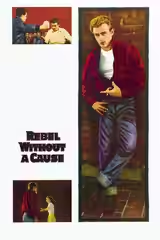
How does A Brighter Summer Day compare to Rebel Without a Cause?
A Brighter Summer Day is the stronger choice for a patient viewer seeking a fuller account of teenage life and family pressures; we recommend Rebel Without a Cause for its young cast’s painfully particular unhappiness. Both concern troubled boys and knives, but Yang gives the parents more complexity, while Nicholas Ray’s drama draws them too simply.
What should I watch after A Brighter Summer Day?
After A Brighter Summer Day, try Yi Yi (2000, Fi1m 92): Yang’s last film; a Taipei family over one year, gentler and just as exact. Then Rebel Without a Cause (1955, Fi1m 84): The American original these boys are half imitating, knives and all; and The 400 Blows (1959, Fi1m 91): Another boy failed by school and parents, in a Paris shot with the same patience.

Cast

Awards

International Submission to the Academy Awards, 1992

Nominated
International Submission to the Academy Awards

Golden Horse Award for Best Feature Film, 1991

Won
Golden Horse Award for Best Feature Film

If you liked this, try…

  1. Yi Yi (2000, Fi1m 92)Yang’s last film; a Taipei family over one year, gentler and just as exact.

  2. A City of Sadness (1989) · not on Fi1m yetHou Hsiao-hsien on the same Taiwan a decade earlier, told through one family.

  3. Rebel Without a Cause (1955, Fi1m 84)The American original these boys are half imitating, knives and all.

  4. The 400 Blows (1959, Fi1m 91)Another boy failed by school and parents, in a Paris shot with the same patience.

  5. Mean Streets (1973, Fi1m 87)Young men, small territories and a neighbourhood that decides things for them.