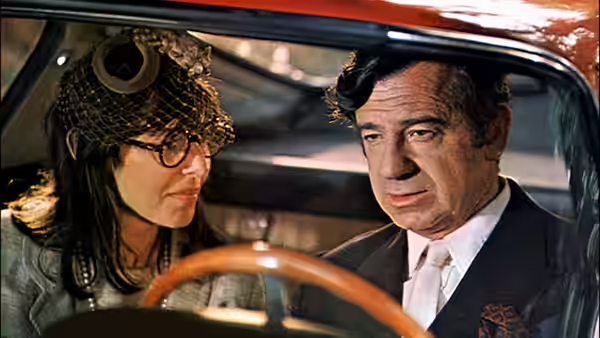
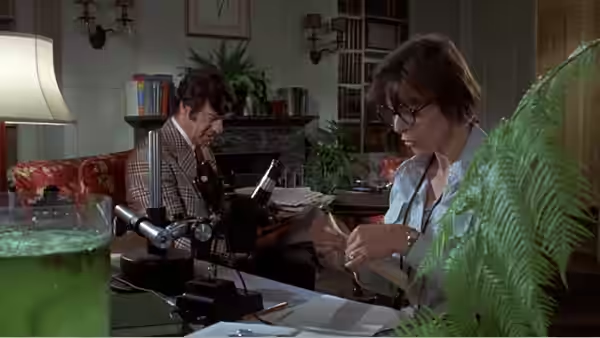
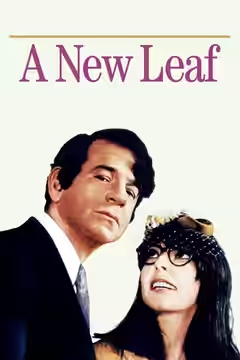
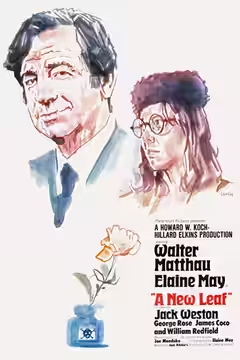
Elaine May and Walter Matthau make an unlikely romantic pairing funny and unexpectedly affecting. The pacing is slack in places, but the attention given to Henrietta keeps the comedy from becoming a prolonged exercise in cruelty.
A New Leaf is a funny, unexpectedly tender comedy with a pace that sometimes needs a firm word. Elaine May writes and directs, and plays Henrietta Lowell opposite Walter Matthau’s Henry Graham. The difficult job is to make a cold, self-serving man worth spending time with while giving the woman opposite him something more than the duty of improving him. She largely manages it, without making Henry’s company any more comfortable than it should be.
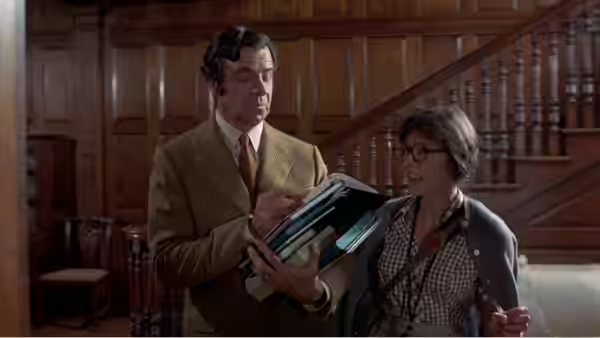
Walter Matthau makes Henry’s self-regard funny by giving it so little visible strain. There is no pleading for affection in the performance, and no need to underline each piece of unpleasantness. His reserve suggests someone who considers his own convenience an adequate explanation for everything, and finds further discussion faintly improper. We can enjoy the precision of the acting without needing to find the man charming.
Elaine May has the harder task, because Henrietta’s awkwardness could easily reduce her to a collection of comic mannerisms. She gives those mannerisms a sense of the person experiencing them, including the sweetness that makes her vulnerable to Henry. We laughed at the contrast between his composure and her guilelessness, then felt protective of her. That feeling comes from the difference between the performances: he appears thoroughly defended, while she has scarcely thought to defend herself.
The writing keeps finding humour in that uncomfortable difference. The dialogue is sharp enough to make Henry’s cynicism entertaining, although the performance opposite him supplies the stronger reason to care what happens between them. Romantic comedy often gives its awkward partner the thankless job of teaching the colder one how to behave. Henrietta holds our attention in her own right, and we would resent any suggestion that fixing Henry was her sole purpose.
Gayne Rescher’s cinematography and the production design by Warren Clymer and Richard Fried are less distinctive pleasures. We remember the people more clearly than their surroundings, which seems fair enough for a comedy so dependent on the amount of sympathy each performer permits. Neal Hefti provides the music, though the actors’ contrasting delivery supplies the rhythm we notice most. Our attention keeps returning to the performances.
The editing, credited to Don Guidice, Fredric Steinkamp and Edward Beyer, leaves a more substantial reservation. Some stretches linger after their comic point has registered, and the looseness can make the film feel longer than its 102 minutes. The performances often benefit from being allowed room, but that does not mean every pause deserves equal patience. We wanted a little more decisiveness about moving on; a dry comedy loses some of its sting when we have too long to anticipate the next discomfort.
That slackness is worth allowing for, especially if brisk plotting is the main pleasure a comedy offers you. The stronger reason to watch is the attention Elaine May gives Henrietta, even when Henry’s appalling attitude is getting the laughs. There is warmth here, earned by taking an awkward person seriously enough to let her be funny without making her negligible. Choose it for the actors, and do not expect them to hurry.