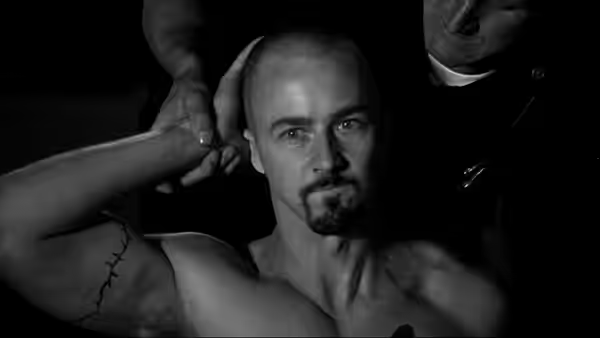
Edward Norton’s disturbing performance makes American History X worth seeing, despite its blunt writing. Tony Kaye directs with force, but the hurried explanations leave too little space for doubt or gradual change.
American History X is a forceful drama weakened by a script that makes difficult changes of belief look too simple. Tony Kaye wants us to face racist hatred without the reassuring thought that only people entirely unlike us could embrace it. That is a worthwhile aim, and Edward Norton gives it an unsettling human shape as Derek. The trouble is that David McKenna’s screenplay so often turns people into speakers for a position, then hurries towards the next lesson.
Norton makes Derek’s confidence the disturbing thing: the certainty that his prejudices amount to knowledge and that other people simply lack his courage. We were unnerved by how reasonable he can make himself sound while saying something vile. Norton does not need to force every line for the menace to register; his command of the conversation is enough. He lets us understand why someone might listen to this man, without making the beliefs themselves any less repellent.
Kaye also serves as cinematographer, and his emphatic compositions give the film a visual confidence that the writing cannot always sustain. The wordless passages allow a face or a group of bodies to hold our attention without somebody explaining what they represent. Yet Derek is photographed with such insistence on his presence that the film sometimes seems impressed by the man it is examining. Norton’s charisma is already dangerous enough, and the images work too hard to underline it.
Jon Gary Steele’s production design gives the working-class surroundings a convincing ordinariness. The settings help place Derek among people with an established life together, so his racism does not seem safely confined to some remote criminal hideout. Anne Dudley’s music is less restrained, supplying a solemnity that can feel prescribed. When both the images and the score are insisting on the weight of a scene, there is little room left for our own response.
The larger weakness belongs to McKenna, whose dialogue keeps making the themes explicit after the performances have made them clear. His account of how racist convictions take hold, and how they might be questioned, depends on lessons that arrive too neatly. We can accept that people change without accepting every dramatic shortcut taken to show it. Too much of the dialogue sounds prepared for a classroom discussion, with each speaker allocated a point to make and little opportunity to stray from it.
Editors Gerald B. Greenberg and Alan Heim keep the drama moving, though that forward pressure makes the simplifications harder to ignore. Some developments need time to settle, and the cutting gives them less of it than the film’s subject requires. The scenes can be forceful individually while the steps between them remain unconvincing. More time with hesitation and doubt would have helped us believe the changes the screenplay wants to make.
We do not require a drama about racism to explain every hateful belief or provide a complete programme for correcting it. We do need its people to remain convincing when the script starts steering them towards its conclusions. Kaye’s film has enough troubling moments to survive its simplifications, though they limit what it can tell us about changing a mind. See it for Norton, and allow for some persistent lecturing.