Alan Bennett and John Schlesinger spin a true afternoon in Moscow into an hour about exile, manners and gossip, and Alan Bates gives Guy Burgess a charm that is never asked to excuse him. It is slight, and we would not have it longer.
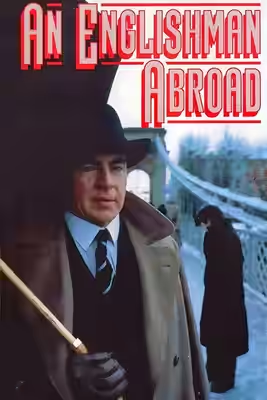
Alan Bennett took a story the actress Coral Browne used to tell at dinner, about the afternoon in 1958 when Guy Burgess, seven years into his Moscow exile, turned up drunk in her dressing room and later asked her to lunch, and made 63 minutes of television out of it. John Schlesinger directs, Browne plays herself, and Alan Bates plays the spy. It is small, dry and close to perfect at what it sets out to do, which is to watch two English people be polite to each other in a place where politeness is the only thing either has left. We would send anyone to it who can sit still for an hour without an explosion. The reviews so far rate it lower than we do, as a slight piece of television; we think slight is what Bennett meant, and an hour with no wasted minute in it is harder to make than most long films with ambitions.
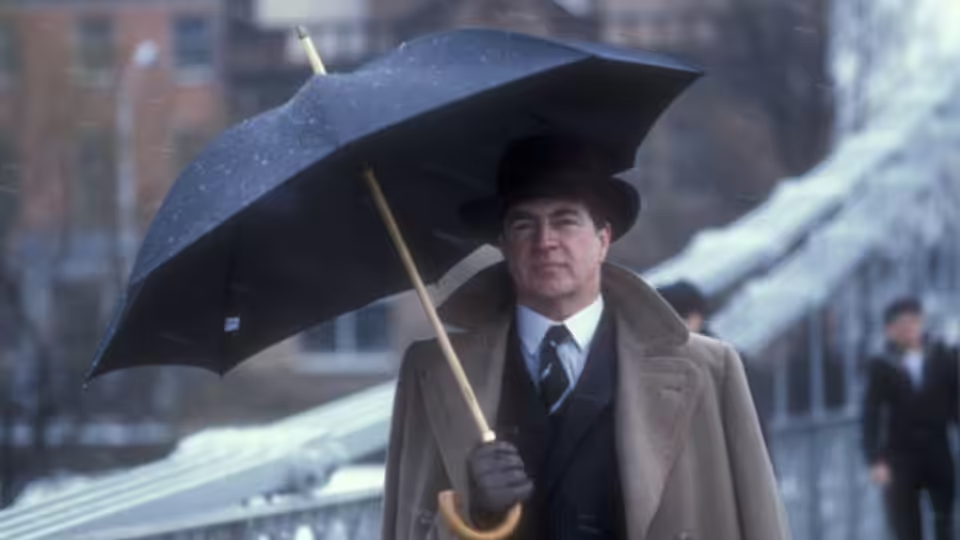
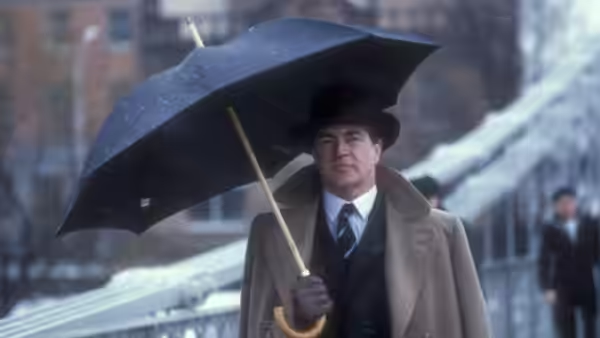
Bates’s Burgess is the reason. He arrives in the interval of Hamlet unable to stand, is sick in Browne’s basin and leaves with her soap, and Bates plays all of it as a man who has not stopped being charming simply because there is nobody left to charm. The Old Etonian tie is still on. The cuffs are going at the edges. In his flat he plays one scratched dance-band record over and over, asks who is sleeping with whom in London, and does not once say why he left. We found ourselves liking him within ten minutes and were slightly ashamed of it, which is the trap Bennett has set, and Bates springs it without ever asking for sympathy out loud.
Browne is the harder trick, because she is playing herself twenty-five years on and has to be both the woman it happened to and the woman remembering it. She does it with a kind of appalled good manners. She is disgusted by the basin and still goes to lunch. She is told nothing about his politics and asks for nothing. When he produces a tape measure and asks her to take his measurements for his old tailor in London, she takes them, and the film’s whole idea of exile is in that scene: a man who cannot go home being fitted for the clothes he would wear there. Charles Gray, as the company’s Claudius, fusses about the embarrassment of it all and speaks for everyone who would have crossed the street.
Nat Crosby shoots a Moscow of browns and greys, snow trodden to mud, streets of people in the same coat, and Browne’s fur and lipstick are the only colour in it until Burgess’s tie turns up. Stuart Walker gives the flat one room, books in piles, a bed and the gramophone, and makes it look lived in by somebody who was once used to servants. Amy Roberts dresses Bates in a suit that was good fifteen years ago and lets that do the work a page of dialogue would otherwise have to. George Fenton’s score is a few bars here and there and is mostly content to leave the record player to it. Ken Pearce cuts nothing slack: there is not an idle minute, and the lunch, which is most of the film, plays close to real time.
The last stretch, in London, is where it thins. Browne goes from tailor to shoe shop to a pyjama counter with Burgess’s order, and the scenes with Denys Hawthorne’s tailor, Roger Hammond’s shop assistant and Trevor Baxter’s pyjama shop manager make a single joke, about what the English will and will not forgive a gentleman, three times with diminishing returns. It is good sketch writing. It is not the same film as the one in the flat, and at 63 minutes the shift shows. And by keeping Burgess’s treason entirely off screen, Bennett makes the man easy company and lets the film off a question it has quite deliberately chosen not to ask.
Schlesinger made Midnight Cowboy and Sunday Bloody Sunday, films about lonely people in big cities, and this is the quietest of them. Bennett went back to the Cambridge spies in A Question of Attribution, and the two sit together well. See this one first, on a cold evening, with the sound up for the record. It carries a PG and asks nothing of you but an hour and a little attention to a tie.