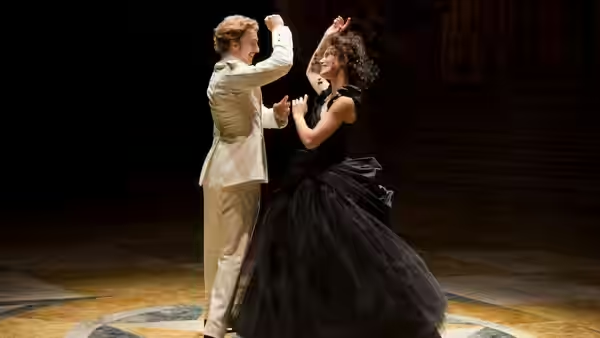
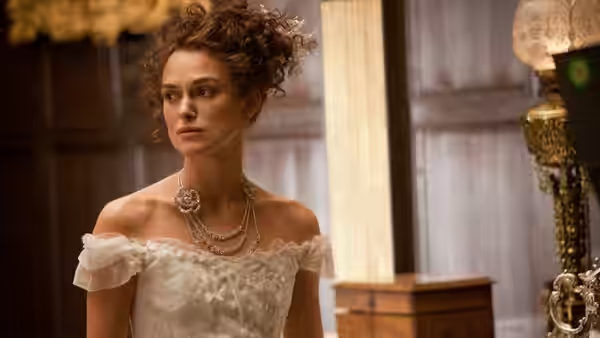
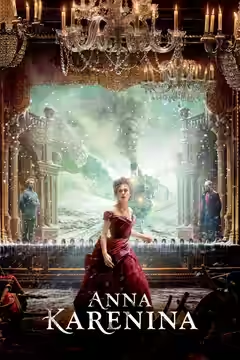
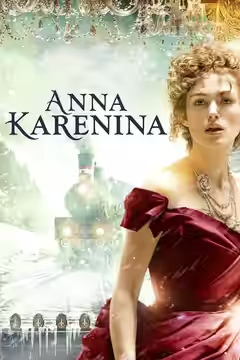
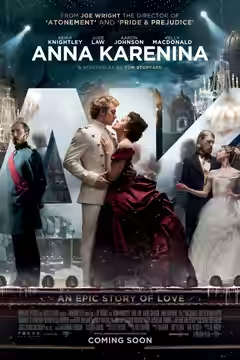
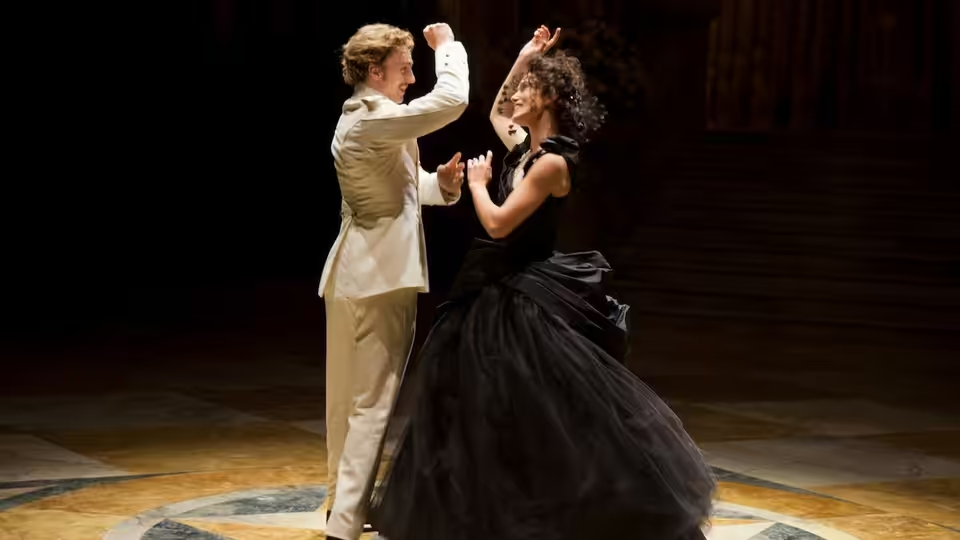
Anna Karenina (Keira Knightley) dances with a man in white on a dark stage
Film review

Anna Karenina

2012 · Directed by Joe Wright · 2h 09m · Statens medieråd 11

In a sentenceThe waltz makes a better case for Vronsky than Vronsky ever manages

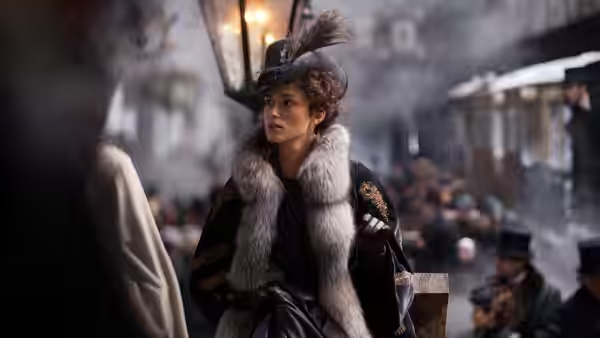
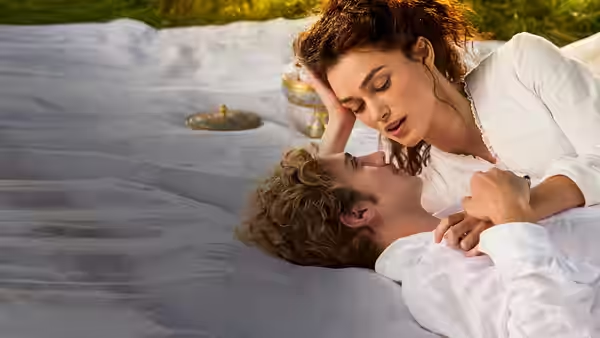
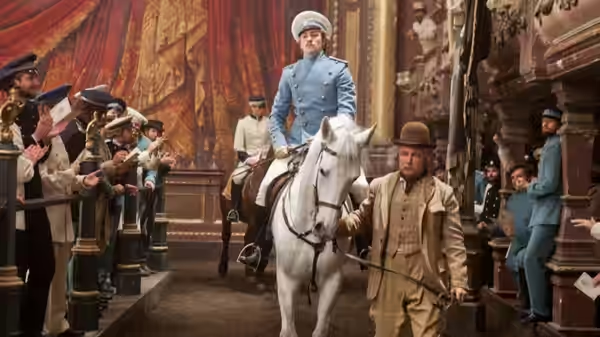
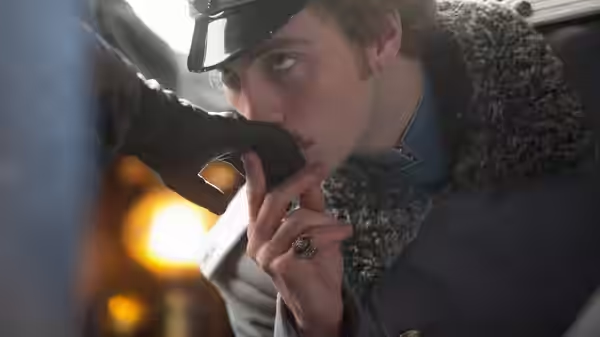
Anna Karenina (Keira Knightley) waltzes with Vronsky (Aaron Taylor-Johnson), bringing their attraction onto a ballroom floor where other people can see it. She wants him to stay, though this courtship offers little privacy. A fashionable ice rink provides another place for romantic encounters, while Levin (Domhnall Gleeson) and Kitty (Alicia Vikander) pursue a romance of their own. The action moves between theatrical settings and outdoor scenes, with clothes, dancing and the presence of other people shaping how these characters express their feelings.

Plays from YouTube when you press play; nothing loads from them until then.

Fi1m review

Joe Wright’s theatrical staging and Keira Knightley’s performance make this worth a look, but the romance is uneven. The weak link is Aaron Taylor-Johnson’s unpersuasive Vronsky.

Joe Wright’s Anna Karenina is worth seeing for its staging and Keira Knightley, though the central romance never quite earns the trouble taken over it. Adapting Leo Tolstoy’s novel from a screenplay by Tom Stoppard, Wright makes theatrical performance part of the characters’ daily lives. These people seem conscious of being watched, and the staging asks us to notice that consciousness as closely as the courtship. It is a workable idea, and for a while the pleasure of seeing a scene take shape is enough.

Sarah Greenwood’s production design makes the changes of scene a pleasure in themselves, letting one theatrical setting give way to another without disguising the artifice. Seamus McGarvey’s photography gives the ballroom enough clarity for us to follow Anna and Vronsky’s waltz without losing them in the surrounding display. We were swept up by that dance. Their movement together makes the attraction easy to believe, and the elaborate staging helps us feel it.

Melanie Oliver’s editing gives the transitions a rhythm, although it cannot make every switch between theatrical and conventional presentation feel necessary. The changes sometimes draw so much attention to themselves that we stop thinking about the people involved. Dario Marianelli’s music gives the ballroom a romantic urgency that the lovers struggle to sustain elsewhere. Once the dancing stops, Wright too often has to work up feeling again through another conspicuous piece of staging.

Knightley gives Anna enough uncertainty to survive all this attention to presentation. Her passion feels impatient and her distress less orderly than the staging around her, which is useful in a film so carefully arranged. Jacqueline Durran’s costumes support that performance by making Anna’s changing feelings part of how she presents herself; the clothes never seem irrelevant to the person wearing them. Knightley makes us care about what Anna wants even when we remain unconvinced by the man she wants it from.

Aaron Taylor-Johnson’s Vronsky is the serious limitation. There is too little in his delivery to explain the force of the attraction, and Knightley is left supplying much of the feeling between them. Jude Law gives Karenin a restraint that makes him more interesting to watch: he allows us to wonder what is being held back. Tom Stoppard’s adaptation needs the central relationship to carry considerable emotional weight, and the casting leaves it struggling to do so.

Domhnall Gleeson’s Levin and Alicia Vikander’s Kitty offer a welcome change of company. Their romance is touching, particularly outdoors, where the film gives us a rest from admiring the scenery and lets us concentrate on the people. Vikander brings a spontaneity that makes the surrounding formality easier to notice, without making Kitty seem to belong in a different film. These scenes suggest how much feeling Wright can find when the arrangement of a scene stops demanding quite so much of our attention.

As a costume romance, Anna Karenina takes an appealing risk in asking us to accept such conspicuous artifice. The ballroom shows precisely how well it can work, which makes the unevenness elsewhere more frustrating. We do not need every literary adaptation to behave respectfully, but a romance does need to convince us that these particular people want each other. Choose it for the staging and Knightley, provided an unconvincing Vronsky is not a disqualification.
Critical consensus AI synthesised

54
Positive
5
Mixed
10
Negative
8

The consensus on Joe Wright’s Anna Karenina is mixed, with praise clustering around its visual invention and reservations around its emotional distance. The reviews repeatedly admire the production design, costumes, choreography and playful transitions, even when they find the theatrical setting distracting. Keira Knightley’s performance draws support across the divide: several critics credit her with giving Anna humanity and emotional force despite the elaborate staging competing for attention.

The spread is wide, and the central disagreement concerns whether that staging helps the drama or gets in its way. Empire finds the approach bold and imaginative, while acknowledging that the romance becomes less involving. At the other extreme, The New Yorker finds the adaptation shallow and impersonal, singling out Alicia Vikander for praise. Between those positions, the recurring complaint is that Wright’s formal flourishes keep the lovers at a distance, leaving their passion less convincing than the world around them.

Empire
4 June 2011 · Ian Freer
85*

Freer finds the adaptation bold, imaginative and intoxicating, despite its central romance becoming less involving. He especially praises Wright’s theatrical staging, singling out the lavish ballroom sequence as stunning.

Read the full review →
IndieWire
2 September 2012 · David Gritten
78*

Gritten finds the adaptation ambitious, romantic, and ultimately triumphant, though it occasionally falters. He especially praises Wright’s dazzling visual inventiveness and the film’s vivid sound design.

Read the full review →
Screen Daily
3 September 2012 · Mark Adams
64*

The accessible page does not reveal the critic’s verdict. It also provides no readable detail about what the review praises or criticizes.

Read the full review →
The New York Times
16 November 2012
64*

The page appears to be a review of Joe Wright’s 2012 film, but its contents are inaccessible. Its verdict and any specific praise or complaint cannot be determined from the available text.

Read the full review →
RogerEbert.com
15 November 2012 · ★★½/4 · Christy Lemire
62

Lemire finds the adaptation visually inventive but emotionally distant. She singles out its theatrical staging as striking, while noting that the film’s formal flourishes can keep viewers at a remove.

Read the full review →
Slant Magazine
9 November 2012 · ★★½/4 · Andrew Schenker
62

Schenker finds the film engrossing and literate despite its overbearing visual ambitions. He praises Keira Knightley’s portrayal of Anna’s passion and despair, while criticizing the theatrical staging as a distracting gimmick.

Read the full review →

Straight answers AI written, from our review

Is Anna Karenina worth watching?
Anna Karenina is worth a look for admirers of theatrical staging and Keira Knightley, though its uneven romance keeps our score at 64. We find the ballroom waltz persuasive and the supporting romance touching, but Aaron Taylor-Johnson’s Vronsky gives us too little reason to believe in Anna’s attraction.
How long is Anna Karenina, and what is it rated?
Anna Karenina runs 2h 09m and is rated 11 by the Statens medieråd in Sweden. It is a drama and romance film.
Where can I watch Anna Karenina in Sweden?
Anna Karenina is available to rent from Apple TV and Amazon Prime Video from kr 39.00. Availability is checked daily; the links above go straight to each service.
How violent or frightening is Anna Karenina, and is it suitable for children?
Anna Karenina has a UK 12A certificate, which allows children under 12 to attend a cinema screening only with an accompanying adult. That classification calls for parental judgement rather than treating it as suitable for all children; it does not, by itself, establish how violent or frightening particular scenes are.
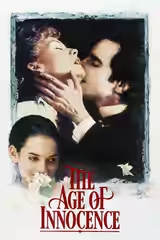
How does Anna Karenina compare to The Age of Innocence?
Anna Karenina is more conspicuously theatrical than The Age of Innocence, but we recommend the latter for a more persuasive romance shaped by social rules. Wright’s staging and Knightley provide considerable interest, while Scorsese’s film gives its finery more human weight, even if it sometimes spends too long explaining the manners.
Is Anna Karenina based on a true story or a book?
Anna Karenina is adapted from Leo Tolstoy’s novel, with a screenplay by Tom Stoppard, rather than presented as a true story. Wright uses theatrical settings to emphasise the characters’ awareness of being watched. Our recommendation rests on Knightley and the staging rather than familiarity with the book, and we make no claim for the adaptation’s fidelity.
What should I watch after Anna Karenina?
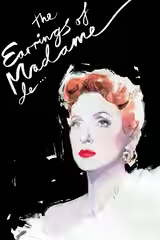
After Anna Karenina, try The Age of Innocence (1993, Fi1m 86): A more controlled account of desire constrained by social rules and immaculate manners. Then The Earrings of Madame de... (1953, Fi1m 87): Ballroom elegance and romantic misjudgement, with feeling that survives the elaborate staging; and The Red Shoes (1948, Fi1m 92): For theatrical invention that makes romantic feeling stronger rather than harder to reach.

Cast

Awards

Academy Awards, 2013

Nominated
Best Cinematography
Nominated
Best Original Score
Nominated
Best Production Design
Won
Best Costume Design

European Film Award for Best Actor, 2013

Nominated
European Film Award for Best Actor

European Film Award for Best Actress, 2013

Nominated
European Film Award for Best Actress

European Film Award for Best Production Designer, 2013

Won
European Film Award for Best Production Designer

European Film Award for Best Screenwriter, 2013

Nominated
European Film Award for Best Screenwriter

European Film Award – People's Choice Award for Best European Film, 2013

Nominated
European Film Award – People's Choice Award for Best European Film

Broadcast Film Critics Association Award for Best Art Direction, 2012

Won
Broadcast Film Critics Association Award for Best Art Direction

Broadcast Film Critics Association Award for Best Costume Design, 2012

Won
Broadcast Film Critics Association Award for Best Costume Design

If you liked this, try…

  1. The Age of Innocence (1993, Fi1m 86)A more controlled account of desire constrained by social rules and immaculate manners.

  2. The Earrings of Madame de... (1953, Fi1m 87)Ballroom elegance and romantic misjudgement, with feeling that survives the elaborate staging.

  3. The Red Shoes (1948, Fi1m 92)For theatrical invention that makes romantic feeling stronger rather than harder to reach.

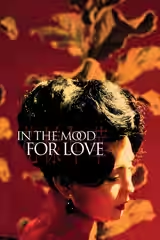
  4. In the Mood for Love (2000, Fi1m 91)For restrained performances and clothes that say what the lovers cannot.

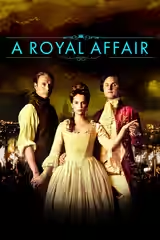
  5. A Royal Affair (2012) · not on Fi1m yetAlicia Vikander faces another courtship in which private desire has public consequences.