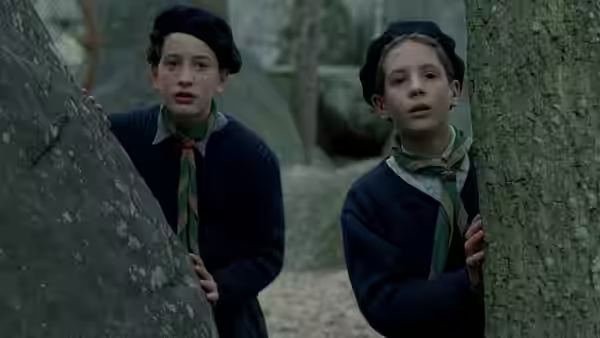
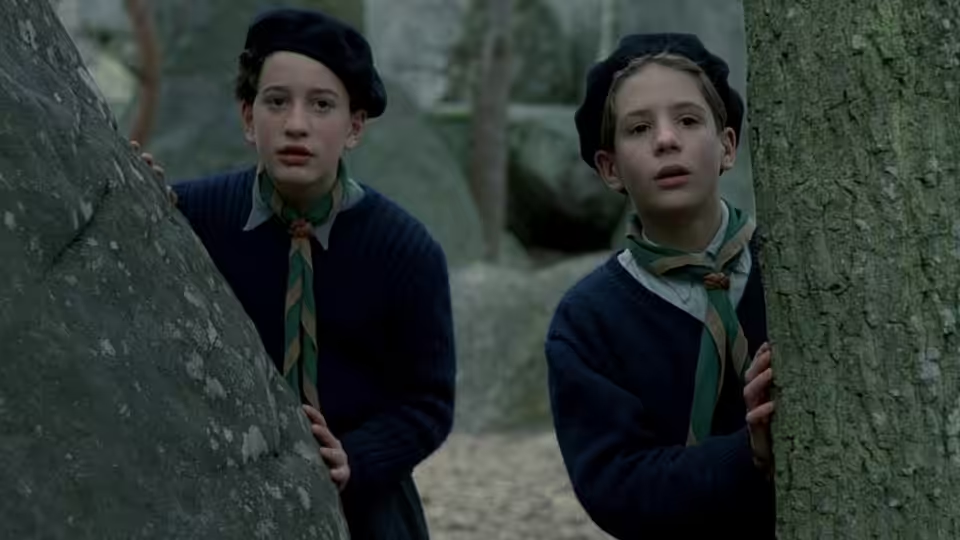
Two boys in berets and scout uniforms peer from behind trees and rocks
Film review

Au Revoir les Enfants

1987 · Directed by Louis Malle · 1h 45m

In a sentenceWe had forgotten how much courage it takes to make a friend at school

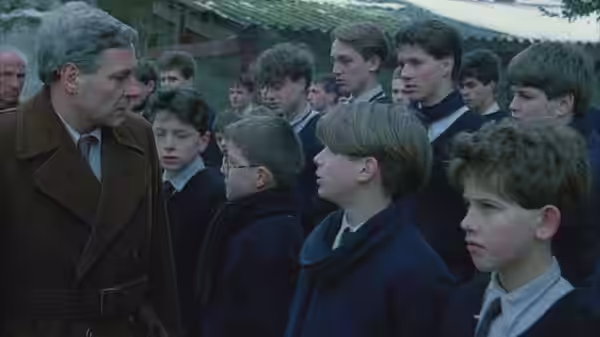
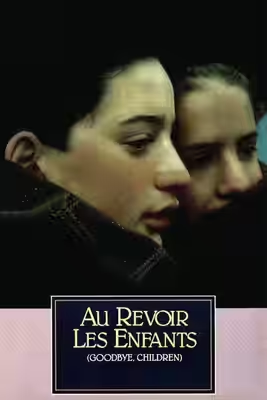
At a Catholic boarding school in occupied France in 1944, Julien Quentin (Gaspard Manesse) and Jean Bonnet (Raphael Fejtö) develop a friendship whose balance keeps changing. The school shelters Jewish pupils, while the boys navigate their relationships within its ordered daily life. Around them are adults whose responsibilities extend beyond education, among them Father Jean (Philippe Morier-Genoud). Louis Malle writes and directs a drama drawn from his childhood, following the two boys as they learn about one another and about the adult world beyond their school routines.

Plays from YouTube when you press play; nothing loads from them until then.

Fi1m review

Louis Malle’s wartime school drama earns its force through two boys learning how to be friends. We recommend it without hesitation, though the school sometimes feels a little too carefully arranged in memory.

Louis Malle’s Au Revoir les Enfants deserves an evening of undivided attention. Set in a Catholic boarding school in occupied France in 1944, it is patient about the business of two boys becoming friends, and exact about how difficult that can be. Malle writes and directs from memories of his own childhood, but he does not give the children the understanding he has acquired since. We recommend it warmly for that patience, and for young performances that never ask to be admired for their sensitivity.

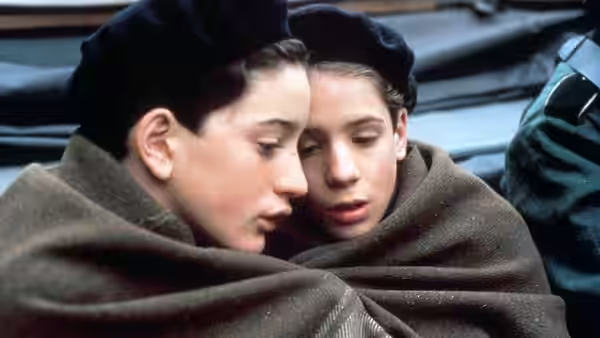
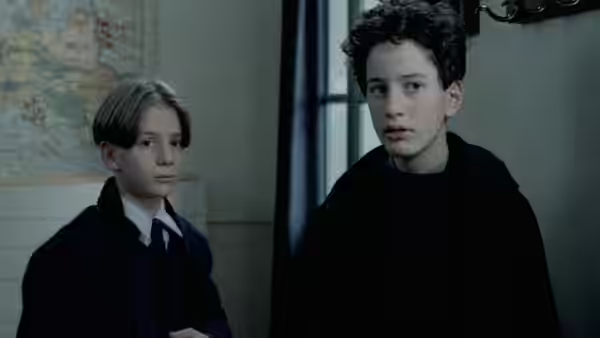
Gaspard Manesse plays Julien Quentin, with Raphael Fejtö as Jean Bonnet. Manesse makes Julien’s interest in the other boy inseparable from his need to know where he stands, while Fejtö gives Jean a life that does not depend upon Julien noticing him. The upper hand passes between them without either performance overstating the change. We found their jostling for position unexpectedly painful. The friendship matters because these boys can want each other’s company and still find ways to make companionship difficult.

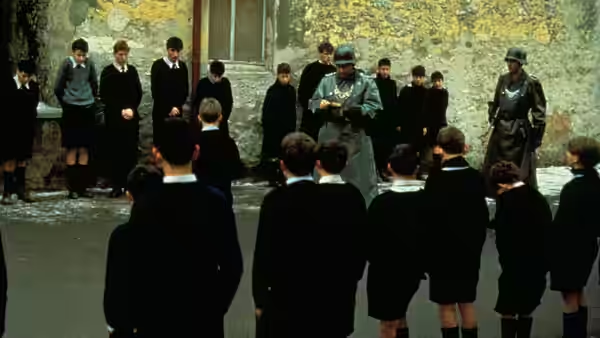
The school shelters Jewish pupils, so its ordinary routines carry responsibilities that the children cannot fully grasp. Philippe Morier-Genoud’s Father Jean helps make the adult world feel close without making it easy for the boys to understand. Malle keeps our attention on how they live among other children, and on the effort of being accepted. The occupation is frightening partly because the pupils have so much else to think about, none of it insignificant to them.

Renato Berta’s cinematography keeps the children more interesting than their surroundings, a useful discipline in a film about a remembered place. Willy Holt’s production design gives the school the reassuring order that its pupils might expect of it. The school feels capable of organising every part of a child’s life, which makes its promise of protection matter. Berta’s work is most affecting when our attention stays with the boys, searching their faces for some change in how they regard each other.

Emmanuelle Castro’s editing makes the everyday rhythm of school worth attending to. At 105 minutes, the film gives the changing friendship enough time to feel earned, without turning every hesitation into a separate dramatic point. There is tension in that pace, because we know more about the danger outside than the children do. Castro and Malle understand that, if the school is to mean anything to us, spending time there cannot feel like a delay.

There is a limitation to such careful control. Malle’s screenplay can make the school feel a little too neatly remembered, with less waste and distraction than we might expect of childhood. We occasionally wanted more room for the children to be uninteresting, as children are perfectly entitled to be. That reservation matters because the film is otherwise so good at resisting the demand that every young character should become an example.

A boarding-school drama can get easy sympathy by making its children innocent and its adults obtuse. Malle is more demanding, particularly about the children’s capacity to wound each other without fully understanding what they are doing. His affection for them does not excuse them, and neither young actor looks like an adult’s improved recollection of himself. Watch it when there is time afterwards to sit quietly for a while.

Critical consensus AI synthesised

81
Positive
6
Mixed
0
Negative
0

Most critics praise Au Revoir les Enfants as a moving, unsentimental account of childhood friendship under occupation. The praise centres on Malle’s handling of the two boys: their growing attachment feels truthful, while the changing balance between them gives the school drama tension. The reviews also value the detail of everyday boarding-school life and the restraint with which Malle brings the adult world’s cruelty into view, drawing emotional force from personal memory without resorting to melodrama.

There is no clear dissent, and the scored reviews sit within a fairly narrow positive range. Differences concern emphasis rather than substantial reservations: Time Out stresses the shifting power within the friendship and the film’s departure from familiar boarding-school stories. The Evening Standard places its emotional power above its ideas, while other reviews give greater weight to moral complexity and the precision of Malle’s recollections.

The Guardian
9 October 1988 · Philip French
90*

The critic praises Malle's subtly detailed portrait of life in a Catholic boarding school in occupied France during 1944, focusing on the developing friendship between two boys and the quiet, shattering ending that captures a haunting memory of betrayal and loss.

Read the full review →
Empire
30 March 2006 · David Parkinson
80*

The critic calls it possibly Malle at his best, with a subtle but affecting drama based on the director's childhood. Malle's handling of the young leads and their developing friendship stands out for avoiding melodrama while conveying the impact of occupation.

Read the full review →
Little White Lies
30 January 2015 · 4/4/4 · Wally Hammond
80

The critic finds Malle’s unsentimental depiction of his boyhood during Nazi occupation stands the test of time, praising the truthful portrayal of characters and complex subjects without simplification.

Read the full review →
The Times
30 January 2015 · Kate Muir
80*

The piece highlights the tender, evocative story of friendship between two boarding school boys in wartime France, noting the director's real-life basis and the moving, unsentimental drama as the boys face the evils of the adult world.

Read the full review →
Time Out
26 January 2015 · ★★★★ · Tom Huddleston
80

Praises the film's corrective to typical boarding school movies, highlighting the shifting balance of power in the boys' friendship and the mounting tension.

Read the full review →
Evening Standard
30 January 2015 · Derek Malcolm
75*

The film is praised as a worldwide success and popular drama that avoids sentimentality while honestly depicting youthful betrayal and the protection of Jewish pupils in a wartime school. Its emotional power is highlighted as more important than ideas.

Read the full review →

Straight answers AI written, from our review

Is Au Revoir les Enfants worth watching?
Au Revoir les Enfants is worth watching, and we scored it 90, our highest bracket. Louis Malle draws on his own childhood at a Catholic boarding school in occupied France in 1944, and the two young leads make the shifting friendship painful without ever asking to be admired. Our one reservation is that the school can feel a little too neatly remembered.
How long is Au Revoir les Enfants, and what is it rated?
Au Revoir les Enfants runs 1h 45m. It is a drama and war film.
Where can I watch Au Revoir les Enfants in Malaysia?
Au Revoir les Enfants is not on any streaming or rental service in Malaysia at the moment. It is available in 7 other countries; change your country at the top of the page to see where. Availability is checked daily.
How violent or frightening is Au Revoir les Enfants, and is it suitable for children?
Au Revoir les Enfants carries a PG certificate and shows very little violence on screen. Its fear comes from what we know about the occupation and the children do not, and from how the boys hurt one another without quite meaning to. Older children can watch it, but its sadness lands hard, so allow time afterwards to talk about it.
How does Au Revoir les Enfants compare to The Spirit of the Beehive?
Au Revoir les Enfants and The Spirit of the Beehive both watch a child grasp only part of an adult fear, but Malle's film is about a friendship and Erice's about a girl alone with her imagination. Malle keeps us close to the boys' faces, while Erice's beautiful images sometimes hold us at a distance. We find Malle's the more affecting of the two, and the easier place to begin.
What should I watch after Au Revoir les Enfants?
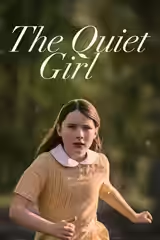
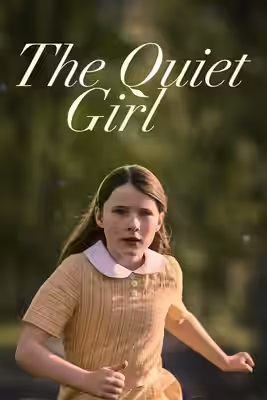
After Au Revoir les Enfants, try The Spirit of the Beehive (1973, Fi1m 87): Another child’s partial understanding of adult fear, observed with patience and unease. Then The 400 Blows (1959, Fi1m 91): For another unsparing account of school, adult authority and a child’s loneliness; and The Quiet Girl (2022, Fi1m 84): A child’s tentative trust receives the same patient attention, with less historical weight.

Cast

Awards

Academy Awards, 1988

Nominated
Best International Feature Film
Nominated
Best Writing, Original Screenplay

European Film Award for Best Director, 1988

Nominated
European Film Award for Best Director

European Film Award for Best Film, 1988

Nominated
European Film Award for Best Film

European Film Award for Best Screenwriter, 1988

Won
European Film Award for Best Screenwriter

International Submission to the Academy Awards, 1988

Nominated
International Submission to the Academy Awards

Louis Delluc Prize, 1987

Won
Louis Delluc Prize

Venice Film Festival, 1987

Won
Golden Lion

If you liked this, try…

  1. The Spirit of the Beehive (1973, Fi1m 87)Another child’s partial understanding of adult fear, observed with patience and unease.

  2. The 400 Blows (1959, Fi1m 91)For another unsparing account of school, adult authority and a child’s loneliness.

  3. Germany Year Zero (1948) · not reviewed yetA harsher encounter with childhood and war, without comforting explanations or easy innocence.

  4. The Quiet Girl (2022, Fi1m 84)A child’s tentative trust receives the same patient attention, with less historical weight.

  5. The Class (2008) · not reviewed yetSchool loyalties and adult authority examined through talk, friction and competing accounts.

Free account

Know what to watch tonight

Two lists that know where things are streaming, collections you can share, your own score beside ours, and Discover that remembers what you have seen.

  • Want to see, sorted by what is streaming now
  • Seen, with your score out of ten
  • No adverts, ever