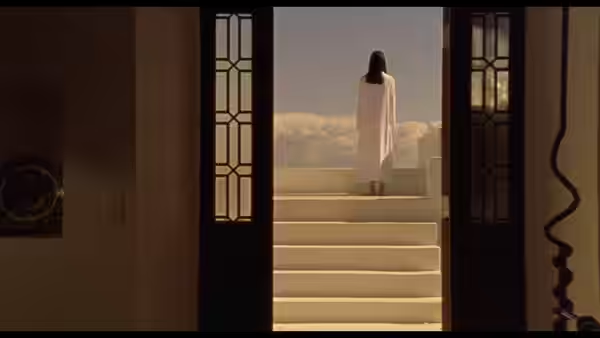
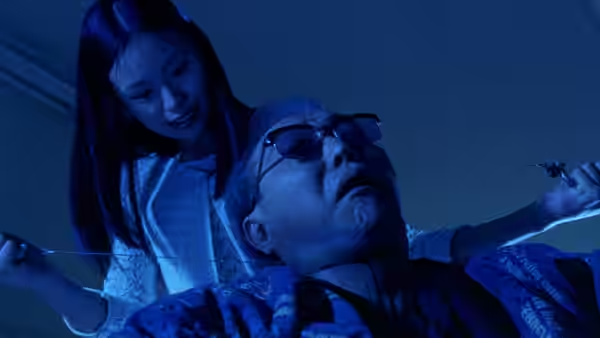
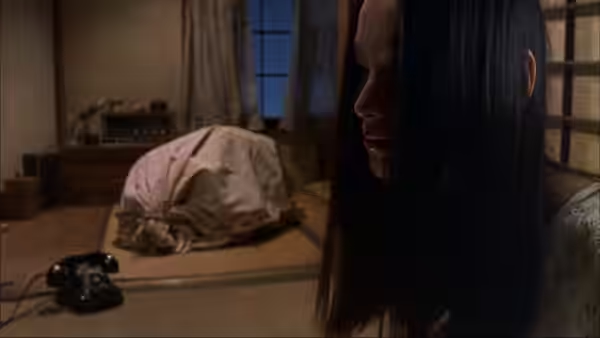
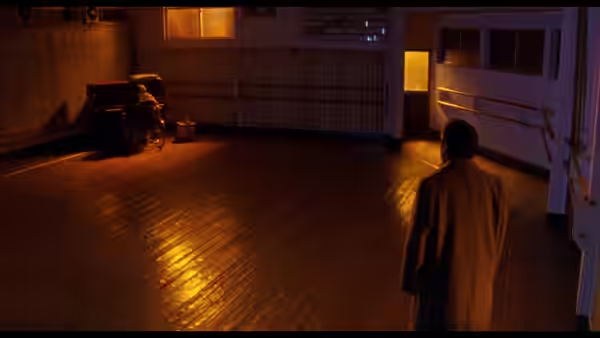
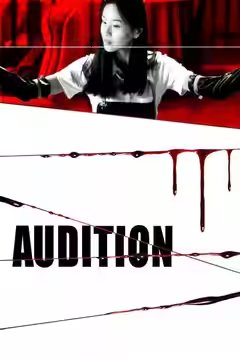
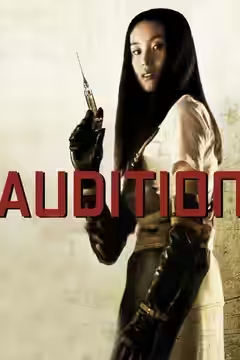
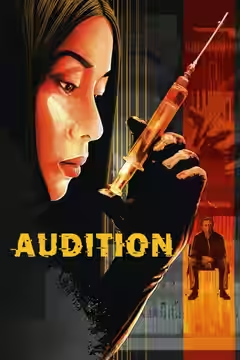
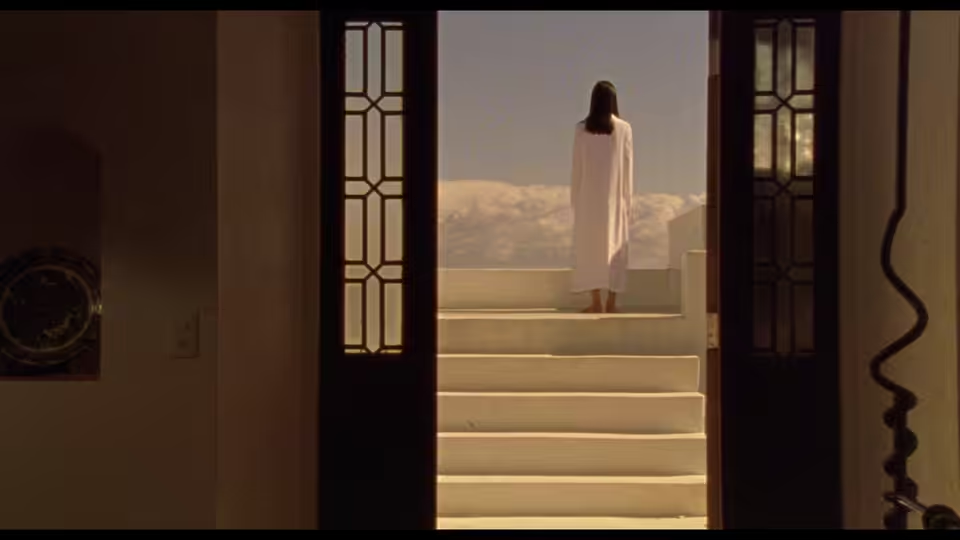
A woman in a white dress stands beyond an open doorway at the top of a staircase
Film review

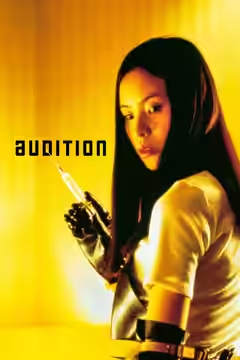
Audition

2000 · Directed by Takashi Miike · 1h 55m · FSK 18

In a sentenceA romance that gives us plenty of time to regret relaxing

Shigeharu Aoyama (Ryo Ishibashi), Asami Yamazaki (Eihi Shiina) and Yasuhisa Yoshikawa (Jun Kunimura) are the central figures in a drama that begins as an apparent romance. Relations between men and women occupy the foreground, with possessiveness and male arrogance complicating the prospect of love. The story takes its time with the characters, allowing unease to build beneath the romantic premise. Its opening stays with their expectations of one another, keeping the emphasis on personal relationships and the uncertainty surrounding them rather than immediate scares.

Plays from YouTube when you press play; nothing loads from them until then.

Fi1m review

Takashi Miike makes the apparent romance in Audition disquieting through patience and Eihi Shiina’s performance. We recommend it with two cautions: the violence is distressing, and its treatment of women is less assured than its control of tension.

Takashi Miike’s Audition is a patient, deeply unsettling horror film, though its treatment of women is harder to defend than its control of tension. It begins sufficiently like a romance to make us attend to the people before we start anticipating danger. That early investment matters, and Miike is prepared to spend time securing it. Daisuke Tengan’s screenplay, adapted from a novel by Ryū Murakami, allows the opening drama to occupy a substantial stretch of the film without continually promising that something dreadful is coming.

Ryo Ishibashi’s Shigeharu Aoyama gives that apparent romance a credible human centre, which is essential if the patient beginning is going to hold. Eihi Shiina’s Asami Yamazaki makes it difficult to settle into watching it. We were unnerved by the difficulty of reading her, even while the film was inviting us to consider its romantic possibilities. Shiina sustains that uncertainty without making the performance feel like a succession of clues, and Miike gives us time to keep trying to understand her.

Hideo Yamamoto’s cinematography makes the drama attractive enough to sustain that attention without reassuring us. The beauty of the images helps explain why the waiting works: there is something worth looking at before there is anything to recoil from. Tatsuo Ozeki’s production design is effective in a quieter way, giving the people surroundings that do not compete with them for attention. Our interest keeps returning to the performers, particularly Shiina, rather than wandering off to admire the setting.

Yasushi Shimamura’s editing does more conspicuous work, making the handling of time contribute to our uncertainty about what we are watching. Its effectiveness depends on discoveries we will leave alone. Kōji Endō’s music contributes less to our unease than the duration of a scene or the difficulty of reading a performance; the score is not what we remember afterwards. At 115 minutes, this is horror that asks for sustained attention, and its long preparation usually earns it.

Usually, rather than always. There are stretches where the deliberate pace starts to feel too protective of its surprises, and understanding why Miike wants us to wait does not make every wait equally involving. The opening has to work as drama, independently of whatever a viewer has heard about the horror. It largely does, but anyone arriving solely for shocks may spend too much of it checking how far there is to go.

The sexual politics are the more substantial reservation. Miike’s examination of male arrogance has bite, particularly in its suspicion of possessiveness passing for love. We are less convinced that the film’s treatment of women consistently escapes the attitudes it appears to question. Its ambiguity is disturbing, but we hesitate to credit every troubling implication as evidence of psychological insight; some of the discomfort comes from uncertainty about how carefully those implications have been considered.

Within horror, the commitment to an apparently romantic beginning is what makes Audition distinctive. Miike risks allowing the early drama to disappoint expectations that the genre itself encourages, and the actors give that decision substance. The reservation about its sexual politics remains worth discussing rather than explaining away because the film frightened us. We recommend it to horror viewers prepared to give the early drama their full attention, and prepared for distressing violence.

Critical consensus AI synthesised

85
Positive
6
Mixed
1
Negative
0

Most critics are strongly positive about Audition, with praise clustering around its patient build-up of unease and the psychological weight behind its horror. The reviews repeatedly describe a film whose disturbing effects depend on more than shock: sexual politics, male arrogance and gender conflict give the violence something to examine. Eihi Shiina’s chilling performance draws particular praise from Empire, while other reviews emphasise the sharp wit and the gradual accumulation of tension.

The differences concern pacing and interpretation more than basic approval. Variety admires the visual craft and temporal editing but notes that the deliberate pace delays the scares, and finds ambiguity in the treatment of possessive love and misogyny. Elsewhere, that patience is largely counted as a strength. The apparent spread needs some caution: the accessible Screen Daily review does not disclose a verdict, so it cannot establish a clear dissent from the favourable consensus.

The Guardian
10 December 2015 · ★★★★★ · Peter Bradshaw
100

Bradshaw calls the film a stomach-turning masterpiece and a landmark of J-horror. He singles out its vengeful female antagonist and its critique of male arrogance for praise.

Read the full review →
Empire
1 January 2000 · Kim Newman
90*

Newman praises the film as a disturbing, memorable horror story that builds from apparent romance into a nightmare. He singles out Eihi Shiina’s chilling performance and the slow accumulation of tension.

Read the full review →
Slant Magazine
18 February 2019 · ★★★★½ · Chuck Bowen
90

Bowen regards the film as a profound, psychologically rich horror work, not merely a shock artifact. He praises Arrow’s vivid restoration and the film’s patient handling of gender conflict and violence.

Read the full review →
Time Out
15 March 2012
80*

The description presents the film as an absorbing, sly psychodrama. It praises its sharp wit and provocative take on sexual politics.

Read the full review →
Variety
31 October 1999 · festival review · Ken Eisner
75*

Eisner presents the film as a shocking, beautifully made horror story, though its deliberate pacing delays the scares. He praises the haunting visual beauty and temporal editing, while noting the film’s ambiguity about possessive love and misogyny.

Read the full review →
Screen Daily
23 February 2000 · Edna Fainaru
64*

The accessible page does not reveal the critic’s verdict. It also provides no praise or complaint to identify.

Read the full review →

Straight answers AI written, from our review

Is Audition worth watching?
Audition is worth watching for horror viewers who enjoy patient character drama before the scares, and we score it 84 out of 100. Eihi Shiina’s unreadable performance keeps us uneasy through the apparent romance, though the pace occasionally drags, the violence is distressing and the treatment of women warrants caution.
How long is Audition, and what is it rated?
Audition runs 1h 55m and is rated 18 by the FSK in Germany. It is a horror and drama film.
Where can I watch Audition in Germany?
Audition is streaming on Amazon Prime Video in Germany. Availability is checked daily; the links above go straight to each service.
How violent or frightening is Audition, and is it suitable for children?
Audition carries a UK 18 certificate and contains distressing violence, making it unsuitable for children and a difficult choice for squeamish adults. Its fear grows through a patient, apparently romantic opening and uncertainty about the characters rather than immediate scares; we find that sustained unease deeply unsettling.
How does Audition compare to The Piano Teacher?
Audition is our choice for slow-building horror, while The Piano Teacher is the stronger recommendation for a harsher examination of desire, control and intimacy. We find reservations in both: Audition is less assured about its treatment of women, while The Piano Teacher benefits from Erika’s vulnerability but makes Walter less convincing as a character.
Is Audition based on a true story or a book?
Audition is adapted from a novel by Ryū Murakami, rather than presented as a true story. Daisuke Tengan’s screenplay gives the apparent romance substantial room before the horror; we recommend approaching it without prior reading, though we make no claim about how closely it follows the book.
What should I watch after Audition?
After Audition, try The Piano Teacher (2001, Fi1m 82): For a harsher examination of desire, control and the difficulty of intimacy. Then Burning (2018, Fi1m 72): Desire and resentment keep an ambiguous mystery troubling long after it finishes.

Cast

If you liked this, try…

  1. Cure (1997) · not on Fi1m yetAnother patient Japanese horror film that makes uncertainty steadily harder to bear.

  2. The Piano Teacher (2001, Fi1m 82)For a harsher examination of desire, control and the difficulty of intimacy.

  3. Diabolique (1955) · not on Fi1m yetCarefully rationed information and intimate cruelty, with suspense given time to develop.

  4. The Invitation (2015) · not on Fi1m yetSocial unease becomes difficult to dismiss in this deliberately paced horror film.

  5. Burning (2018, Fi1m 72)Desire and resentment keep an ambiguous mystery troubling long after it finishes.