Rodney Dangerfield makes Back to School worth the evening through timing, nerve and a dependable supply of one-liners. The college comedy around him is predictable and occasionally clumsy, but Sally Kellerman helps keep it companionable.
Back to School is a good vehicle for Rodney Dangerfield, with enough warmth to make its bluntness agreeable. Alan Metter directs a college comedy whose premise gives the star plenty of excuses to be interested in anything except coursework. The pleasure is in the one-liners and the confidence with which they arrive. We would not choose it for an ingenious story, and the film is sensible enough to keep offering jokes.
Rodney Dangerfield makes Thornton Melon funny without requiring us to think every remark deserves the laugh it gets. His timing is persuasive even when the joke itself is ordinary: he seems to know precisely how little ceremony it needs. We laughed at his brusque one-liners, often because he had already moved on before we had quite caught up. That briskness helps the coarser material, though it cannot rescue every gag. The performance also has enough warmth to keep the character from becoming merely exhausting.
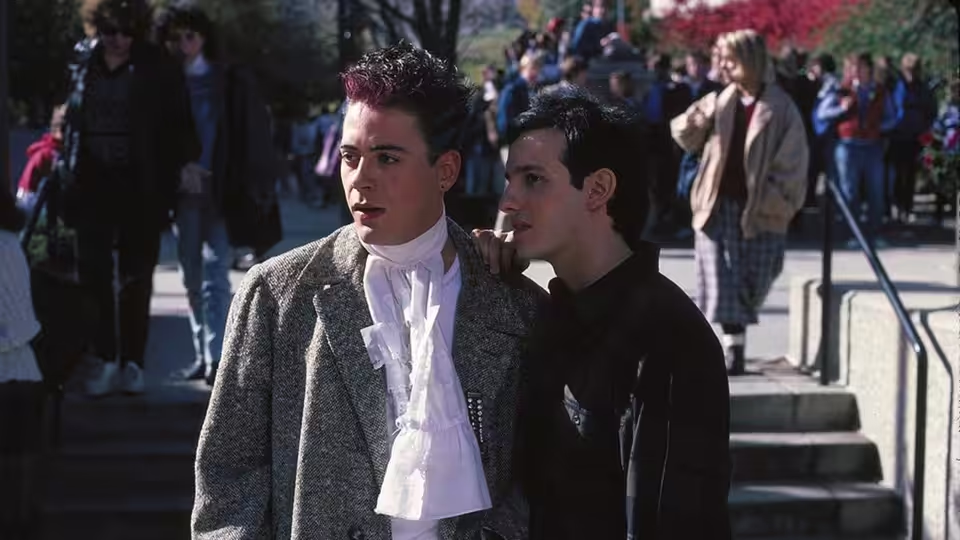
Sally Kellerman’s Diane is the most welcome supporting presence, bringing an ease that makes the comedy feel less insistent. Her contribution matters in a film that can otherwise seem determined to fill every available space with another gag. Keith Gordon, as Jason Melon, has a less immediately rewarding comic assignment, while Robert Downey Jr.’s Derek adds to the liveliness of the company. Sally Kellerman’s scenes are among the most enjoyable, and we could comfortably have spent longer in her company.
The screenplay is credited to Harold Ramis, PJ Torokvei, Steven Kampmann and William Porter, and its strength is the individual line. The story is considerably more predictable, with too little surprise in how situations develop. There is enough good material to carry the familiar stretches, although some gags are pushed harder than their modest rewards justify. Alan Metter is better at letting a performer make a joke work than at making the surrounding comedy feel fresh.
Thomas E. Ackerman’s cinematography is clear and undistracting, though we found little visual pleasure separate from watching the actors. David L. Snyder’s production design gives the college comedy an adequate setting without adding many comic pleasures of its own. David Rawlins’s editing works best around the one-liners, allowing Rodney Dangerfield’s timing to make its point. Across whole scenes, the rhythm can feel more dutiful. Danny Elfman’s music is agreeable enough, but rarely seems necessary when the star can set the pace so firmly himself.
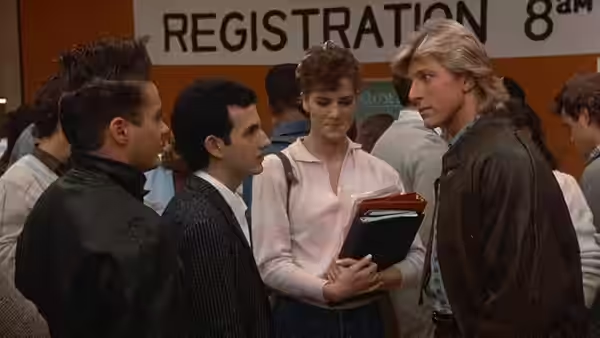
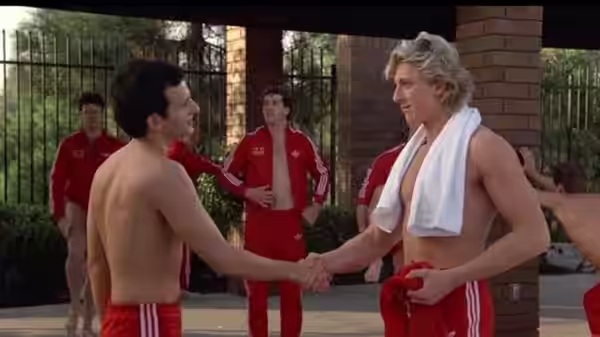
As a college comedy, the film is content with familiar appetites and familiar targets. The interest in female students and attractive professors is explicit in the premise, and there are limits to how much comedy that can provide. Its coarseness will be a barrier for some, yet the amiability of the performances keeps it from becoming tiresome. The gentler moments help, even when the writing has not done much to earn them.
At 96 minutes, it does not demand an unreasonable commitment, although the predictability still tells. Our recommendation comes with a simple condition: an appetite for Rodney Dangerfield’s delivery is essential, because much of the pleasure depends on it. If that sounds like thin provision for an evening, choose something else. We would stay for another line.