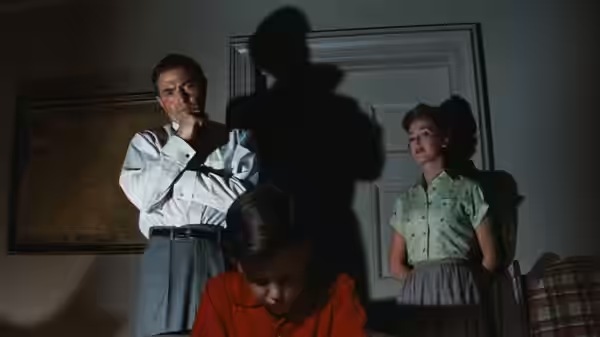
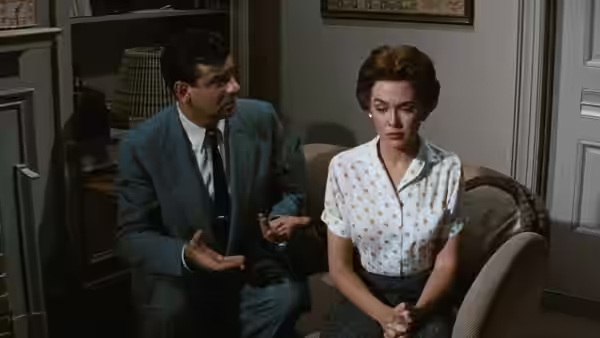
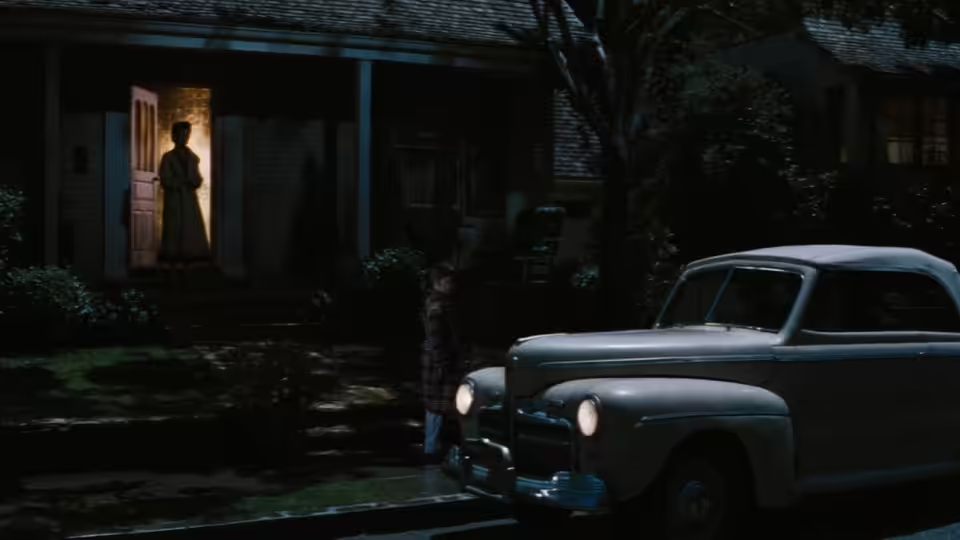
A silhouetted woman stands in a lit doorway as two cars are parked outside the house
Film review

Bigger Than Life

1956 · Directed by Nicholas Ray · 1h 35m

In a sentenceJames Mason makes staying in with the family sound like a threat

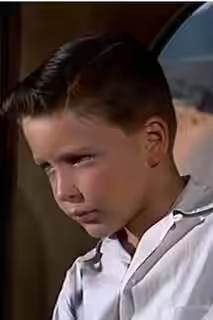
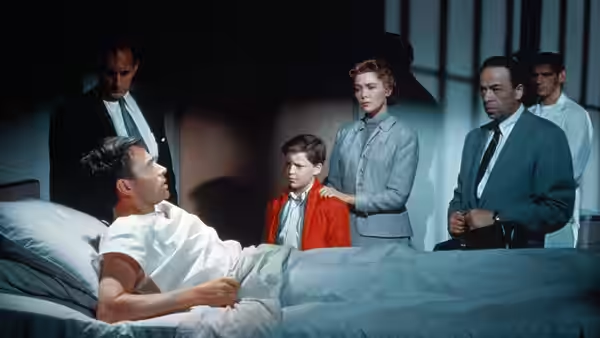
Ed Avery (James Mason), a mild-mannered teacher in suburban America, wants to get through an illness and resume his family life. He takes cortisone as an experimental treatment, bringing the drug into the household he shares with Lou Avery (Barbara Rush) and Richie Avery (Christopher Olsen). As the treatment begins, Ed’s anger becomes harder to contain. Lou must contend with changes in her husband while trying to preserve their life at home. The family’s middle-class respectability offers little help as the medicine alters the behaviour of the man they know.

Plays from YouTube when you press play; nothing loads from them until then.

Fi1m review

Nicholas Ray’s family drama is frightening and well worth the discomfort. James Mason and Barbara Rush make the household’s distress persuasive, though the film sometimes presses its warnings harder than their performances need.

Bigger Than Life is a frightening family drama, and we recommend it with a warning about how hard it sometimes underlines its point. Nicholas Ray takes a teacher’s illness and treatment with cortisone as the beginning of a household crisis. The film asks what happens when a respectable man’s anger becomes impossible for his family to manage. Its force comes from how recognisable the household remains even as his behaviour grows alarming.

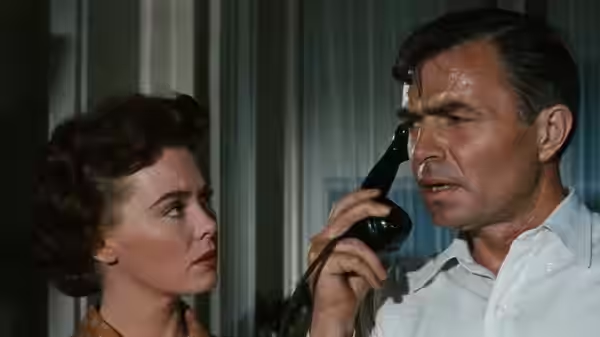
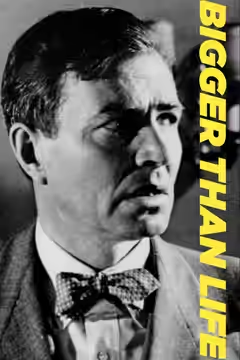
James Mason makes Ed Avery’s change unsettling because he allows us to recognise the mild man inside the increasingly furious one. The performance gives the anger a cold certainty, as though everybody else has failed to understand something obvious. We were frightened by that certainty: there is so little room left for another person’s feelings. James Mason does not need us to admire the difficulty of the part; he makes us worry about being near this man.

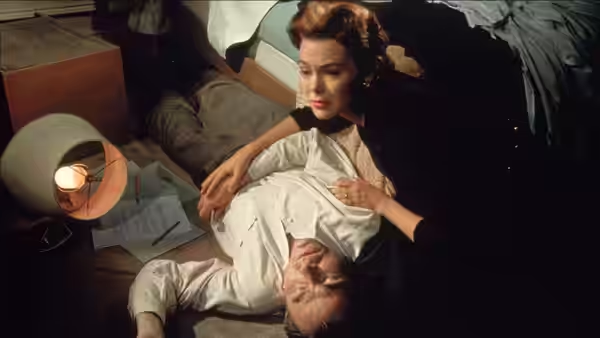
Barbara Rush gives Lou Avery enough steadiness to prevent her becoming merely an audience for Ed’s deterioration. Her restraint makes the pressure on the marriage felt without competing with James Mason for the most alarming moment. We believe in her concern, which matters because the film could easily become an exhibition of its leading actor’s range. The domestic distress is persuasive before we start thinking about what it says about the neighbourhood.

Joseph MacDonald’s cinematography and Nicholas Ray’s use of the wide frame give that distress somewhere to spread. The home feels increasingly oppressive, with the people inside it unable to make the space comfortable. Household objects suggest ambitions that have not been satisfied, so the possessions are worth watching as closely as the faces. The heightened lighting pushes the familiar rooms towards horror without requiring us to forget that people have to live in them.

Louis R. Loeffler’s editing keeps the increasing strain easy to follow, and the 95-minute running time suits a story that depends on sustained discomfort. There is little relief in simply waiting for the film to move on. David Raksin’s music is less persuasive when it seems to insist on alarm already supplied by the performances. The more emphatic passages occasionally make us wish for the plainness that Barbara Rush brings to her scenes.

The screenplay by Cyril Hume and Richard Maibaum is sometimes too insistent about the disappointments beneath middle-class respectability. Giving the family’s troubles a medical cause also risks making them seem like an exceptional case, when the performances suggest tensions that belong to ordinary married life. These reservations matter, but they do not undo the fear the film creates. Its less subtle moments are carried by actors who keep giving the distress a human scale.

The film’s excesses make sense within melodrama, where unhappiness is allowed to become loud and unreasonable. Its particular strength is the familiarity of Ed’s authority, which makes the family drama feel close to horror. Nicholas Ray and James Mason are most convincing when that authority needs no explanation. See it for James Mason and Barbara Rush, provided a frightening evening at home is what you had in mind.

Critical consensus AI synthesised

82
Positive
11
Mixed
0
Negative
0

The reviews are uniformly positive about Bigger Than Life, with praise centring on James Mason’s frightening portrayal of a mild-mannered teacher’s psychological collapse. Most critics also admire Nicholas Ray’s treatment of suburban frustration and middle-class respectability, finding the domestic setting an effective source of menace. The visual style draws praise for making that pressure palpable through ominous atmosphere, expressive household objects and tense widescreen framing. Variety gives particular attention to Barbara Rush’s performance as Mason’s wife.

The differences are chiefly in enthusiasm rather than basic judgement, though several reviews identify weaknesses. Slant Magazine finds some of the ideas dated while admiring Ray’s direction, and Paste sees occasional heavy-handedness in an otherwise forceful social critique. Eye for Film praises the restrained performances but finds the final scene unconvincing. These reservations leave the positive consensus intact: the critics differ over how persuasively the drama makes its points, not whether it remains compelling.

The AV Club
24 March 2010 · A · Nathan Rabin
95

Rabin praises the film as a brutal, compelling portrait of suburban despair, while noting that its ending only seems happy if its darkness is ignored. He singles out James Mason’s frightening performance and the film’s ominous, German Expressionist atmosphere for praise.

Read the full review →
Empire
1 January 2000 · Patrick Peters
90*

Peters strongly recommends the film, emphasizing Ray’s sharp understanding of the suburban American psyche. He particularly praises James Mason’s unsettling performance and the way the home’s objects reflect suppressed ambition and disappointment.

Read the full review →
The Guardian
28 November 2003 · Peter Bradshaw
90*

Bradshaw calls the film outstanding, praising its seriousness and daring. He singles out James Mason’s performance for capturing Ed Avery’s escalating anger and madness.

Read the full review →
The New Yorker
85*

The capsule presents the film as an extravagantly effective melodrama about middle-class respectability and its collapse. It praises James Mason’s portrayal of cold-eyed madness, heightened by Nicholas Ray’s lurid visual style.

Read the full review →
Radio Times
★★★★ · Adrian Turner
80

Turner presents the film as a major work of art and a legendary melodrama. He especially praises James Mason’s performance as a mild-mannered teacher transformed by cortisone addiction.

Read the full review →
Slant Magazine
22 March 2010 · ★★★★ · Eric Henderson
80

Henderson regards the film as an effective 1950s horror movie, despite finding its ideas somewhat dated. He praises Nicholas Ray’s dynamic direction and striking use of Cinemascope framing to convey psychological stress.

Read the full review →

Straight answers AI written, from our review

Is Bigger Than Life worth watching?
Bigger Than Life is well worth watching if a frightening family drama appeals; we score it 85 out of 100. James Mason’s increasingly alarming certainty and Barbara Rush’s restraint make the household’s distress persuasive, though the music and screenplay sometimes press warnings that the performances convey well enough on their own.
How long is Bigger Than Life, and what is it rated?
Bigger Than Life runs 1h 35m. It is a drama film.
Where can I watch Bigger Than Life in Germany?
Bigger Than Life is not on any streaming or rental service in Germany at the moment. It is available in 1 other country; change your country at the top of the page to see where. Availability is checked daily.

Cast

If you liked this, try…

  1. The Servant (1963) · not on Fi1m yetAnother comfortable home becomes unbearable as its inhabitants struggle for control.

  2. Safe (1995) · not on Fi1m yetIllness unsettles suburban comfort, with quieter performances and an equally persistent dread.

  3. A Woman Under the Influence (1974) · not on Fi1m yetA marriage under pressure, with performances that resist easy judgements about either partner.

  4. The Headless Woman (2008) · not on Fi1m yetMiddle-class reassurance grows sinister as a woman struggles to trust her own perceptions.

  5. Repulsion (1965) · not on Fi1m yetDomestic rooms become frightening through framing, sound and an increasingly isolated central performance.