Jean Renoir’s comedy is funny, unruly and worth an evening for Michel Simon’s stubborn presence alone. The attack on middle-class smugness sometimes comes too easily, but the moving camera keeps the film from feeling stiff.
Jean Renoir’s Boudu Saved from Drowning is a sharply funny comedy about people who put too much faith in respectability. We recommend it, chiefly for Michel Simon, whose performance makes the social criticism entertainingly awkward. There is an easy version of this comedy in which every offence against good manners deserves applause. This one is more interesting, although its mockery of middle-class self-satisfaction occasionally comes close to being too pleased with itself.
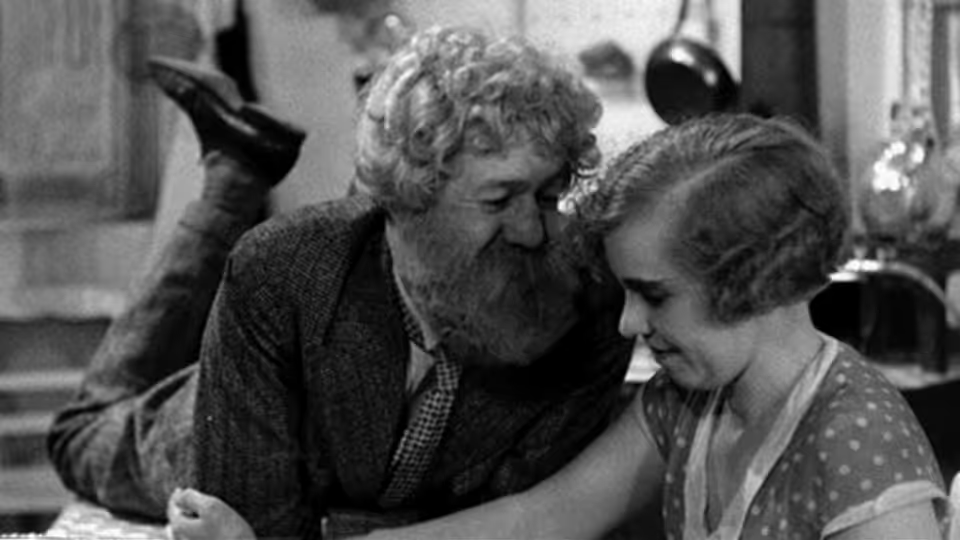
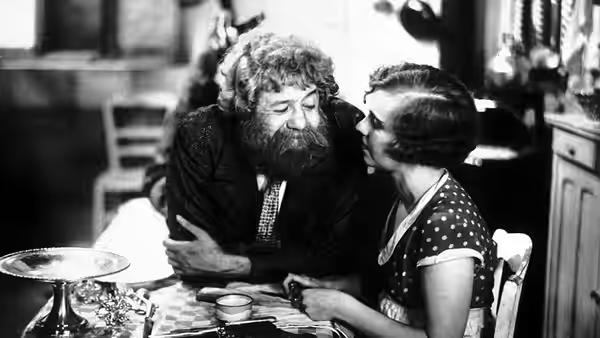
As Priape Boudu, Michel Simon seems unusually unconcerned with securing our approval. The stubbornness of the performance is funny because there is so little reassurance beneath it: we are not invited to wait patiently for a more agreeable fellow to emerge. We laughed at that obstinacy, and were surprised by how much we liked him. It is possible to enjoy his company while remaining grateful that the screen puts some distance between us.
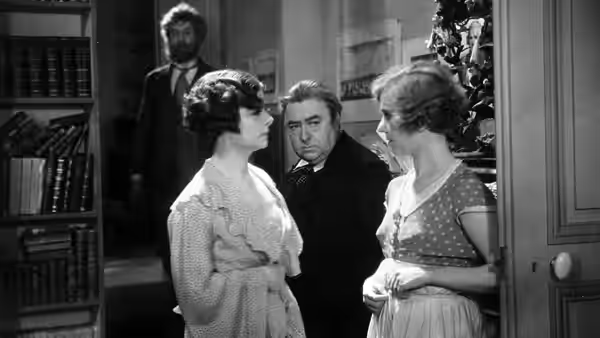
Charles Granval as Édouard Lestingois and Marcelle Hainia as Emma Lestingois give the leading performance something firmer to work against than a collection of disapproving faces. Sévérine Lerczinska, playing Chloë Anne Marie, la Bonne, contributes to that necessary resistance. Their less conspicuous work matters in a comedy that could easily become a solo turn. Even when Boudu dominates our attention, the other performers give us reasons to look elsewhere.
The camera helps with that. The cinematography, credited to Georges Asselin and Marcel Lucien, uses fluid tracking and location shooting to give the comedy a welcome freedom. The movement keeps our attention active; we are watching people rather than waiting for the next piece of social criticism to be delivered. This is where the film feels most alive, and where its technical assurance has a purpose beyond making everything look accomplished.
Suzanne de Troye and Marguerite Renoir’s editing works comfortably with that mobility, without competing for attention. At 84 minutes, the film has room for its performers without making a ceremony of every joke. The production design by Jean Castanier and Hugues Laurent is similarly discreet, and we remember the people more readily than the décor. These contributions are less conspicuous than the leading performance, but the film would feel considerably heavier without their restraint.
The screenplay, credited to Jean Renoir and Albert Valentin, is strongest when amusement leaves room for irritation. Its weaker tendency is to make middle-class smugness too easy to recognise and dismiss, as though identifying a social failing were quite enough work for a comedy. Some of the ridicule needs more resistance from the people being ridiculed. That is a limitation worth naming, particularly in a film whose leading performance makes difficult behaviour so entertaining.
Social comedy needs a little affection for the people it embarrasses, and there is enough here to keep the laughter from becoming merely punitive. We would not insist on liking Boudu before settling down with him; that would rule out much of the pleasure. Choose it when an agreeable leading character is not a requirement.