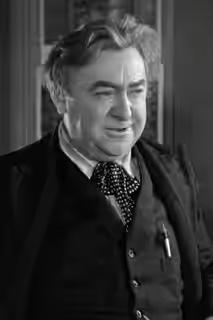
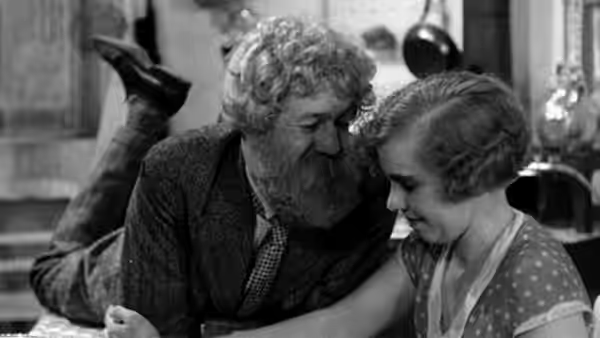
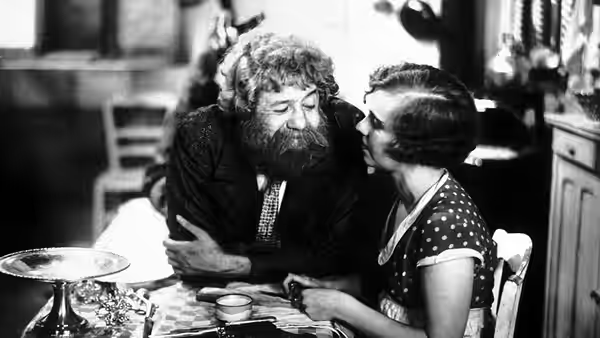
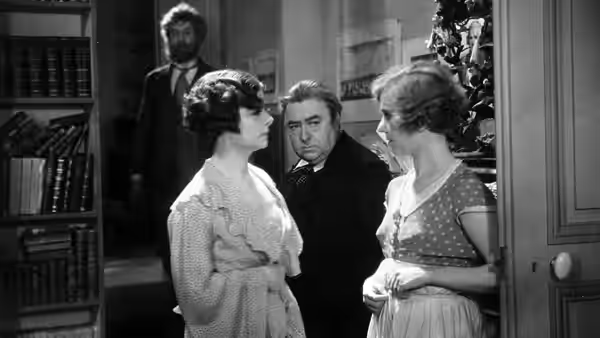
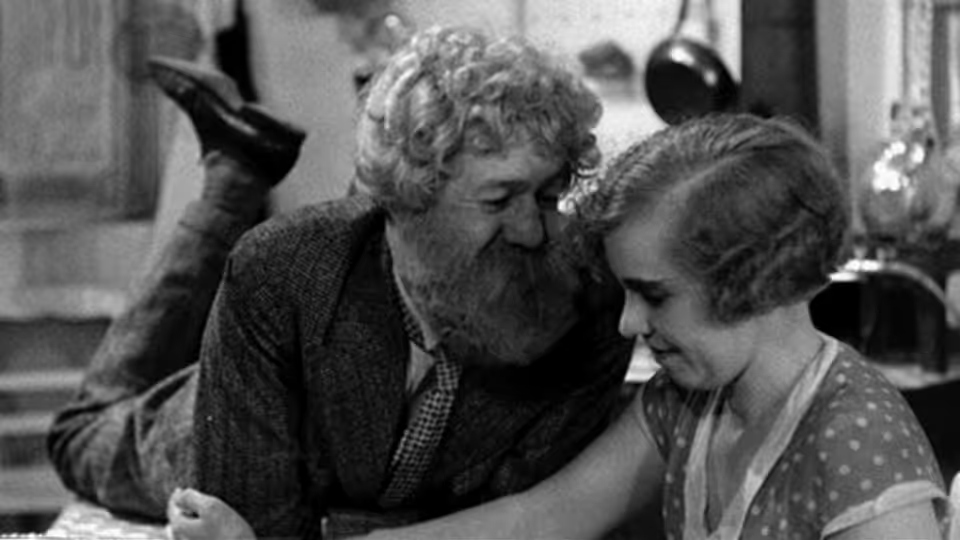
Boudu (Michel Simon) leans close to a woman seated beside him at a table
Film review

Boudu Saved from Drowning

1932 · Directed by Jean Renoir · 1h 24m

In a sentenceMichel Simon makes good manners look like a fairly serious character defect

Priape Boudu (Michel Simon) is the central figure in Jean Renoir’s comedy about middle-class manners and the judgements people make about one another. Édouard Lestingois (Charles Granval), Emma Lestingois (Marcelle Hainia) and Chloë Anne Marie, la Bonne (Sévérine Lerczinska) are among the people in his story. The comedy concerns people’s confidence in their own good conduct and their readiness to judge everyone else’s. Written by Jean Renoir and Albert Valentin, it questions the self-satisfaction behind respectable behaviour, with Boudu at the centre of its scrutiny.

Plays from YouTube when you press play; nothing loads from them until then.

Fi1m review

Jean Renoir’s comedy is funny, unruly and worth an evening for Michel Simon’s stubborn presence alone. The attack on middle-class smugness sometimes comes too easily, but the moving camera keeps the film from feeling stiff.

Jean Renoir’s Boudu Saved from Drowning is a sharply funny comedy about people who put too much faith in respectability. We recommend it, chiefly for Michel Simon, whose performance makes the social criticism entertainingly awkward. There is an easy version of this comedy in which every offence against good manners deserves applause. This one is more interesting, although its mockery of middle-class self-satisfaction occasionally comes close to being too pleased with itself.

As Priape Boudu, Michel Simon seems unusually unconcerned with securing our approval. The stubbornness of the performance is funny because there is so little reassurance beneath it: we are not invited to wait patiently for a more agreeable fellow to emerge. We laughed at that obstinacy, and were surprised by how much we liked him. It is possible to enjoy his company while remaining grateful that the screen puts some distance between us.

Charles Granval as Édouard Lestingois and Marcelle Hainia as Emma Lestingois give the leading performance something firmer to work against than a collection of disapproving faces. Sévérine Lerczinska, playing Chloë Anne Marie, la Bonne, contributes to that necessary resistance. Their less conspicuous work matters in a comedy that could easily become a solo turn. Even when Boudu dominates our attention, the other performers give us reasons to look elsewhere.

The camera helps with that. The cinematography, credited to Georges Asselin and Marcel Lucien, uses fluid tracking and location shooting to give the comedy a welcome freedom. The movement keeps our attention active; we are watching people rather than waiting for the next piece of social criticism to be delivered. This is where the film feels most alive, and where its technical assurance has a purpose beyond making everything look accomplished.

Suzanne de Troye and Marguerite Renoir’s editing works comfortably with that mobility, without competing for attention. At 84 minutes, the film has room for its performers without making a ceremony of every joke. The production design by Jean Castanier and Hugues Laurent is similarly discreet, and we remember the people more readily than the décor. These contributions are less conspicuous than the leading performance, but the film would feel considerably heavier without their restraint.

The screenplay, credited to Jean Renoir and Albert Valentin, is strongest when amusement leaves room for irritation. Its weaker tendency is to make middle-class smugness too easy to recognise and dismiss, as though identifying a social failing were quite enough work for a comedy. Some of the ridicule needs more resistance from the people being ridiculed. That is a limitation worth naming, particularly in a film whose leading performance makes difficult behaviour so entertaining.

Social comedy needs a little affection for the people it embarrasses, and there is enough here to keep the laughter from becoming merely punitive. We would not insist on liking Boudu before settling down with him; that would rule out much of the pleasure. Choose it when an agreeable leading character is not a requirement.

Critical consensus AI synthesised

2 of 6
Positive
2
Mixed
0
Negative
0
Sight and Sound
· Tom Milne
90*

Milne finds the film as fresh, joyful and anarchic as ever. He especially praises Renoir’s fluid tracking and location shooting, and Michel Simon’s performance.

Read the full review →
Variety
1 January 1932 · Variety Staff
70*

The review is positive, praising Renoir’s critique of middle-class smugness and human behavior. It also singles out the film’s technical excellence.

Read the full review →

Straight answers AI written, from our review

Is Boudu Saved from Drowning worth watching?
Boudu Saved from Drowning is worth watching for Michel Simon’s stubborn, sharply funny performance, and we score it 82. We recommend it to anyone who enjoys social comedy with an awkward central character: the moving camera keeps things lively, though the mockery of middle-class smugness sometimes comes too easily.
How long is Boudu Saved from Drowning, and what is it rated?
Boudu Saved from Drowning runs 1h 24m. It is a comedy film.
Where can I watch Boudu Saved from Drowning in Denmark?
Boudu Saved from Drowning is not on any streaming or rental service in Denmark at the moment. Availability is checked daily.
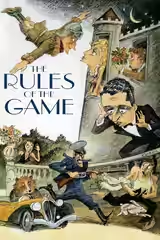
How does Boudu Saved from Drowning compare to The Rules of the Game?
Boudu Saved from Drowning is the better choice for a performance-led comedy, while The Rules of the Game offers more unsettling romantic intrigue. We recommend the former for Michel Simon’s entertaining obstinacy; the latter demands more concentration, with a busy opening whose characters take time to distinguish, but rewards that effort with painfully recognisable evasions.
What should I watch after Boudu Saved from Drowning?
After Boudu Saved from Drowning, try The Rules of the Game (1939, Fi1m 91): Another social comedy in which good manners offer remarkably little protection. Then My Man Godfrey (1936, Fi1m 82): Class comedy with a patient outsider and wealthy people who test him; and Toni Erdmann (2016, Fi1m 86): A prolonged assault on professional decorum, with embarrassment doing the serious work.

Cast

If you liked this, try…

  1. The Rules of the Game (1939, Fi1m 91)Another social comedy in which good manners offer remarkably little protection.

  2. My Man Godfrey (1936, Fi1m 82)Class comedy with a patient outsider and wealthy people who test him.

  3. The Servant (1963) · not on Fi1m yetFor a darker, more claustrophobic examination of who controls the household.

  4. Tampopo (1985) · not on Fi1m yetFood, unruly digressions and people whose appetites make polite behaviour difficult.

  5. Toni Erdmann (2016, Fi1m 86)A prolonged assault on professional decorum, with embarrassment doing the serious work.

Boudu Saved from Drowning (1932) review: funny, rude and sometimes too (Denmark) | Fi1m