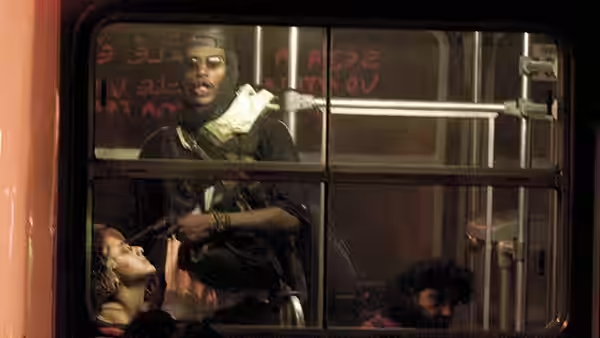
A man aims a handgun through a bus window as passengers crouch below
Film review

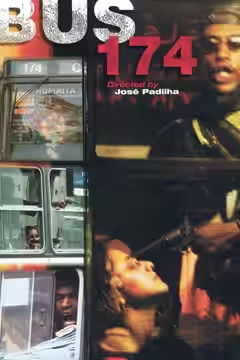
Bus 174

2002 · Directed by José Padilha · 1h 58m

In a sentenceWe wanted the hostages safe and found ourselves worrying about the hijacker too

In Rio, a bus hijacking brings Sandro do Nascimento before television news cameras. Passengers become hostages, and the footage records a crisis whose causes the cameras cannot explain. José Padilha’s documentary follows the hijacking while turning to Sandro do Nascimento’s childhood and the hardships of life among the city’s street children. Yvonne Bezerra de Mello and Rodrigo Pimentel are among those appearing as themselves. Interviews interrupt the television coverage, placing the man on the bus within a history of social abandonment. The immediate question is how the hostages can get out; the accompanying accounts ask how Sandro do Nascimento got here.

Fi1m review

José Padilha makes a gripping, humane documentary from a televised hostage crisis and the life behind it. Its scrutiny of social neglect is persuasive, though those with power escape the questioning they deserve.

José Padilha’s Bus 174 is a gripping, compassionate documentary that should have put harder questions to people in power. It takes a bus hijacking in Rio, recorded by television news cameras, and keeps interrupting the coverage to examine the hijacker’s life. That decision could have weakened the urgency of the hostage crisis. Instead, each return to the bus becomes harder to watch because Sandro do Nascimento has become harder to dismiss.

The television footage creates an immediate fear for the passengers. We were frightened for the hostages, and then unsettled by our growing concern for the man holding them. The accounts of Sandro do Nascimento’s childhood, set against the continuing crisis, produce that uncomfortable shift. Nothing about understanding his past makes the hostages’ predicament easier to bear. The film allows both fears to remain, without requiring us to settle which life deserves our attention.

Alongside the cinematography credited to Marcelo ‘Guru’ Duarte and César Moraes sits extensive television news footage, and José Padilha is careful about what those images can tell us. They were gathered to cover an event; surrounded by interviews, they begin to reveal how little of a person such coverage can show. The documentary makes productive use of those limits. The images keep the danger present while the accounts of street childhood describe years outside the cameras’ attention.

The editing does much of the difficult work. Interviews about hardship and social abandonment interrupt the hijacking, yet the film sustains enough tension to prevent those passages from feeling like a separate lecture. We need time to absorb what is being said, and the return to the bus gives that information an immediate, troubling purpose. Across 118 minutes, the alternation sometimes becomes heavy. There are stretches where the accumulation of suffering adds weight without adding much to our understanding.

There is a risk in this approach of making a person’s childhood explain every subsequent action. José Padilha largely avoids it by keeping the hostage crisis in view: the suffering of people on the bus cannot simply be explained away. The interviews broaden the account to include the hardships of Rio’s street children, so that Sandro do Nascimento is no longer treated as a case without a history. Understanding those conditions still leaves us with difficult questions about his conduct.

What is missing is a comparably searching encounter with those who might answer for the failures described. Television executives and politicians are not directly challenged, despite the film’s concern with public neglect and the broadcast spectacle. That matters because explanations of systemic failure can become too comfortable when nobody in authority has to defend a decision. José Padilha has ample material about the people who endure those failures; the people who help sustain them should have faced questions too.

As a crime documentary, Bus 174 asks us to do more than wait for a crisis to end. The interviews make it difficult to treat the news footage simply as suspense, and that is a substantial achievement when the footage is so tense. It deserves an evening without distractions, and someone to talk to afterwards.

Critical consensus AI synthesised

71
Positive
7
Mixed
4
Negative
1

Most critics respond positively to Bus 174, praising its tense account of the hostage crisis and its compassionate investigation of Sandro do Nascimento’s past. The strongest agreement concerns the editing: the combination of television news footage and interviews builds suspense while explaining the social neglect behind the event. The reviews also value the attention paid to Rio’s street children and economic divisions, finding that this context gives Sandro’s circumstances weight without reducing the crisis to spectacle.

The spread is wide, with reservations concerning clarity, accountability and the accumulation of painful detail. Variety finds the hijacking sometimes difficult to follow, despite admiring the film’s compassion. The Guardian faults its failure to challenge television executives or politicians directly. IndieWire offers the sharpest dissent, finding the documentary exhausting even while praising its editing; the same sustained attention that moves its admirers becomes, in this reading, excessive.

The AV Club
7 October 2003 · Scott Tobias
90*

Tobias calls the documentary superb and moving, praising its empathetic investigation into Sandro do Nascimento’s past. He especially singles out the editing’s impeccable timing and rhythm.

Read the full review →
Slant Magazine
12 October 2003 · ★★★½/4 · Ed Gonzalez
88

Gonzalez presents the documentary as a taut, compelling chronicle of a tragedy shaped by social neglect. He praises Padilha’s novelistic structure, which steadily builds tension while exposing the links between Sandro’s life and the hostage crisis.

Read the full review →
Empire
1 January 2000 · Will Lawrence
85*

The critic calls the documentary a powerful, depressing triumph that makes Sandro’s circumstances demand empathy. They praise how interviews and footage of the hijacking reveal the hardships faced by Rio’s street children.

Read the full review →
Los Angeles Times
24 October 2003 · Ernesto Lechner
75*

Lechner finds the documentary gripping and socially incisive, with suspense that outdoes many Hollywood thrillers. He particularly praises how Padilha’s editing and interviews reveal Sandro’s history and Rio’s systemic failures.

Read the full review →
Time Out
· TCh
70*

The available description presents the documentary as engrossing despite its troubling subject. It singles out the use of television news footage and interviews to tell the story.

Read the full review →
Variety
31 October 2002 · festival review · Deborah Young
65*

Young finds the documentary tense and compassionate, while noting that its presentation of the hijacking is sometimes hard to follow. She praises the contrast between the event’s footage and the accounts of Sandro’s childhood and social abandonment.

Read the full review →

Straight answers AI written, from our review

Is Bus 174 worth watching?
Bus 174 is worth watching for its tense, humane examination of a hostage crisis and social neglect; we score it 82 out of 100. We recommend it to viewers who want a crime documentary that looks beyond the immediate danger, though its account of suffering sometimes becomes heavy and those in power escape sufficiently direct questioning.
How long is Bus 174, and what is it rated?
Bus 174 runs 1h 58m. It is a documentary and crime film.
Where can I watch Bus 174 in Israel?
Bus 174 is not on any streaming or rental service in Israel at the moment. Availability is checked daily.
How violent or frightening is Bus 174, and is it suitable for children?
Bus 174 is a frightening documentary about a real hostage crisis, with a US R certificate and no UK certificate supplied here; we would not recommend it for children. The television footage creates sustained fear for the passengers, while accounts of childhood hardship add distress, making it a demanding choice for viewers sensitive to real people in danger.
How does Bus 174 compare to Pixote?
Bus 174 and Pixote both examine children surviving adult neglect, but we recommend the documentary for its urgent scrutiny of a televised crisis and Pixote for its patient attention to the children themselves. Neither is an unqualified winner: Bus 174 leaves people in power insufficiently challenged, while Pixote sometimes makes its children's prospects seem too predictably hopeless.
What should I watch after Bus 174?
After Bus 174, try Pixote (1981, Fi1m 88): Another unflinching account of street children left to manage the failures of adults. Then The Thin Blue Line (1988, Fi1m 90): Patient interviews and exacting edits make official certainty look dangerously convenient; and Close-Up (1990, Fi1m 92): A patient hearing for an impostor makes easy moral judgements harder to sustain.

Cast

If you liked this, try…

  1. Pixote (1981, Fi1m 88)Another unflinching account of street children left to manage the failures of adults.

  2. The Thin Blue Line (1988, Fi1m 90)Patient interviews and exacting edits make official certainty look dangerously convenient.

  3. Close-Up (1990, Fi1m 92)A patient hearing for an impostor makes easy moral judgements harder to sustain.

  4. The Arbor (2010) · not on Fi1m yetPainful family testimony becomes a searching account of damage passed between generations.

  5. The Interrupters (2011, Fi1m 78)An attentive documentary about the exhausting, necessary work of preventing neighbourhood violence.

Bus 174 (2002) review: a gripping film that insists on compassion (Israel) | Fi1m