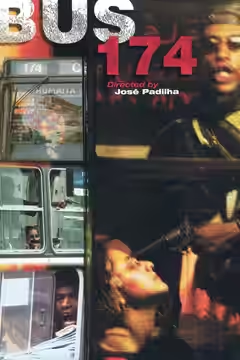
José Padilha makes a gripping, humane documentary from a televised hostage crisis and the life behind it. Its scrutiny of social neglect is persuasive, though those with power escape the questioning they deserve.
José Padilha’s Bus 174 is a gripping, compassionate documentary that should have put harder questions to people in power. It takes a bus hijacking in Rio, recorded by television news cameras, and keeps interrupting the coverage to examine the hijacker’s life. That decision could have weakened the urgency of the hostage crisis. Instead, each return to the bus becomes harder to watch because Sandro do Nascimento has become harder to dismiss.
The television footage creates an immediate fear for the passengers. We were frightened for the hostages, and then unsettled by our growing concern for the man holding them. The accounts of Sandro do Nascimento’s childhood, set against the continuing crisis, produce that uncomfortable shift. Nothing about understanding his past makes the hostages’ predicament easier to bear. The film allows both fears to remain, without requiring us to settle which life deserves our attention.
Alongside the cinematography credited to Marcelo ‘Guru’ Duarte and César Moraes sits extensive television news footage, and José Padilha is careful about what those images can tell us. They were gathered to cover an event; surrounded by interviews, they begin to reveal how little of a person such coverage can show. The documentary makes productive use of those limits. The images keep the danger present while the accounts of street childhood describe years outside the cameras’ attention.
The editing does much of the difficult work. Interviews about hardship and social abandonment interrupt the hijacking, yet the film sustains enough tension to prevent those passages from feeling like a separate lecture. We need time to absorb what is being said, and the return to the bus gives that information an immediate, troubling purpose. Across 118 minutes, the alternation sometimes becomes heavy. There are stretches where the accumulation of suffering adds weight without adding much to our understanding.
There is a risk in this approach of making a person’s childhood explain every subsequent action. José Padilha largely avoids it by keeping the hostage crisis in view: the suffering of people on the bus cannot simply be explained away. The interviews broaden the account to include the hardships of Rio’s street children, so that Sandro do Nascimento is no longer treated as a case without a history. Understanding those conditions still leaves us with difficult questions about his conduct.
What is missing is a comparably searching encounter with those who might answer for the failures described. Television executives and politicians are not directly challenged, despite the film’s concern with public neglect and the broadcast spectacle. That matters because explanations of systemic failure can become too comfortable when nobody in authority has to defend a decision. José Padilha has ample material about the people who endure those failures; the people who help sustain them should have faced questions too.
As a crime documentary, Bus 174 asks us to do more than wait for a crisis to end. The interviews make it difficult to treat the news footage simply as suspense, and that is a substantial achievement when the footage is so tense. It deserves an evening without distractions, and someone to talk to afterwards.