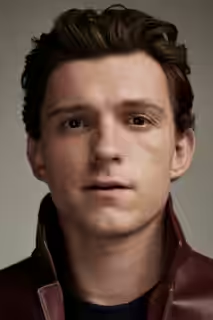
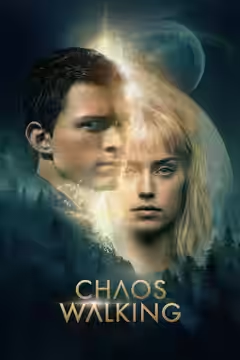
Chaos Walking has a useful idea and two leads worth following, but little sense of what to do with either. Tom Holland makes public embarrassment funny; the adventure around him is thin, hurried and hard to care about.
Chaos Walking is a disappointing science-fiction adventure with an idea that deserves a better script. Doug Liman takes the Noise, which makes thoughts available for others to hear and see, and builds a film around the difficulty of keeping anything to yourself. There is plenty to explore in that: embarrassment, desire, and the advantage held by someone who can control what others hear. The screenplay by Patrick Ness and Christopher Ford touches these possibilities, then keeps returning to broadly drawn confrontations.
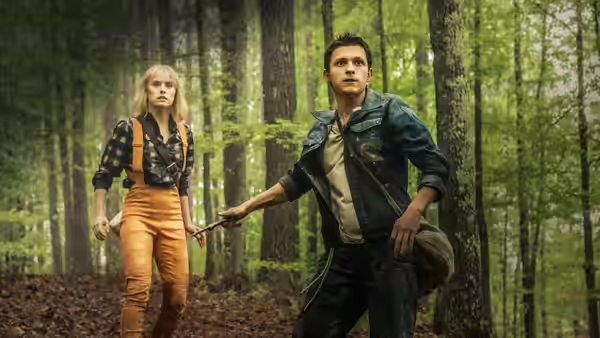
Tom Holland gives that idea its most persuasive use as Todd Hewitt, whose attempts to manage his own mind are both funny and uncomfortable. We felt for him when he repeated his name to keep his thoughts in check; the effort is small, recognisable and more affecting than the surrounding danger. His awkwardness needs little explanation, which becomes a problem when the Noise keeps supplying one. Doug Liman lets us read the embarrassment in the performance, then makes us listen to it as well.
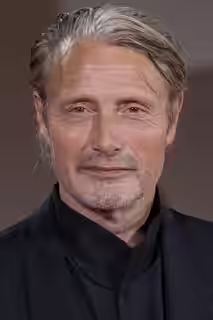
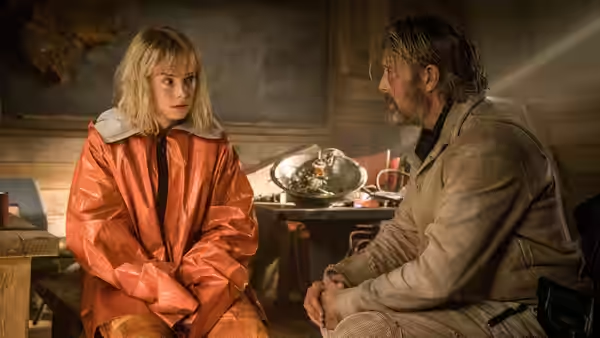
Daisy Ridley gives Viola Eade a welcome directness, and the two leads have an ease together that briefly makes the journey seem worth taking. Their quieter exchanges allow us to notice another person instead of another effect. But Patrick Ness and Christopher Ford do not give Viola Eade enough of a life beyond the requirements of the adventure, leaving Daisy Ridley to suggest what the writing has not supplied. Mads Mikkelsen makes Mayor David Prentiss compelling through sheer presence, though the surrounding conflicts give him too little to complicate.
The horseback sequence offers a glimpse of a more distinctive film, with Noise trailing behind the riders as they move. Ben Seresin’s cinematography has something useful to work with here: we can see the thoughts moving through the landscape with the people thinking them. For a moment, the effect belongs in the action. Dan Weil’s production design is less successful at making this way of living feel convincing; we get too little sense of how constant exposure might change ordinary life.
Doc Crotzer’s editing keeps the story moving, but gives its relationships too little room to develop. At 109 minutes, the film is not long, yet its haste makes the action feel less urgent because there is so little reason to worry about the people involved. The score by Marco Beltrami and Brandon Roberts adds urgency without making the danger feel personal. With thoughts already crowding the soundtrack, the action has plenty of noise and too little suspense.
The larger difficulty is that Doug Liman cannot settle on how seriously to take the Noise. Jokes about unwanted thoughts sit awkwardly beside suggestions of male rage and coercion, and the film moves on before those subjects become uncomfortable. As a young-adult dystopian adventure, it has a chance to make the familiar business of growing up under hostile authority feel newly invasive. Instead, too many encounters could belong to any story about young people facing powerful adults, once the effects were switched off.
We wanted more time with the two leads and fewer scenes telling us what Tom Holland had already made clear. There is enough warmth between them to keep the film from becoming a complete chore, and enough invention to make its waste frustrating. If the premise appeals, be prepared for an adventure much less curious about it than we were.