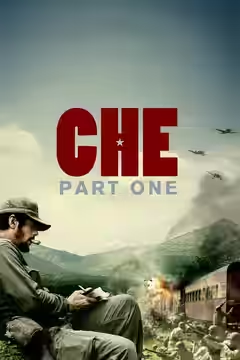
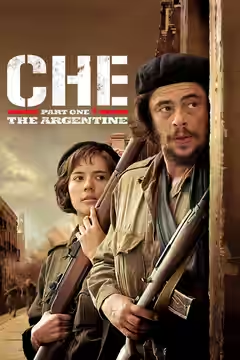
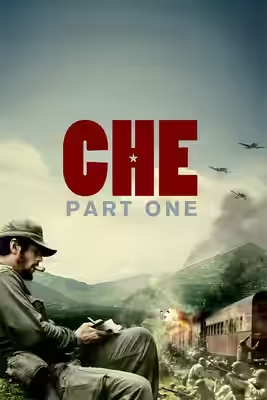
Che: Part One poster

Che: Part One

2008 · Directed by Steven Soderbergh
2h 14mDramaHistoryWar15
72
Fi1m score
68
Critics · 11
Audience · not yet

Where to watch in the UK

Checked 10 September at 22:29. Prices and availability change; the service’s page is the last word.

Synopsis

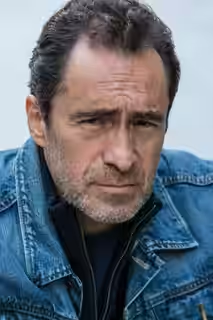
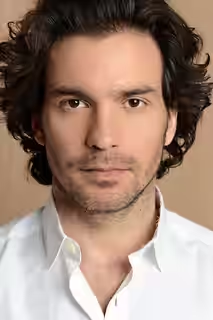
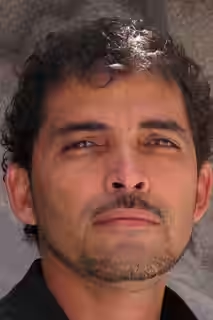
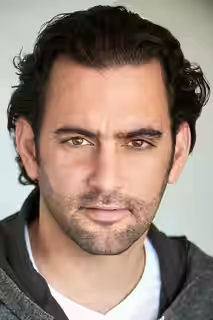
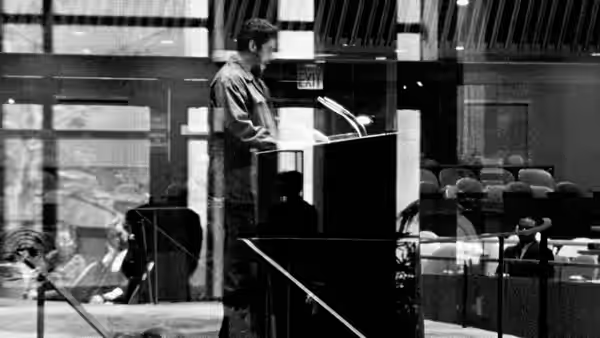
Steven Soderbergh’s two-part account of Ernesto Che Guevara begins here, with the Cuban campaign. Guevara (Benicio del Toro), an Argentine doctor, meets Fidel Castro (Demián Bichir) in Mexico and joins the small force that sails for Cuba. In the Sierra Maestra the rebels train recruits, treat the sick, argue over discipline and move slowly down from the mountains towards the towns. Cut against this, in black and white, is Guevara in New York in 1964, giving interviews to the journalist Lisa Howard (Julia Ormond) and speaking at the United Nations. Santiago Cabrera, Vladimir Cruz, Elvira Mínguez and Edgar Ramírez play the fighters around him. Soderbergh shot it himself; Peter Buchman wrote the screenplay.

Fi1m review

In a sentenceTwo hours of men in the trees arguing about supply lines, and it turns out that is what a revolution is

Soderbergh’s first half of his Guevara film is about how a revolution is run: marches, supply, discipline, argument. Del Toro is watchful and commanding, the method is bracing, and the man himself stays just out of reach.

Steven Soderbergh’s account of the Cuban revolution runs a little over four hours and arrives as two films. This is the first, and it stops before Havana. It opens with Ernesto Guevara, an Argentine doctor, at a table in Mexico with Fidel Castro (Demián Bichir), follows him into the Sierra Maestra, and ends in the streets of Santa Clara. Cut against that is a second strand, in black and white: Guevara in New York in 1964, being interviewed and addressing the United Nations. Peter Buchman’s screenplay is not much interested in what made the man. It is interested in how the war was fought, day by day, and that is the whole film.

Benicio del Toro, who also produced, plays Guevara from the outside. We never see a man deciding to become a revolutionary; we see one who has already decided, wheezing through an asthma attack on a climb, teaching a fighter to read, treating the wounded when the shooting stops. His voice barely rises in 134 minutes. Guevara is in nearly every scene and we learn almost nothing about what he wants for himself, and the performance makes that feel like discipline rather than a gap. There is one scene with a horse that will not go where it is told, and for a few seconds Del Toro’s face does something it does nowhere else.

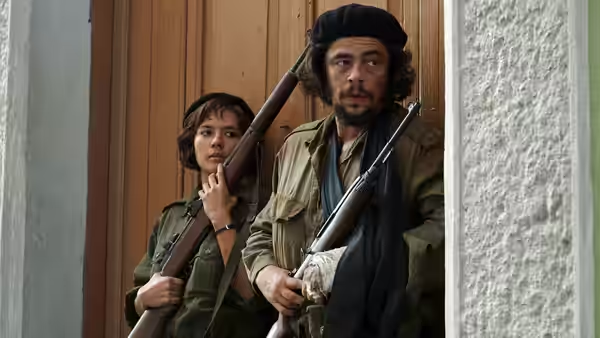
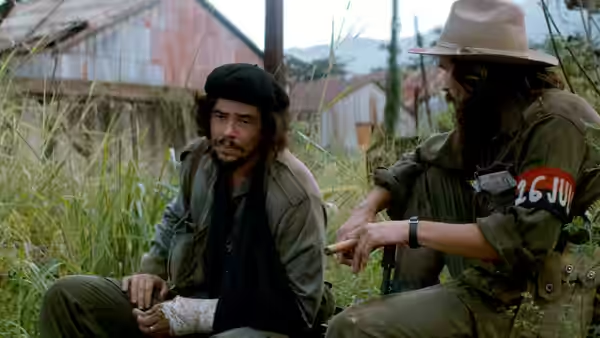
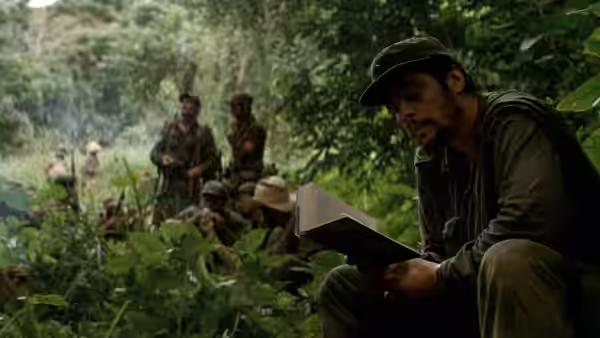
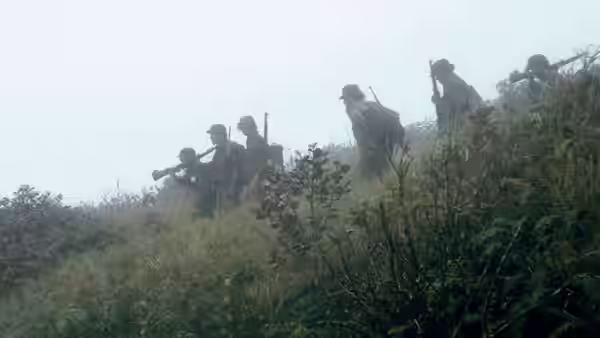
Soderbergh shot it himself, and the two strands look nothing alike. The Sierra is in colour and wide, green and wet, with the camera at eye level, walking when the column walks and stopping when it stops. New York is grainy black and white, handheld, framed like the television of the period, so that we are watching a public face being asked what it thinks. Antxón Gómez’s camps are a few hammocks, a stove and a radio, and they look as if they could be gone in an hour. Bina Daigeler’s fatigues get dirtier and better fitted as the months pass; you can tell how long a man has been up the mountain by his trousers. Alberto Iglesias’s score is spare and often absent. The loudest thing in the film is rain.

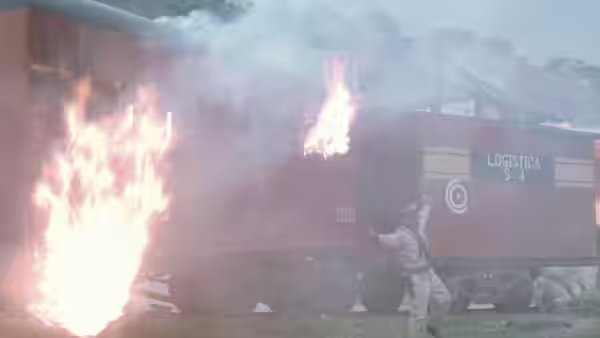
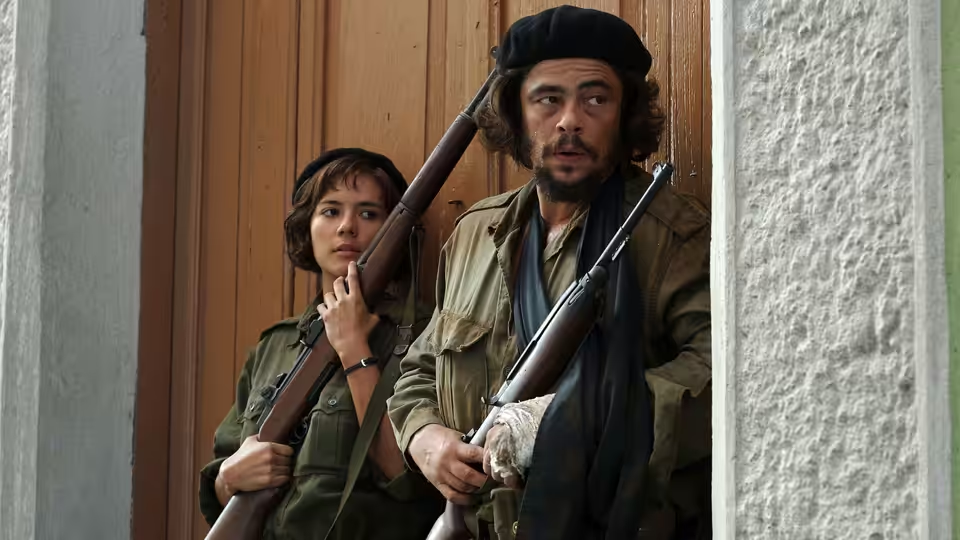
Pablo Zumárraga cuts between the two so that a question put in New York is answered by something done in the hills, or is not answered, and the film lets the gap stand. The fighting comes late, and it is the best stretch. Santa Clara is taken from rooftops and through doorways, a block at a time, the camera down among the men doing the firing, and it is the one place where the film’s patience turns into excitement. We were properly gripped, and a little surprised to be, after an hour and a half of marching.

The cost of the method is that for long stretches the film asks us to be interested rather than moved, and we were interested, and we noticed the difference. Bichir’s Castro is good and sly and does most of the talking. The men around Guevara are another matter. Santiago Cabrera’s Cienfuegos, Vladimir Cruz’s Valdés and Edgar Ramírez’s Redondo are names attached to beards, and forty minutes in we could not have told you which was which. Julia Ormond’s Lisa Howard asks the questions we would ask and gets the answers a politician gives. The film knows what Guevara did after Havana and does not raise it. Part One ends before that argument can start.

Set against the ordinary biopic, this is close to a rebuke. There is no childhood, no wound to explain everything, no scene in which somebody tells Guevara what he means to history. Set against Soderbergh’s own record it is the most patient thing the director of Ocean’s Eleven has made, and for most of its length the patience is rewarded.

See it in a cinema if one will show it, where the length works on you and the Sierra is big enough to get lost in. At home it can turn into a documentary you admire from the sofa, which is not quite what it is. It runs 134 minutes and carries a 15. Do not expect to come out knowing the man. Expect to come out knowing how he ran a war, which is the rarer thing.
Critical consensus AI synthesised

68
Positive
8
Mixed
2
Negative
1

Most critics are on the film’s side, though few love it without reservation. The praise clusters around Benicio Del Toro, whose quiet, matter-of-fact Guevara is repeatedly named as the thing holding the film together, and around Soderbergh’s decision to make a procedural about guerrilla warfare rather than a biopic about a famous man. Several reviews admire the attention to marches, tactics and the daily business of fighting, and Empire singles out the battle for Santa Clara. The reservations cluster just as tightly: the battle scenes repeat, the film is dry, and Che himself is given almost no inner life. Slant argues that Soderbergh’s professed neutrality drains the emotion from the story, and The AV Club finds it more interesting to think about than to sit through. The spread is wide. Time Out calls it monumental; The Times finds it bogged down in the mechanics of warfare and too respectful of the myth.

Time Out
7 January 2009 · ★★★★★ · Geoff Andrew
100

The critic calls it a monumental achievement and a great movie that rewards patience and proper attention. They single out its formal audacity and eschewal of traditional heroics in focusing on the process of revolutionary struggle rather than conventional biopic portraiture.

Read the full review →
The Guardian
4 January 2009 · Philip French
80*

The critic calls it an intelligent, fast-moving, well-researched film that offers a convincing account of the bitter struggle and a portrait of a great and complex revolutionary. The exciting, adventurous narrative with Guevara in virtually every scene is singled out for praise.

Read the full review →
Empire
1 January 2008 · Andrew Male
75*

The critic finds Part One a dream-like if frustrating essay on the heroism and claustrophobia of war, perfectly centred by a compelling star performance. They single out the final battle for Santa Clara as a stunning set-piece.

Read the full review →
Los Angeles Times
12 December 2008 · Sheri Linden
75*

The critic praises the film’s resistance to conventional biopic tropes by emphasizing guerrilla strategy and tactics over psychology, singling out its meticulous compositions and the one emotionally naked moment involving a recalcitrant horse.

Read the full review →
Screen Daily
22 May 2008 · festival review
70*

The review praises Soderbergh’s measured approach that eschews grand gestures for an absorbing, thoughtful focus on personalities and political arguments. It highlights Benicio Del Toro’s commanding performance stressing Che the man rather than the hero, while noting the film grips intellectually but may seem dry to general audiences.

Read the full review →
The AV Club
9 September 2008 · B- · Noel Murray, Scott Tobias
70

The four-hour, two-part film contains a surfeit of ideas and amazing scenes but is held together by mush, with lengthy battle sequences that feel slapped-together and a lack of visceral connection. It is fascinating in theory but more compelling as an intellectual exercise than as an actual moviegoing experience.

Read the full review →

Cast

Benicio del Toro
Ernesto Che Guevara
Demián Bichir
Fidel Castro
Santiago Cabrera
Camilo Cienfuegos
Vladimir Cruz
Ramiro Valdés Menéndez
Alfredo de Quesada
Israel Pardo
Jsu Garcia
Jorge Sotus
Kahlil Méndez
Leonardo Tamayo Núñez
Elvira Mínguez
Celia Sánchez

Stills

If you liked this, try…

Che: Part Two poster76

Che: Part Two

2008 · The second half, in Bolivia, where the same method turns bleak and the men grow thin.

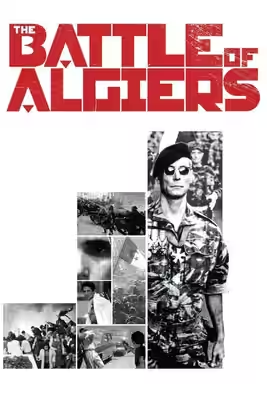
The Battle of Algiers poster

The Battle of Algiers

1966 · Insurgency as procedure, shot like newsreel; the model Soderbergh is plainly working from.

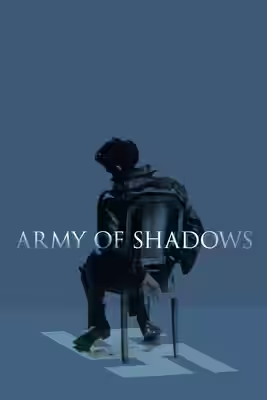
Army of Shadows poster

Army of Shadows

1969 · Melville’s Resistance is fear, waiting and paperwork, and nobody makes a speech.

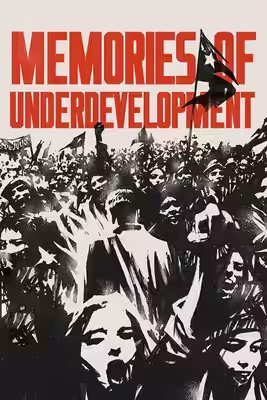
Memories of Underdevelopment poster

Memories of Underdevelopment

1968 · Havana after the revolution, seen by a man who cannot decide what he thinks of it.

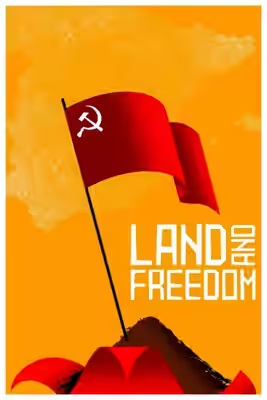
Land and Freedom poster

Land and Freedom

1995 · Loach’s Spanish Civil War, with the arguments about land held in real time, in a barn.