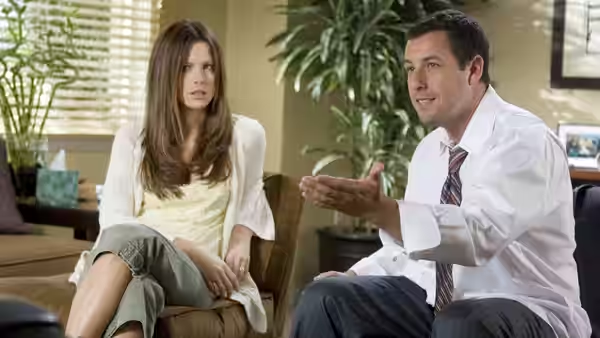
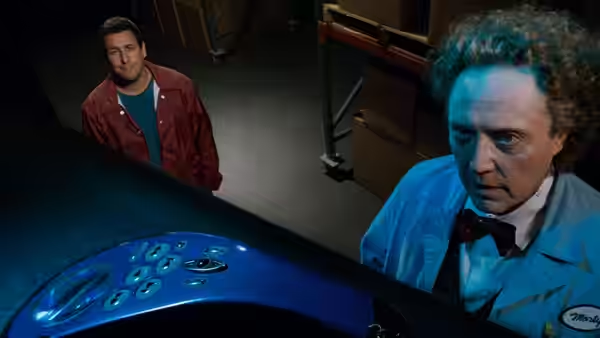
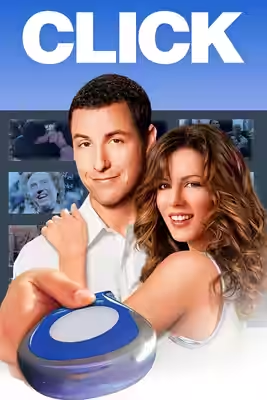
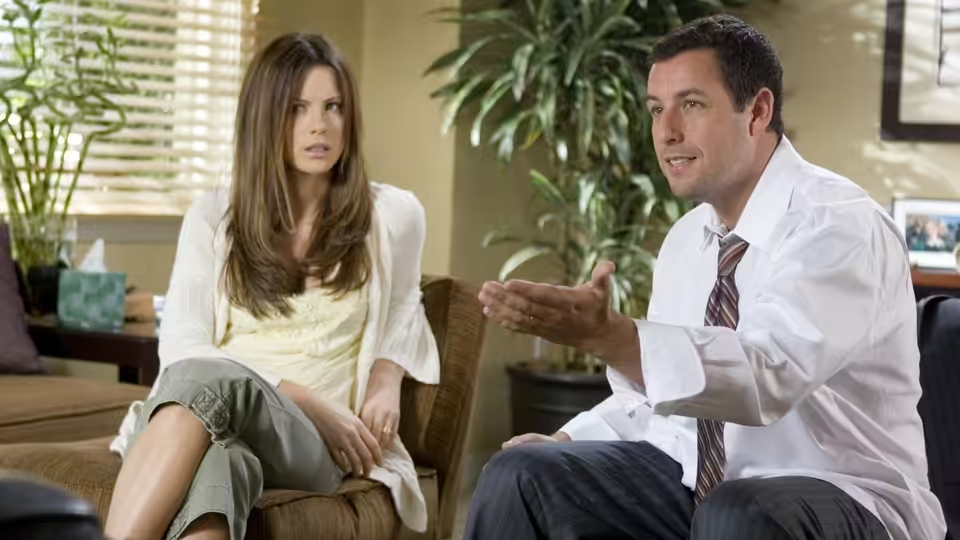
Donna Newman (Kate Beckinsale) sits beside Michael Newman (Adam Sandler) as he gestures in an office
Film review

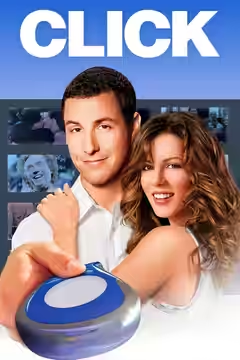
Click

2006 · Directed by Frank Coraci · 1h 47m

In a sentenceWe could have used that remote during several of the jokes

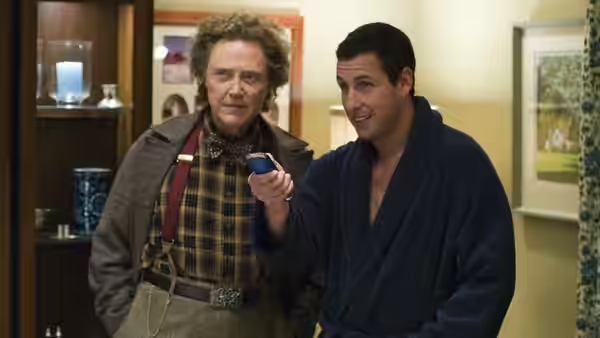
Michael Newman (Adam Sandler) has a universal remote that controls his universe, not just the television. He wants the convenience it promises, but using it means choosing which parts of his life deserve his attention. Donna Newman (Kate Beckinsale) is part of the family affected by those choices, while Morty (Christopher Walken) brings an unsettling presence to Michael’s dealings with the device. Michael can treat daily life like a television programme. His family still needs his attention, and the remote’s promise of an easier life brings complications: he must decide how much he is prepared to miss.

Plays from YouTube when you press play; nothing loads from them until then.

Fi1m review

Click has an inventive premise, a welcome oddness from Christopher Walken and moments of affecting family drama. Too much crude comedy and insistent sentiment keep Frank Coraci’s fantasy from making enough of its idea.

Click has a good idea for a fantasy comedy and too many poor jokes to make proper use of it. Frank Coraci directs Adam Sandler as Michael Newman in a story built around a universal remote that can control its user’s universe. We can see the appeal without needing much persuasion: most of us have something we would rather get past. The film is mixed, occasionally affecting and too eager to insist on a family lesson that scarcely needs explaining.

Steve Koren and Mark O’Keefe have written a wish-fulfilment story with room for unease as well as laughter. A device that can make life more convenient also raises a useful question about how much of that life we might be willing to miss. The screenplay understands the danger well enough to find some disturbing possibilities in its central idea. It is less disciplined about deciding which jokes and lessons belong, and the 107 minutes feel overfilled.

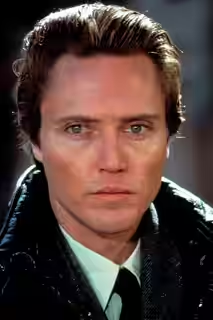
Christopher Walken, as Morty, is the most reliable reason to stay with it. His performance has an odd, faintly threatening energy that suits a story in which an appealing device can become disturbing. He makes the fantasy feel less safe without requiring the film to stop being a comedy. Kate Beckinsale, as Donna Newman, also does useful work, bringing some steadiness to material that keeps changing its mind about how seriously it wants to be taken.

Adam Sandler is more convincing when the film lets Michael Newman seem desperate. We were moved by his desperation in the straight-played family scenes, which allow Michael Newman to seem vulnerable without making that vulnerability another joke. The feeling is modest but recognisable, and it makes the consequences of using the remote matter. It also makes the earlier comedy harder to excuse: a leading character this difficult to warm to needs better writing if we are to enjoy his company.

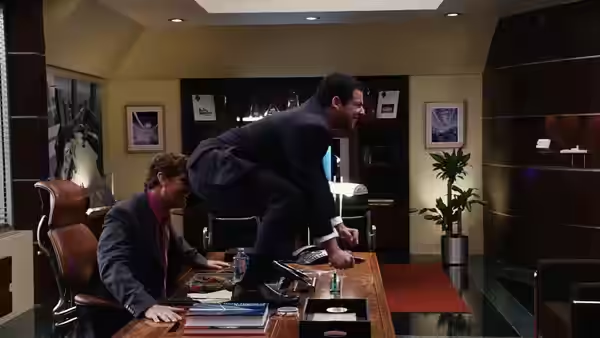
Dean Semler’s cinematography and Perry Andelin Blake’s production design keep the fantasy legible, but the remote supplies most of the visual interest. It is an object whose promise needs no explanation: press something and get a response. Applying that familiar operation to an entire life gives the film plenty of possibilities for visual jokes. The disappointment is how often the writing falls back on coarse business that could have appeared in any number of comedies.

Jeff Gourson’s editing cannot reconcile the quick-payoff comedy with scenes that need time for feeling to develop. The changes remain awkward, and the sentimental passages demand more sympathy than the comedy has prepared us to give. Rupert Gregson-Williams’s music adds to the pressure when the performances would be better left to do the persuading. The insistence makes the family lesson feel less convincing precisely when the film most wants it to matter.

There is nothing wrong with a broad comedy asking us to take a family seriously. Here, however, Frank Coraci asks for more sympathy than the earlier jokes have helped him earn, and explaining the lesson harder does not solve that. Anyone drawn chiefly to the remote-control idea should expect a substantial helping of moral instruction alongside it. If coarse humour is already an obstacle, the sincere passages are unlikely to repay the patience required.

Critical consensus AI synthesised

55
Positive
1
Mixed
7
Negative
3

The consensus on Click is mixed, with critics finding promise in its remote-control premise but uneven results from its blend of broad comedy and family sentiment. Praise clusters around the idea’s inventive, sometimes nightmarish possibilities and Christopher Walken’s performance, which several reviews identify as a bright spot. Some also find warmth and emotional force beneath the cruder jokes, though enthusiasm for Adam Sandler’s performance is limited.

The sharpest divide concerns the sentimentality: what moves some critics strikes others as sugary or overearnest. Empire is the most favourable, finding an amiable, moving comedy despite an uneven first half and an overfilled script. Variety is much harsher on the comedy but still values the straight-played family drama, so even a negative verdict contains substantial praise. Radio Times finds Sandler unusually unlikeable and the supporting cast hampered, while other reviews respond to his vulnerability.

Empire
25 August 2006 · Sam Toy
70*

The review finds Click an amiable, moving comedy that works despite its uneven first half. It praises Kate Beckinsale’s performance and says the overfilled script could have been more streamlined.

Read the full review →
Screen Daily
23 June 2006 · John Hazelton
64*

The page confirms a review, but the review text is inaccessible. Its verdict and specific praise or complaint cannot be determined from the available text.

Read the full review →
The New York Times
23 June 2006
64*

The page is inaccessible, so the critic’s verdict cannot be determined. No specific praise or complaint is available from the text provided.

Read the full review →
Time Out
26 September 2006 · Trevor Johnston
64*

The available page text does not reveal the critic’s verdict. It also does not show what the critic singles out for praise or complaint.

Read the full review →
RogerEbert.com
22 June 2006 · ★★½/4 · Roger Ebert
62

Ebert finds the comedy amusing at first but says it falters as it turns sentimental. He singles out Christopher Walken’s energetic performance as a bright spot.

Read the full review →
The Guardian
29 September 2006 · Peter Bradshaw
60*

Bradshaw finds the film a goofy, sentimental improvement over Sandler’s earlier attempt at Capra-style comedy, though it remains flawed. He praises its moments of good-natured sweetness while criticizing Sandler as conceited and opaque.

Read the full review →

Straight answers AI written, from our review

Is Click worth watching?
Click offers enough for viewers drawn to broad fantasy comedy, but we find it too uneven to recommend without reservations and score it 58/100. Christopher Walken’s unsettling oddness and Adam Sandler’s affecting family scenes give it some value; the coarse jokes and insistent moral lesson waste much of the remote-control premise.
How long is Click, and what is it rated?
Click runs 1h 47m. It is a comedy and drama film.
Where can I watch Click in India?
Click is streaming on Zee5 and Netflix in India, and it is also available to rent from Apple TV from ₹129.00. Availability is checked daily; the links above go straight to each service.
How violent or frightening is Click, and is it suitable for children?
Click carries a UK 12 certificate, so it is not a suitable default choice for younger children despite its playful remote-control premise. The main cautions we identify are coarse humour, disturbing possibilities in the fantasy and emotionally difficult family scenes; Walken’s faintly threatening presence also makes the comedy feel less safe.
How does Click compare to It's a Wonderful Life?
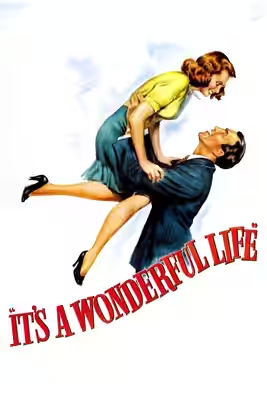
Click is the cruder, less emotionally convincing choice beside It's a Wonderful Life, which we recommend more readily for its treatment of family responsibilities. Both use fantasy to reconsider ordinary life, but Click awkwardly joins broad jokes to earnest lessons, while James Stewart makes the sentiment in Frank Capra’s film feel earned despite some overinsistent whimsy.
What should I watch after Click?
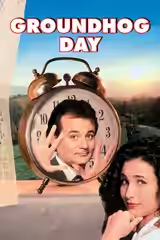
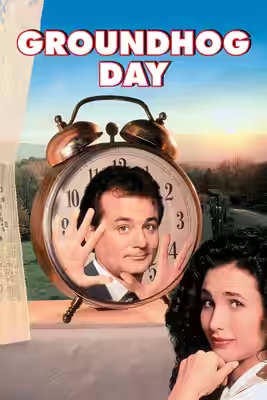
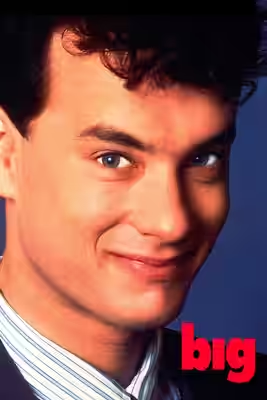
After Click, try It's a Wonderful Life (1946, Fi1m 91): Another fantasy about ordinary responsibilities, with the family feeling more securely earned. Then Groundhog Day (1993, Fi1m 88): A comic time trap that gives its difficult leading man room to change; and Big (1988, Fi1m 81): A wish granted too literally, with warmth that survives the broad comedy.

Cast

Awards

Academy Awards, 2007

Nominated
Best Makeup and Hairstyling

Kids' Choice Award for Favorite Movie, 2007

Nominated
Kids' Choice Award for Favorite Movie

If you liked this, try…

  1. It's a Wonderful Life (1946, Fi1m 91)Another fantasy about ordinary responsibilities, with the family feeling more securely earned.

  2. Groundhog Day (1993, Fi1m 88)A comic time trap that gives its difficult leading man room to change.

  3. Big (1988, Fi1m 81)A wish granted too literally, with warmth that survives the broad comedy.

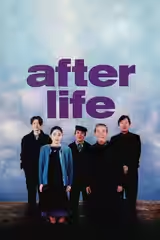
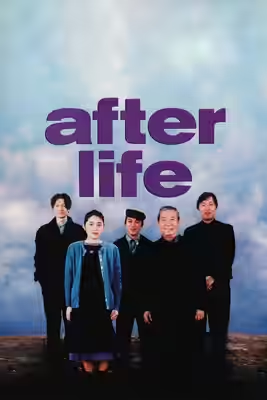
  4. After Life (1998, Fi1m 85)For the questions about time and memory, approached with far more patience.

  5. About Time (2013, Fi1m 66)Time manipulation and family feeling, with an equally open appetite for tears.

Free account

Know what to watch tonight

Two lists that know where things are streaming, collections you can share, your own score beside ours, and Discover that remembers what you have seen.

  • Want to see, sorted by what is streaming now
  • Seen, with your score out of ten
  • No adverts, ever