Richard Curtis gives a young man the power to relive any moment and finds, to his credit, that the story is about his father rather than his girl. The romance is engineered and the rules keep changing; Bill Nighy makes it worth the evening.
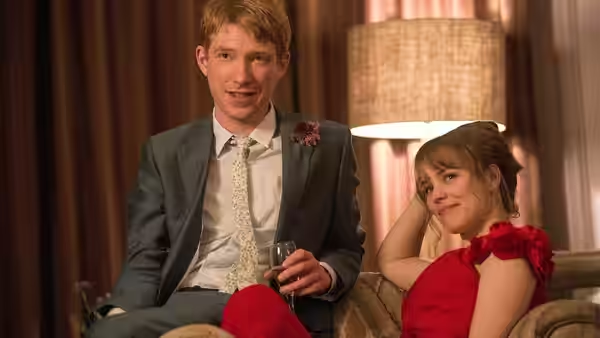
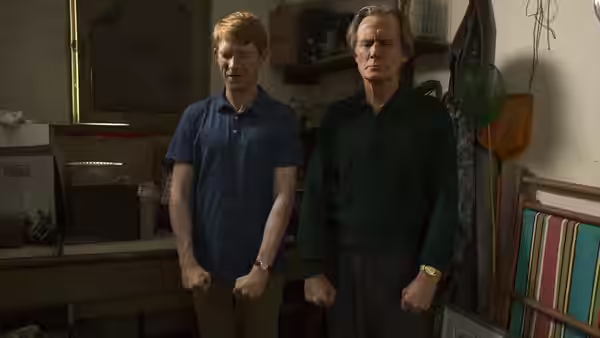
Richard Curtis, who wrote Four Weddings and a Funeral and Notting Hill, here writes and directs a romance with a device in it. On his 21st birthday Tim Lake (Domhnall Gleeson) is told by his father (Bill Nighy) that the men of the family can go back in time within their own lives: stand in a dark cupboard, clench your fists, and you are wherever you were. Tim decides to use this to get a girlfriend. About Time is a soft, long, likeable film that keeps changing its own rules, and it is at its best when it forgets the girlfriend and looks at the father.
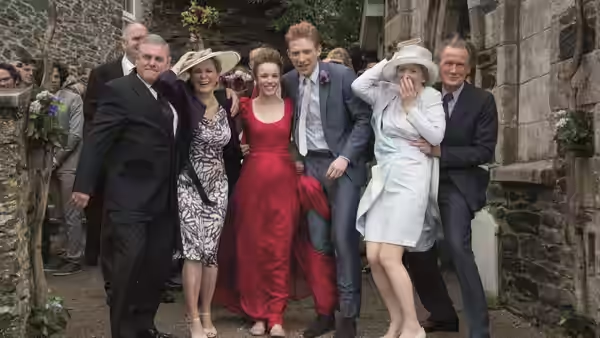
Gleeson is a good choice for a Curtis hero because he does not look like one. He is tall and pale and holds his elbows as though they were lent to him, and when he goes back to redo a botched moment the joke is that he botches it again, differently. The Cornwall scenes are the film’s happiest: a cluttered house above the sea, tea on the beach in any weather, Nighy padding about in a cardigan with a paperback, Lindsay Duncan’s Mum saying exactly what she thinks, Richard Cordery’s Uncle D unsure what year it is. John Paul Kelly fills the house with things bought decades ago, and John Guleserian lights it in late-afternoon gold, so that London, when Tim moves there to be a lawyer, looks grey and rented by comparison.
The romance is where the machinery shows. Tim meets Mary (Rachel McAdams) in a restaurant kept in total darkness, and Curtis plays their first minutes as voices over a black screen, a nice idea. Then Tim loses her through some time-travel housekeeping on behalf of his landlord Harry (Tom Hollander), and has to find her again, win her again and get their first night right, and Mark Day cuts the repeated attempts so fast that we see three versions of one doorway in ten seconds. It is funny. It is also where we started to feel uneasy, because Mary never learns what he is doing and the film never wonders whether she should. Verity Hawkes gives her a wardrobe of patterned frocks; the script gives her little else to want.
The rules do not hold. Early on Dad says the gift cannot change the wide world, only your own small one; later the film forgets that when it needs to and remembers it when it needs a sad scene. If you keep a tally of what the cupboard can and cannot undo, the second hour will annoy you. We stopped keeping one at about the point Tim was using it to spare friends small embarrassments, because the film so plainly does not care and is asking us not to.
What it does care about is the father. Nighy plays Dad with his hands in his pockets and his sentences trailing off, a man who has had the gift for decades and has used it mostly to read more books. Every scene he shares with Gleeson is better than the scene either side of it. There is a conversation between them late on, which we will not describe, that moved us a good deal more than we expected, and it did so because Nighy underplays it almost to nothing and Curtis, for once, does not put a song on top. When the film is about how to spend an ordinary afternoon, and with whom, it is quietly good.
Hollander, as a playwright who hates everybody, gets the sharpest lines and delivers them as if they cost him. Margot Robbie has a summer’s worth of screen time as Charlotte, the first girl Tim fails to win in any timeline, and is more amused than the writing. Nick Laird-Clowes supplies gentle piano under the family scenes and Curtis lays pop songs over the rest, one per montage, and by the fourth we could feel the film reaching for the tissues before we had.
At 123 minutes it is half an hour longer than its story, and Curtis teaches his one lesson in voiceover at the end in case the beach and the cardigan had not got it across. Set beside Groundhog Day (1993), which also gave a man his days back and made him earn every one, this is a gentler, lazier, warmer thing. See it for Nighy and Gleeson, with someone whose father you know, and do not try to make the time travel add up. It will not, and it was never the point.