Click has an inventive premise, a welcome oddness from Christopher Walken and moments of affecting family drama. Too much crude comedy and insistent sentiment keep Frank Coraci’s fantasy from making enough of its idea.
Click has a good idea for a fantasy comedy and too many poor jokes to make proper use of it. Frank Coraci directs Adam Sandler as Michael Newman in a story built around a universal remote that can control its user’s universe. We can see the appeal without needing much persuasion: most of us have something we would rather get past. The film is mixed, occasionally affecting and too eager to insist on a family lesson that scarcely needs explaining.
Steve Koren and Mark O’Keefe have written a wish-fulfilment story with room for unease as well as laughter. A device that can make life more convenient also raises a useful question about how much of that life we might be willing to miss. The screenplay understands the danger well enough to find some disturbing possibilities in its central idea. It is less disciplined about deciding which jokes and lessons belong, and the 107 minutes feel overfilled.
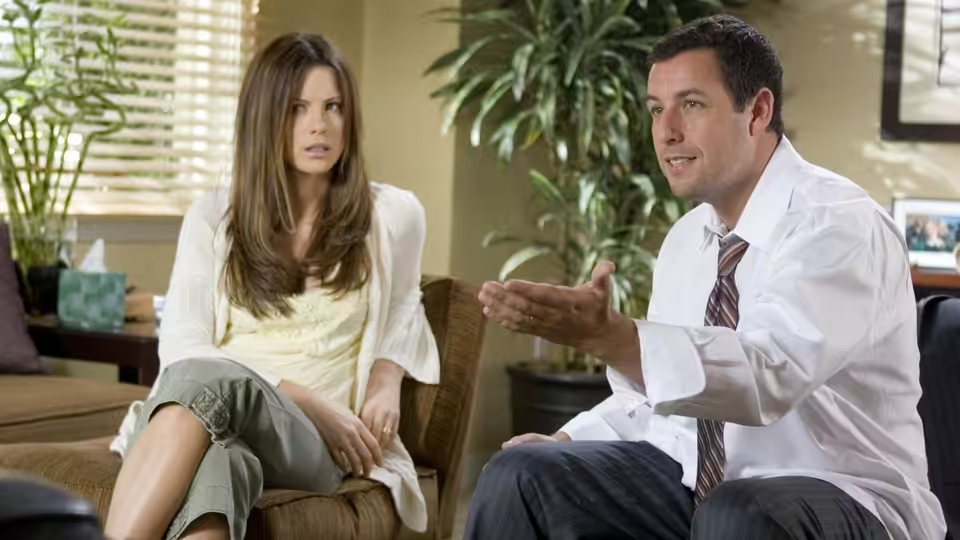
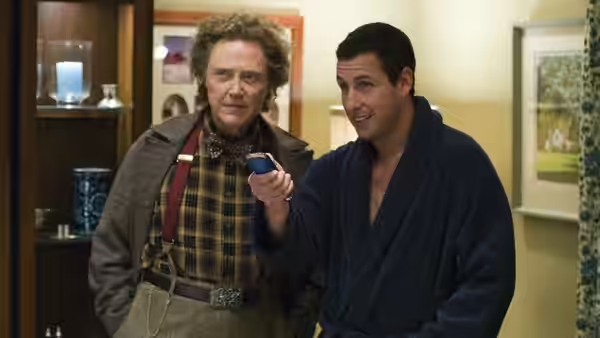
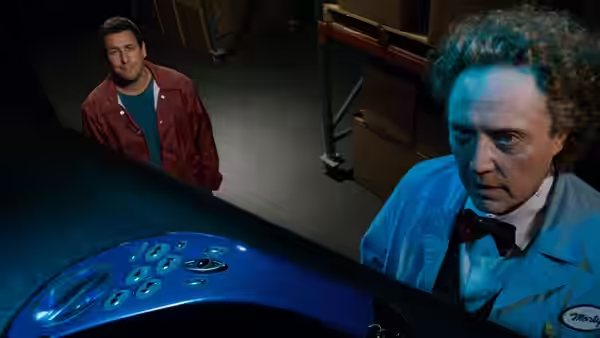
Christopher Walken, as Morty, is the most reliable reason to stay with it. His performance has an odd, faintly threatening energy that suits a story in which an appealing device can become disturbing. He makes the fantasy feel less safe without requiring the film to stop being a comedy. Kate Beckinsale, as Donna Newman, also does useful work, bringing some steadiness to material that keeps changing its mind about how seriously it wants to be taken.
Adam Sandler is more convincing when the film lets Michael Newman seem desperate. We were moved by his desperation in the straight-played family scenes, which allow Michael Newman to seem vulnerable without making that vulnerability another joke. The feeling is modest but recognisable, and it makes the consequences of using the remote matter. It also makes the earlier comedy harder to excuse: a leading character this difficult to warm to needs better writing if we are to enjoy his company.
Dean Semler’s cinematography and Perry Andelin Blake’s production design keep the fantasy legible, but the remote supplies most of the visual interest. It is an object whose promise needs no explanation: press something and get a response. Applying that familiar operation to an entire life gives the film plenty of possibilities for visual jokes. The disappointment is how often the writing falls back on coarse business that could have appeared in any number of comedies.
Jeff Gourson’s editing cannot reconcile the quick-payoff comedy with scenes that need time for feeling to develop. The changes remain awkward, and the sentimental passages demand more sympathy than the comedy has prepared us to give. Rupert Gregson-Williams’s music adds to the pressure when the performances would be better left to do the persuading. The insistence makes the family lesson feel less convincing precisely when the film most wants it to matter.
There is nothing wrong with a broad comedy asking us to take a family seriously. Here, however, Frank Coraci asks for more sympathy than the earlier jokes have helped him earn, and explaining the lesson harder does not solve that. Anyone drawn chiefly to the remote-control idea should expect a substantial helping of moral instruction alongside it. If coarse humour is already an obstacle, the sincere passages are unlikely to repay the patience required.