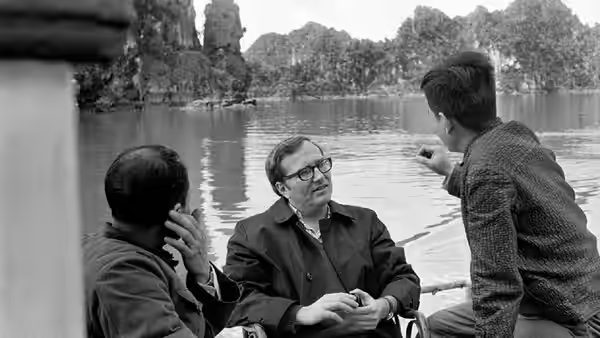
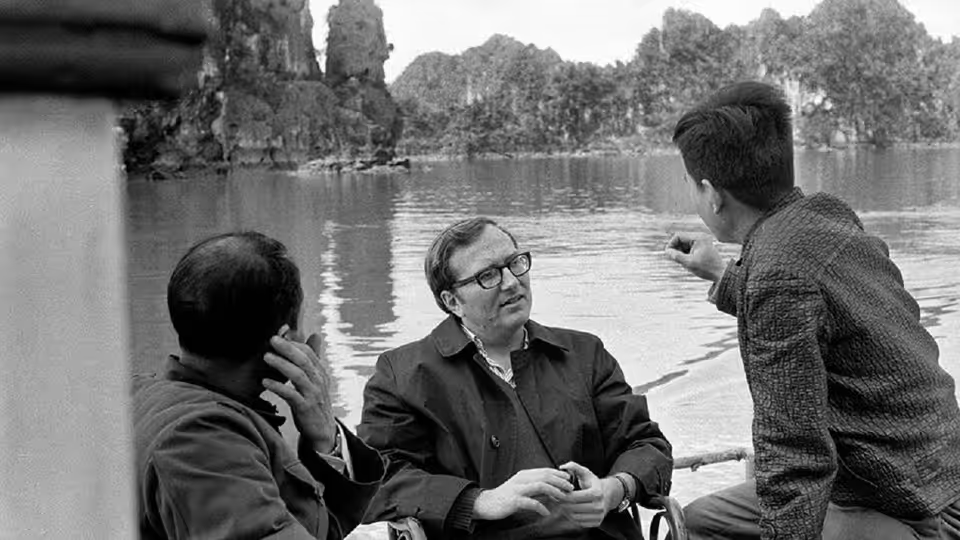
Three men sit beside a lake as one gestures toward the water
Film review

Cover-Up

2025 · Directed by Laura Poitras, Mark Obenhaus · 1h 57m · ClassInd 16

In a sentenceSeymour Hersh has spent a lifetime asking awkward questions; being asked about his notebooks is another matter

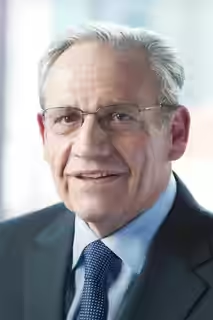
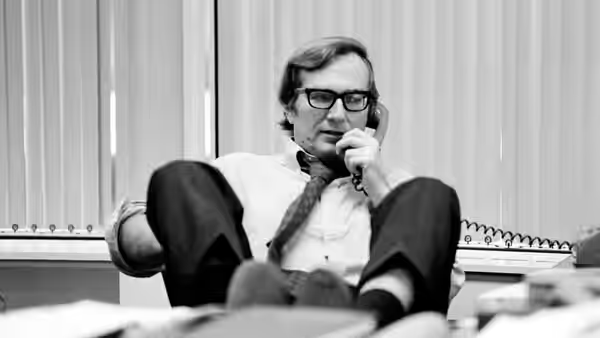
Investigative journalist Seymour Hersh appears as himself in a documentary about reporting on American power and protecting the people who provide the evidence. His notebooks and reporting materials sit alongside interviews and archival footage as the filmmakers ask how he gets his stories. Alongside him are Jeff Gerth of The New York Times and David Obst of Dispatch News, both appearing as themselves. The questions concern what a reporter can establish, what institutions keep hidden and what he will share with the filmmakers. He must explain his methods without surrendering the confidentiality on which his sources depend.

Plays from YouTube when you press play; nothing loads from them until then.

Fi1m review

Laura Poitras and Mark Obenhaus make the painstaking work of investigative reporting absorbing, using Seymour Hersh’s archive and difficult presence to good effect. Their admiration is earned, though the questions about his own methods deserve more time.

Laura Poitras and Mark Obenhaus make Cover-Up a compelling account of investigative journalism, with an awkward interview subject usefully close at hand. Seymour Hersh has made a profession of asking questions that powerful people would rather leave unanswered. The directors want him to explain how that work gets done, including what happens between a source speaking and a story reaching the public. The film earns its admiration for him, though it does not press every difficult question as far as it should.

The notebooks and reporting materials matter as much as the interview. Editors Peter Bowman, Amy Foote and Laura Poitras bring them together with archival footage at a pace that makes following the evidence feel like active work. We are asked to keep up, and generally that is a pleasure: the materials give us something to examine beyond the journalist’s recollection of his achievements. Occasionally the cutting gives us too little time to absorb one piece of material before moving on to the next.

Mia Cioffi Henry’s cinematography is most useful in the interviews, where our attention stays on the man trying to decide how much to say. His reluctance to explain everything gives these encounters an edge that a straightforward celebration would lack. There is pleasure in watching someone who knows the uses of a question recognise one being put to him. The directors also let his personality remain difficult, without constantly smoothing over his resistance to being questioned.

The reporting on My Lai explains why his stubbornness matters, tracing an investigation pursued despite official resistance. We were horrified by the first-person testimony about Abu Ghraib. Placing such testimony alongside the reporting keeps our attention on the people affected, rather than merely on the journalist who got the story. Maya Shenfeld’s music is less memorable than those voices, which is a reasonable outcome in a film with this much to hear.

The difficulty comes when the questions turn towards his own working methods. Protecting an anonymous source is an intelligible obligation, but it cannot make every question about verification improper. The exchanges around his notebooks bring that problem into view, and the film becomes more interesting whenever Laura Poitras challenges him. It then seems reluctant to stay with the discomfort for long enough. We would welcome a fuller explanation of how he checks what confidential sources tell him, without needing their names disclosed.

That matters because this kind of documentary can so easily turn a working life into a procession of vindications. Here the materials and the interviewing usually resist that habit, showing enough of the labour to make admiration feel earned. The nostalgic appeal is understandable, but the film is strongest when it shows the practical difficulties of finding evidence and persuading people to speak. At 117 minutes, there is room for more of that scrutiny.

This is worth an evening for anyone interested in how a story gets past the people determined to stop it. Allow some patience for the crowded archive, and do not expect every dispute about methods to be settled. We would have welcomed a few more awkward minutes with those notebooks.
Critical consensus AI synthesised

79
Positive
13
Mixed
2
Negative
0

Most critics welcome Cover-Up as a compelling portrait of Seymour Hersh and a forceful reminder of investigative journalism’s value. Praise centres on his tenacity, vivid presence and willingness to challenge powerful institutions, with the account of his My Lai reporting drawing particular admiration. The reviews also credit the filmmakers’ use of archival footage and reporting materials with showing how investigations develop and how concealment recurs across decades of American wrongdoing.

Reservations concern how thoroughly the film questions its subject, alongside an occasionally overwhelming pace and less assured later sections. The AV Club finds the tensions between Hersh and the filmmakers insufficiently explored, while The Wrap values the moments when Poitras challenges his blind spots but sees competing directorial perspectives. The spread is chiefly between enthusiasm and qualified approval, not outright rejection; the two entries counted as mixed have no accessible verdict to clarify their reservations.

Little White Lies
5 December 2025 · 4/5/5 · Sophie Monks Kaufman
100

The review finds the documentary scintillating and worthy of Seymour Hersh, though its fast pace can feel overwhelming. It praises Hersh’s vivid personality and the filmmakers’ skillful use of his source materials and archival footage.

Read the full review →
Slant Magazine
6 September 2025 · ★★★½/4 · Marshall Shaffer
88

Shaffer sees the film as a sweeping, tempered tribute to investigative journalism and its continuing importance. He praises the filmmakers’ respectful, evidence-grounded portrayal of Hersh’s reporting and its landmark revelations.

Read the full review →
The Observer
6 December 2025 · Wendy Ide
85*

Ide finds the documentary a compelling and inspiring portrait of Seymour Hersh. She praises its attention to his tenacious investigations and to journalism’s power to shape history and policy.

Read the full review →
IndieWire
29 August 2025 · B+ · David Ehrlich
83

Ehrlich calls the documentary brilliant, damning, and urgently relevant in connecting decades of American wrongdoing. He praises its archival material and its use of Seymour Hersh’s reporting to reveal recurring patterns of concealment.

Read the full review →
The AV Club
19 December 2025 · B+ · Katarina Docalovich
83

The review calls the documentary a vital reminder of investigative journalism’s importance and a thrilling watch. It praises Hersh’s willingness to confront disturbing truths, while noting the film does not fully explore tensions between him and the filmmakers.

Read the full review →
The Hollywood Reporter
29 August 2025 · festival review · Sheri Linden
80*

Linden finds the documentary exhilarating and an urgent reminder of the value of informed dissent, though its later sections sometimes feel equivocal. She especially praises its treatment of Hersh’s My Lai reporting and the first-person testimony about Abu Ghraib.

Read the full review →

Straight answers AI written, from our review

Is Cover-Up worth watching?
Cover-Up is worth watching for anyone interested in investigative journalism, and we score it 80 out of 100. Seymour Hersh’s notebooks, reporting materials and resistant interview presence make the work absorbing, though the crowded archive needs patience and we would welcome tougher, longer questioning about how he verifies confidential sources.
How long is Cover-Up, and what is it rated?
Cover-Up runs 1h 57m and is rated 16 by the ClassInd in Brazil. It is a documentary and history film.
Where can I watch Cover-Up in Brazil?
Cover-Up is streaming on Netflix in Brazil. Availability is checked daily; the links above go straight to each service.
How violent or frightening is Cover-Up, and is it suitable for children?
Cover-Up carries a UK 15 certificate and is not suitable for children under 15; its first-person testimony about Abu Ghraib is particularly distressing. We found that testimony horrifying, and the reporting on My Lai adds to the difficult subject matter, so teenagers and adults sensitive to accounts of real suffering should approach with care.
How does Cover-Up compare to All the President's Men?
Cover-Up is a documentary examination of reporting methods, while All the President's Men turns patient journalistic work into a thriller; we recommend the latter more broadly. Both find suspense in obstructive institutions and the search for evidence, but Cover-Up particularly suits those interested in a reporter’s difficult relationship with questions about his own methods.
What should I watch after Cover-Up?
After Cover-Up, try All the President's Men (1976, Fi1m 90): Patient reporting, obstructive institutions and the satisfaction of finding evidence that holds. Then The Thin Blue Line (1988, Fi1m 90): Interviews and contradictory accounts become a demanding lesson in how evidence works; and Citizenfour (2014, Fi1m 83): Another documentary about the difficult business of getting guarded sources to speak.

Cast

If you liked this, try…

  1. All the President's Men (1976, Fi1m 90)Patient reporting, obstructive institutions and the satisfaction of finding evidence that holds.

  2. The Thin Blue Line (1988, Fi1m 90)Interviews and contradictory accounts become a demanding lesson in how evidence works.

  3. Citizenfour (2014, Fi1m 83)Another documentary about the difficult business of getting guarded sources to speak.

  4. Collective (2019, Fi1m 88)Romanian reporters investigate hospital wrongdoing, with consequences that extend far beyond a newsroom.

  5. The Lost Honour of Katharina Blum (1975) · not reviewed yetFiction about press persecution, for a less comforting view of journalistic power.